Best Functional Coatings for Lightweight Materials: 2026 Review
Compare the best functional coatings for lightweight materials in 2026. Expert analysis of intumescent, elastomeric, and thermal barriers for EPS, XPS, and AAC.

Substrate Vulnerabilities: Why Standard Coatings Fail
Lightweight construction materials—specifically Expanded Polystyrene (EPS), Extruded Polystyrene (XPS), Autoclaved Aerated Concrete (AAC), and Structural Insulated Panels (SIPs)—dominate modern energy-efficient building envelopes. However, their low density and unique chemical compositions make them inherently hostile to standard architectural paints and conventional protective coatings. EPS and XPS exhibit severe chemical reactivity to volatile organic compounds (VOCs) and solvents, while AAC possesses a high-capillary porous structure that traps moisture if sealed with low-permeability films. Applying a standard acrylic or alkyd coating to these substrates inevitably leads to chemical melting, adhesion failure, or concealed moisture degradation.
Selecting the correct functional coating requires matching the coating’s chemical base, vapor permeability (perm rating), and thermal expansion coefficient to the specific lightweight substrate. This 2026 comparison review evaluates the top functional coating categories, providing exact dry film thickness (DFT) requirements, substrate compatibility, and installed cost metrics.
2026 Evaluation Matrix: Top Functional Coatings Compared
| Coating Category | Ideal Substrate | Required DFT | Vapor Permeability | 2026 Avg. Installed Cost |
|---|---|---|---|---|
| Water-Based Intumescent | EPS, XPS, Polyiso | 15 - 25 mils | Low (< 1 perm) | $8.50 - $12.00 / sq ft |
| Silicate Elastomeric | AAC, Lightweight Gypsum | 10 - 15 mils | High (> 15 perms) | $4.25 - $6.50 / sq ft |
| Ignition/Thermal Barrier | SIPs (OSB Facers), SPF | 6 - 9 mils | Moderate (2-5 perms) | $3.00 - $5.50 / sq ft |
| Ceramic Microsphere | Metal-faced SIPs, CFRP | 20 - 30 mils | Low (< 1 perm) | $11.00 - $15.00 / sq ft |
Fire-Retardant Intumescent Coatings for EPS and XPS
Expanded and Extruded Polystyrene foams are highly combustible and begin to soften at temperatures as low as 165°F (74°C). To meet building code requirements for exposed foam plastics, water-based intumescent coatings are mandatory. Unlike solvent-borne alternatives, 100% acrylic water-based intumescents will not dissolve the polystyrene matrix during application.
When exposed to the ASTM E119 standard time-temperature curve, these coatings undergo an endothermic reaction. The chemical matrix expands up to 50 times its original thickness, forming a dense, carbonaceous char that insulates the underlying foam from radiant heat. For a standard 1-hour fire rating on 2-inch EPS, a DFT of 18 to 22 mils is typically required. This equates to a wet film thickness (WFT) of roughly 35 to 45 mils, necessitating multiple passes with an airless sprayer equipped with a 0.021-inch to 0.025-inch tip to prevent sagging on vertical surfaces.
Breathable Elastomerics for Autoclaved Aerated Concrete (AAC)
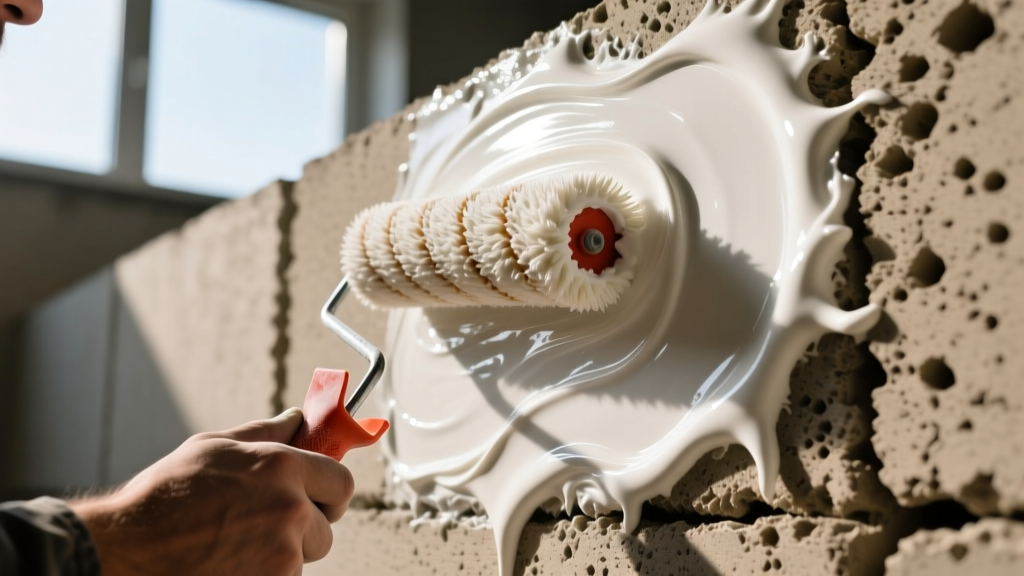
Autoclaved Aerated Concrete is prized for its thermal mass and lightweight properties, but its interconnected micro-pore structure acts like a rigid sponge. If coated with a standard low-perm elastomeric paint, moisture migrating from the interior or the ground becomes trapped. In freeze-thaw climates, this trapped water expands, causing severe surface spalling and delamination of the coating.
The best functional coatings for AAC are silicate-based or highly breathable acrylic elastomerics with a vapor permeability rating exceeding 15 perms. Silicate coatings chemically bond with the calcium hydroxide in the AAC through a process called petrification, creating a micro-crystalline structure that is entirely vapor-open but highly resistant to liquid water ingress. According to the NIST Fire Research Division, maintaining the structural integrity of masonry and concrete-like substrates requires coatings that do not alter the material's natural moisture equilibrium. When applying elastomerics to AAC, a localized alkali-resistant primer is required to prevent the high pH (often 10-11) of the fresh concrete from saponifying the coating binders.
Thermal Barrier Coatings for Structural Insulated Panels (SIPs)
SIPs typically consist of an EPS or polyisocyanurate core sandwiched between Oriented Strand Board (OSB) facers. The International Building Code (IBC Section 2603) requires foam plastics to be separated from the interior of a building by a 15-minute thermal barrier, traditionally achieved by installing 1/2-inch gypsum wallboard. However, in commercial or industrial applications where exposed SIPs are desired for aesthetic or spatial reasons, functional intumescent thermal barrier coatings provide a code-compliant alternative.
Specialized thermal barrier paints (such as DC315 or equivalent IFTI products) are applied directly to the OSB facer at a much lower DFT than structural steel intumescents—typically 6 to 9 mils. The U.S. Department of Energy notes that while SIPs offer superior continuous insulation, their exposed OSB facers require rigorous ignition barrier protection to prevent rapid flame spread in the event of an interior fire. These coatings delay the temperature rise of the underlying foam core, keeping it below the critical 250°F threshold for the required 15 minutes.
Application Pitfalls and Adhesion Failure Modes
Even the highest-performing functional coatings will fail if substrate preparation and application parameters are ignored. The most common failure modes in lightweight material coatings include:
- AAC Surface Dusting: AAC blocks generate a fine, talc-like silica dust when cut or handled. If not removed via HEPA vacuuming and high-pressure water blasting prior to priming, the coating will adhere to the dust layer rather than the substrate, leading to sheet-like peeling within months.
- Intumescent Mil-Thickness Variance: Fire ratings are strictly tied to exact DFT. Applicators frequently under-apply in corners and over-apply on flat planes. Under-application voids the fire rating, while over-application (exceeding 30 mils per coat) causes the coating to cure on the outside while remaining liquid inside, eventually leading to cracking and mud-crazing.
- Solvent Entrapment in SIP Joints: When coating SIP splines and joints, applicators often flood the seams. If the coating skins over before the underlying solvents or water evaporate, osmotic blistering will occur along the panel seams during the first summer heat cycle.
Cost Analysis and Coverage Rates
When budgeting for functional coatings in 2026, contractors must calculate the total installed cost, which includes surface preparation, primer, the functional topcoat, and quality assurance (QA) mil-thickness verification. While standard architectural paints cost between $1.50 and $2.50 per square foot installed, functional coatings command a premium due to material density and QA requirements.
Water-based intumescents for EPS require roughly 1 gallon per 40 square feet to achieve a 15-mil DFT, with material costs averaging $120 to $160 per gallon. When factoring in labor, scaffolding, and wet-film gauge inspections, the total installed cost ranges from $8.50 to $12.00 per square foot. Conversely, silicate elastomerics for AAC offer higher coverage rates (1 gallon per 100 square feet) and lower material costs ($60 to $90 per gallon), resulting in an installed cost of $4.25 to $6.50 per square foot. Despite the higher upfront cost of intumescents and thermal barriers, the ROI is realized through the elimination of physical drywall or cementitious board installations, saving significant framing labor and preserving the lightweight structural advantages of the building envelope.
Written by
Priya KapoorPriya Kapoor is a real estate market analyst and construction economics researcher with expertise in housing affordability, development feasibility, and infrastructure investment. She holds a Master of Regional Planning from Cornell University and previously worked as a senior analyst at CBRE's Investment Properties group, where she modeled returns for $4B in mixed-use development pipelines. Priya now runs an independent research practice advising developers, municipalities, and REITs on construction cost forecasting and market timing. She publishes the quarterly "BuildMat Market Pulse" report tracking material price indices across 12 commodity categories. Based in Austin, TX, Priya serves on the board of Habitat for Humanity Austin and is a marathon runner.
More from Priya Kapoor
View all
Construction Cost
Cost to Build a 1600 Sq Ft Home in 2026: Full Breakdown
Accurate 2026 cost to build a 1600 sq ft home—material, labor, and regional pricing breakdowns included. Plan your budget with real-time estimates.
Aug 11, 2026

Wood & Lumber
Name the Types of Wood for Pressure Treatment and Preservation
Learn how to name the types of wood best suited for pressure treatment. Compare species treatability, chemical retention levels, and 2026 preservation costs.
Aug 4, 2026

Stone & Masonry
Stone Veneer Suppliers Lindenhurst: 2026 Cost Analysis
Analyze 2026 stone veneer costs in Lindenhurst, NY. Compare local supplier pricing, delivery fees, and Suffolk County installation labor rates.
Aug 4, 2026