Steel Alloys: Structural Framing and the Best Material for Sword
Explore steel metallurgy comparing ASTM structural framing alloys with AISI blade steels to determine the best material for sword forging.

The Intersection of Structural Metallurgy and Blade Forging
The selection of steel alloys dictates both the load-bearing capacity of a commercial high-rise and the impact resistance of a forged blade. While structural engineers prioritize yield strength and weldability to meet building codes, bladesmiths focus on the delicate metallurgical balance between hardness (edge retention) and toughness (shock absorption). When metallurgists and historians debate the best material for sword forging, they are fundamentally analyzing carbon content, carbide formation, and heat treatment responsiveness. Understanding the divergence between construction-grade structural steels and specialized blade alloys provides critical insight into material science, whether you are sourcing I-beams for a commercial project or selecting bar stock for a custom forging.
Decoding Steel Classifications: ASTM vs. SAE/AISI
To evaluate steel performance, one must first understand the governing classification systems. In the construction industry, structural steels are standardized by the American Institute of Steel Construction (AISC) and ASTM International. These standards, such as ASTM A992 for wide-flange shapes, mandate strict limits on carbon content (typically under 0.23%) to ensure ductility and weldability. Conversely, blade steels are classified under the SAE/AISI system, which categorizes alloys based on their chemical composition, specifically carbon and manganese percentages. According to the SAE International standards database, a four-digit number like 1095 indicates a plain carbon steel with approximately 0.95% carbon, a composition entirely unsuitable for structural welding but ideal for edge retention.
⚠️ The Rebar Myth in Amateur Forging
A persistent myth in amateur bladesmithing is the use of ASTM A615 concrete rebar as a budget blade steel. This is a metallurgical failure. A615 Grade 60 rebar has a maximum carbon content of roughly 0.30% and contains unpredictable levels of phosphorus and sulfur. It cannot achieve the necessary martensitic transformation during quenching to hold an edge, resulting in a blade that bends permanently upon impact and dulls immediately. Always source certified AISI blade steels rather than repurposing structural construction scrap.
Evaluating the Best Material for Sword Forging
Identifying the optimal alloy requires matching the sword's intended use—whether it is a heavy chopping cleaver, a flexible slashing saber, or a thrust-centric rapier—to the steel's mechanical properties. Below is an analysis of the top three contenders in modern and traditional sword making.
1095 High-Carbon Steel: The Traditional Benchmark
1095 is the most ubiquitous plain carbon steel in historical reproduction and traditional forging. With a carbon content ranging from 0.90% to 1.03%, it can achieve a Rockwell hardness of 58-60 HRC after proper heat treatment. Its primary advantage is ease of forging and predictable quenching behavior. However, its lack of chromium means it has virtually no corrosion resistance, requiring rigorous maintenance. In a metallurgical context, 1095 relies entirely on its martensitic matrix for hardness, making it somewhat brittle in thin cross-sections if not tempered correctly.
5160 Spring Steel: Impact Toughness and Flexibility
When impact toughness is paramount, 5160 is widely considered the best material for sword types designed for heavy chopping or battlefield simulation. Classified as a chromium alloy steel, 5160 contains 0.56-0.64% carbon and 0.75-1.00% chromium. The addition of chromium increases hardenability, allowing the steel to form a deep martensitic structure even in thicker cross-sections (like a broadsword spine) without requiring extreme quenching speeds that might crack the blade. Tempered to 55-57 HRC, 5160 exhibits exceptional lateral flexibility, allowing the blade to absorb severe shock loads without catastrophic failure.
CPM-3V Tool Steel: Modern Powder Metallurgy
For cutting-edge performance that transcends traditional ingot-cast steels, Crucible Industries' CPM-3V represents the pinnacle of modern powder metallurgy. Unlike standard alloys, CPM-3V is produced by atomizing molten steel into a fine powder before hot isostatic pressing. This eliminates carbide segregation, resulting in a uniform microstructure. With 0.8% carbon, 7.5% chromium, 2.75% molybdenum, and 1.3% vanadium, CPM-3V offers the impact toughness of a spring steel combined with the wear resistance of a high-speed tool steel. It is an exceptionally difficult material to forge by hand due to its high carbide volume, making it primarily suited for precision stock removal and CNC grinding.
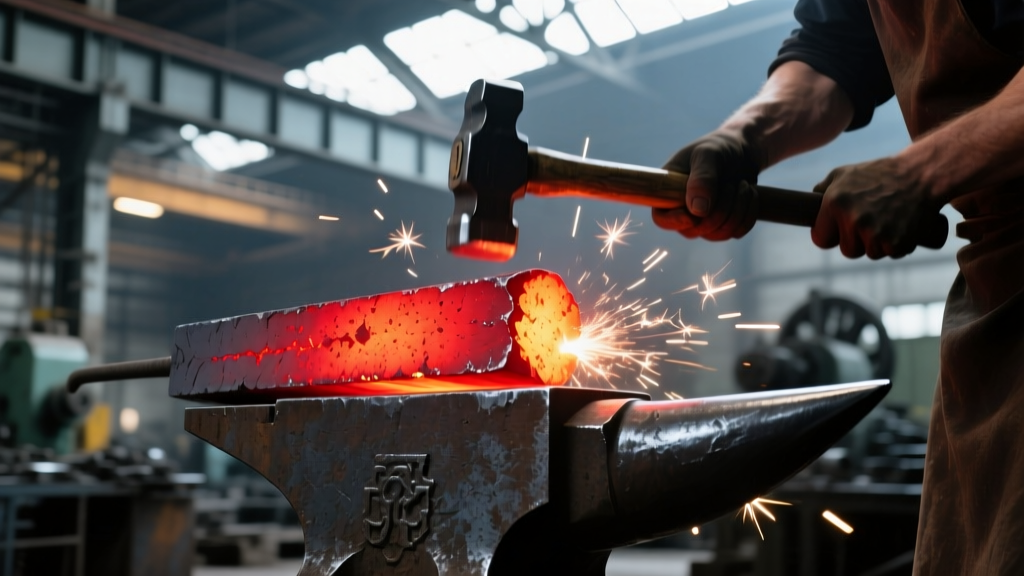
Comparative Matrix: Blade Steels vs. Construction Alloys
The following matrix contrasts the mechanical properties of specialized blade alloys with standard structural framing materials referenced in the AISC Steel Construction Manual.
| Alloy Designation | Carbon Content (%) | Yield Strength (ksi) | Max Hardness (HRC) | Primary Application |
|---|---|---|---|---|
| ASTM A992 | 0.23 (max) | 50 | ~15 (HRB 85) | Structural W-Shapes (I-Beams) |
| ASTM A615 Gr 60 | 0.30 (max) | 60 | ~20 | Concrete Reinforcement (Rebar) |
| AISI 1095 | 0.90 - 1.03 | 120 - 140 | 58 - 60 | Traditional Swords, Knives |
| AISI 5160 | 0.56 - 0.64 | 100 - 125 | 55 - 57 | Heavy Choppers, Leaf Springs |
| CPM-3V | 0.80 | 160+ | 58 - 62 | High-End Tactical Blades |
Heat Treatment: The True Differentiator
Selecting the best material for sword forging is only half the equation; the thermal processing dictates the final mechanical properties. Structural steels like A992 are typically used in the as-rolled or normalized condition, requiring no complex thermal cycling. Blade steels, however, demand precise austenitizing, quenching, and tempering.
"The microstructural transformation from austenite to martensite is highly time-sensitive. A delay of even three seconds during the transfer from the forge to the quench tank can result in the formation of soft pearlite, ruining the blade's edge geometry."
— Principles of Heat Treatment of Steel, ASM International
For 1095 steel, the austenitizing temperature is strictly maintained at 1475°F (802°C). It requires a fast quench, typically in a specialized medium like Parks 50 quenching oil, to bypass the pearlite 'nose' on the Time-Temperature-Transformation (TTT) diagram. Following the quench, the steel is excessively brittle (glass-like) and must be immediately tempered at 400°F (204°C) for two hours, repeated twice, to precipitate fine carbides and relieve internal stresses. As detailed in the ASM International materials database, improper tempering is the leading cause of catastrophic blade failure in the field.
2026 Sourcing and Cost Analysis
Material acquisition costs vary drastically between construction and specialty forging markets. As of early 2026, the global supply chain for specialized powder metallurgy tool steels has stabilized, though raw material costs for vanadium-rich alloys remain elevated compared to standard structural carbon steels.
- Structural Steel (ASTM A992): Purchased in bulk for commercial framing, A992 wide-flange beams cost approximately $850 to $1,050 per ton ($0.42 to $0.52 per pound). This economy of scale is driven by continuous casting and massive production volumes.
- 1095 High-Carbon Bar Stock: Readily available from industrial metal suppliers, precision-ground 1095 flat bar costs between $12.00 and $18.00 per linear foot for a 1/4" x 2" cross-section, translating to roughly $6.00 to $9.00 per pound.
- 5160 Spring Steel: Often sourced from automotive leaf spring suppliers or specialty mills, 5160 annealed bar stock averages $15.00 to $22.00 per linear foot for standard sword-width dimensions.
- CPM-3V Tool Steel: Due to the expensive powder atomization process and high alloying element costs, CPM-3V annealed sheet or bar commands a premium, frequently exceeding $160.00 per linear foot for a 3/16" x 2" profile. It is an investment-grade material reserved for high-end production runs.
Ultimately, the best material for sword applications depends entirely on the mechanical demands of the weapon and the manufacturing capabilities of the smith. While structural alloys excel in static load-bearing and ductility, high-carbon and powder metallurgy steels remain unmatched in dynamic impact resistance and edge geometry retention.
Written by
David NakamuraDavid Nakamura is a licensed architect (AIA) and construction technology writer focused on sustainable building methods, mass timber engineering, and high-performance building envelopes. He holds a Master of Architecture from the University of Washington and is a certified Passive House Consultant (CPHC). David spent eight years at the Seattle firm Mithun, where he led the design of three LEED Platinum projects, before founding his own practice specializing in net-zero residential design. He serves on the editorial advisory board of GreenBuilder Magazine and has authored peer-reviewed papers on cross-laminated timber (CLT) connections for the Journal of Structural Engineering. In his spare time, David teaches woodworking at Pratt Fine Arts Center and kayaks the Puget Sound.
More from David Nakamura
View all
Construction Cost
Labor Cost to Build a Deck Per Sq Ft: 2026 Installation Guide
Discover the exact labor cost to build a deck per sq ft in 2026. This installation guide breaks down contractor rates, complexity factors, and hidden fees.
Aug 4, 2026

Construction Cost
How Much Does It Cost to Build a 3 Bedroom House? Financing Guide
Learn exactly how much it costs to build a 3 bedroom house and explore 2026 financing options, construction loan types, and budget frameworks for your build.
Aug 4, 2026

Construction Cost
Cost to Build a Tennis Court: 2026 Guide
How much does it cost to build a tennis court in 2026? Breakdowns for asphalt, concrete, and synthetic surfaces plus fencing and lighting.
Jul 30, 2026