Best Materials for Built-In Closet Systems: 2026 Cost Analysis
Compare the best materials for built-in closet systems with our 2026 cost analysis. Discover pricing, durability, and ROI for TFL, MDF, and plywood.

The Economics of Closet Materials: Beyond the Initial Quote
When evaluating the best materials for built-in closet systems, homeowners and contractors frequently make the mistake of comparing sheet-good prices in isolation. In 2026, the raw material accounts for only 35% to 45% of the total installed cost of a custom closet. The remaining budget is consumed by edgebanding, specialized hardware, finishing labor, and structural reinforcement. A material that appears inexpensive per sheet can easily become the most expensive option once fabrication and installation labor are factored in.
This cost analysis dissects the four primary materials used in custom closet manufacturing—Thermally Fused Laminate (TFL), Paint-Grade Medium Density Fiberboard (MDF), Hardwood Plywood, and Solid Wood. We evaluate them not just on upfront pricing, but on structural span limits, hardware compatibility, and long-term return on investment.
Core Material Breakdown: Cost, Durability, and Lifespan
The following matrix provides a baseline comparison of material costs and structural properties for standard 3/4-inch thick panels, which is the mandatory thickness for load-bearing closet shelving and cabinet boxes.
| Material | Sheet Cost (4x8) | Installed Cost (Per Linear Ft) | Max Shelf Span (30 lbs/ft) | Moisture Resistance | Expected Lifespan |
|---|---|---|---|---|---|
| TFL (Melamine) | $95 - $140 | $110 - $160 | 32 inches | Low (Core swells if exposed) | 15 - 20 years |
| Paint-Grade MDF | $80 - $110 | $180 - $240 | 28 inches | Very Low (Requires sealing) | 10 - 15 years |
| Hardwood Plywood | $160 - $280 | $280 - $420 | 36 inches | Moderate | 30+ years |
| Solid Hardwood | $400+ | $550 - $800+ | 40+ inches | High (with finish) | 50+ years |
Thermally Fused Laminate (TFL) / Melamine
TFL remains the undisputed workhorse of the custom closet industry. Manufactured by fusing a decorative paper saturated with melamine resin directly to a particleboard or MDF core under high heat and pressure, TFL requires zero additional finishing. The cost savings are massive because the panels are cut, edgebanded, and assembled without ever entering a spray booth.
Cost Driver: The quality of the edgebanding dictates the lifespan of a TFL closet. Standard 1mm PVC edgebanding is prone to chipping when wire hangers strike the shelf edges. Upgrading to 2mm ABS edgebanding adds roughly 8% to the material cost but increases impact resistance by over 40%, making it a non-negotiable specification for high-traffic wardrobe zones.
Paint-Grade Medium Density Fiberboard (MDF)
For homeowners seeking the seamless, opaque look of custom millwork without the cost of solid wood, paint-grade MDF is the standard. However, MDF is heavy, highly susceptible to moisture swelling, and requires extensive labor to finish properly. To achieve a factory-grade finish, MDF must be primed, sanded, and sprayed with a catalyzed polyurethane or conversion varnish. This finishing labor is why MDF installed costs are significantly higher than TFL, despite the raw sheets being cheaper.
Specification Note: Always specify Moisture Resistant (MR) MDF for closet systems, particularly in master suites adjacent to bathrooms. MR-MDF is dyed green or brown at the core and utilizes moisture-resistant resins that reduce swelling thickness by up to 50% compared to standard MDF.
Hardwood Plywood with Veneer
When architectural warmth and structural superiority are required, hardwood plywood (such as maple, walnut, or white oak veneer over a multi-ply core) is the premium choice. According to the APA - The Engineered Wood Association, hardwood plywood offers superior screw-holding strength compared to particleboard or MDF, which is critical for heavy-duty closet hardware like pull-out valet rods and multi-tiered shoe racks.
Plywood allows for wider shelf spans without sagging, meaning fewer vertical dividers are required. This opens up the visual space of the closet and reduces the total linear footage of material needed, partially offsetting the higher per-sheet cost.
Hidden Cost Drivers That Destroy Budgets
Material selection is only the foundation. Upgrading from standard side-mounted drawer slides to premium undermount soft-close systems (like the Blum Legrabox or Hafele InnoTech lines) will add $85 to $140 per drawer box. In a walk-in closet with a 12-drawer dresser island, hardware upgrades alone can add $1,200 to $1,680 to the final invoice, regardless of whether the cabinet boxes are built from cheap melamine or expensive walnut plywood.
- Hinge Selection: Standard 110-degree hinges cost $2 to $4 each. Upgrading to zero-protrusion soft-close hinges (required for pull-out trays behind doors) costs $12 to $18 each. Multiply this by 30 doors, and the variance is substantial.
- Lighting Integration: Routing channels into 3/4-inch TFL or plywood for embedded LED strip lighting requires specialized CNC machining. Expect to pay an additional $45 to $75 per linear foot for integrated lighting channels, transformers, and smart-home dimmers.
- Toe Kicks and Scribing: Built-in systems require precise scribing to uneven drywall and flooring. Installers typically charge $15 to $25 per linear foot for custom scribe molding and toe-kick integration, a cost that applies equally to all material types.
Structural Span Limits and Failure Modes
A critical, often overlooked aspect of closet material cost is the shelf span limit. If a material sags under the weight of folded denim or winter sweaters, the system fails functionally, regardless of its aesthetic appeal. Based on industry-standard sag calculations for a uniform load of 30 pounds per linear foot:
- 3/4" MDF: Maximum unsupported span of 28 inches. Requires frequent vertical dividers, which increases material usage and cuts into hanging space.
- 3/4" Particleboard (TFL Core): Maximum unsupported span of 32 inches. The industry standard for folding shelves.
- 3/4" Hardwood Plywood: Maximum unsupported span of 36 to 40 inches. Allows for wide, open shelving bays.
- 1 1/4" Thick Panels: For ultra-wide luxury spans (48+ inches), fabricators must bond two sheets of material together or use specialized honeycomb cores, tripling the material cost for those specific shelves.
Environmental Compliance and Indoor Air Quality
Closets are often enclosed, poorly ventilated spaces. Off-gassing from composite wood products can concentrate in these areas. When sourcing TFL, MDF, or Plywood, it is imperative to verify compliance with the EPA TSCA Title VI formaldehyde emission standards.
For the highest indoor air quality, specify materials certified as NAF (No Added Formaldehyde) or ULEF (Ultra-Low-Emitting Formaldehyde). Many premium TFL manufacturers now utilize soy-based or polyurethane resins in their core boards to achieve NAF status. Additionally, for projects targeting LEED certification or sustainable building standards, sourcing veneers certified by the Forest Stewardship Council (FSC) ensures the wood was harvested from responsibly managed forests, though this typically carries a 10% to 15% material premium.
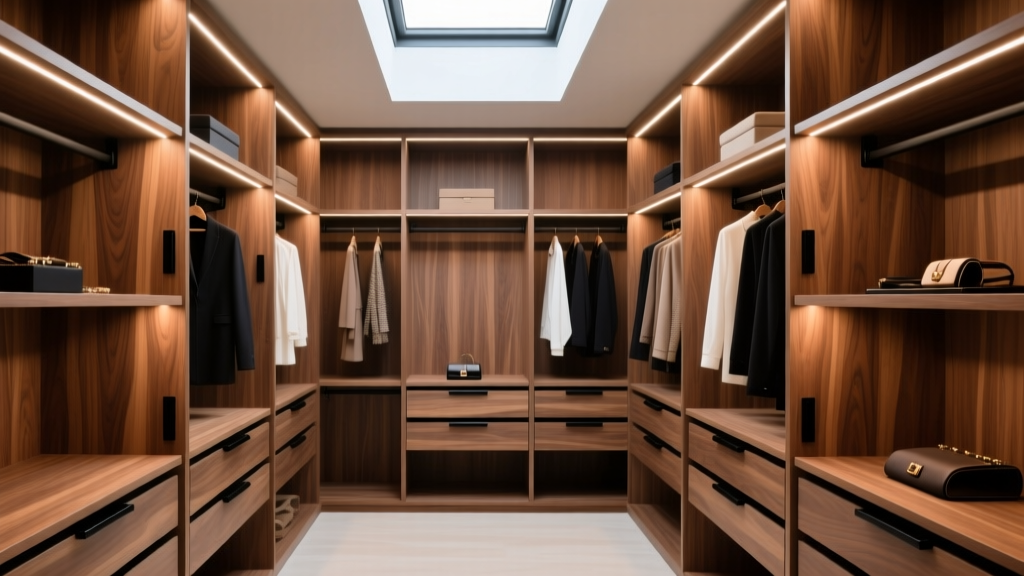
2026 Cost Projection: Standard 10x10 Walk-In Closet
To contextualize these metrics, consider a standard 10x10 foot walk-in closet configured in a U-shape (approximately 30 linear feet of cabinetry), featuring 12 drawer boxes, 4 double-hang sections, and 8 adjustable shelves. The following projections include materials, standard hardware, fabrication, and professional installation.
| Material Specification | Estimated Total Cost (2026) | Cost Per Square Foot (Floor Area) |
|---|---|---|
| Standard TFL (White/Gray, PVC edge) | $5,800 - $7,500 | $58 - $75 / sq ft |
| Premium TFL (Textured Woodgrain, ABS edge) | $8,200 - $10,500 | $82 - $105 / sq ft |
| Painted MR-MDF (Custom Color, Poly finish) | $12,000 - $16,000 | $120 - $160 / sq ft |
| Hardwood Plywood (Walnut Veneer, Clear coat) | $18,500 - $24,000 | $185 - $240 / sq ft |
Decision Framework: Matching Material to Project Scope
Selecting the best material requires aligning the physical properties of the board with the financial realities of the project.
- Choose TFL if: The budget is strictly capped below $10,000, the design utilizes standard woodgrain or solid color aesthetics, and the priority is maximizing storage volume per dollar without the need for on-site painting or finishing.
- Choose Painted MDF if: The closet is an extension of the bedroom's architectural millwork, requiring specific custom paint colors to match existing baseboards and crown molding, and the budget accommodates the high labor costs of professional spray finishing.
- Choose Hardwood Plywood if: The closet is designed as a luxury boutique space with glass-front doors, integrated lighting, and wide open spans where the natural grain of the wood is the primary aesthetic feature, and the structure must support heavy motorized lift systems.
Written by
Priya KapoorPriya Kapoor is a real estate market analyst and construction economics researcher with expertise in housing affordability, development feasibility, and infrastructure investment. She holds a Master of Regional Planning from Cornell University and previously worked as a senior analyst at CBRE's Investment Properties group, where she modeled returns for $4B in mixed-use development pipelines. Priya now runs an independent research practice advising developers, municipalities, and REITs on construction cost forecasting and market timing. She publishes the quarterly "BuildMat Market Pulse" report tracking material price indices across 12 commodity categories. Based in Austin, TX, Priya serves on the board of Habitat for Humanity Austin and is a marathon runner.
More from Priya Kapoor
View all
Construction Cost
Cost to Build a 1600 Sq Ft Home in 2026: Full Breakdown
Accurate 2026 cost to build a 1600 sq ft home—material, labor, and regional pricing breakdowns included. Plan your budget with real-time estimates.
Aug 11, 2026

Wood & Lumber
Name the Types of Wood for Pressure Treatment and Preservation
Learn how to name the types of wood best suited for pressure treatment. Compare species treatability, chemical retention levels, and 2026 preservation costs.
Aug 4, 2026

Stone & Masonry
Stone Veneer Suppliers Lindenhurst: 2026 Cost Analysis
Analyze 2026 stone veneer costs in Lindenhurst, NY. Compare local supplier pricing, delivery fees, and Suffolk County installation labor rates.
Aug 4, 2026