Car Noise Insulation Material: R-Value vs Acoustic Performance
Discover why R-value is a flawed metric for car noise insulation material. Compare butyl, MLV, and CCF performance for optimal automotive NVH reduction.

The R-Value Myth in Automotive Acoustics
When evaluating car noise insulation material, consumers frequently encounter marketing claims centered around "high R-values." This is a fundamental misapplication of building science to automotive engineering. R-value strictly measures steady-state thermal resistance—specifically, a material's ability to impede conductive heat flow. It does not measure sound absorption, acoustic decoupling, or vibration damping.
In residential construction, trapping air inside fiberglass batts yields a high R-value. In a vehicle, trapping air does nothing to stop the 85-decibel structure-borne resonance of a stamped steel floor pan vibrating at 120 Hz. Applying building insulation metrics to automotive Noise, Vibration, and Harshness (NVH) leads to severely underperforming builds. To properly spec car noise insulation material, you must abandon R-value as your primary acoustic benchmark and pivot to mass, damping coefficients, and decoupling mechanics.
True Performance Metrics: Damping Factor vs. STC
Automotive noise enters the cabin through two distinct pathways: structure-borne vibration (low-frequency road hum and panel resonance) and airborne noise (high-frequency tire hiss, exhaust drone, and wind). Effective car noise insulation material must address both using entirely different physical principles.
Structure-Borne Noise: The Damping Factor
Sheet metal acts like a bell. When excited by low-frequency vibrations from the suspension or powertrain, it resonates. Viscoelastic materials (like butyl rubber) convert this mechanical vibrational energy into negligible amounts of heat. The performance metric here is the Damping Factor (Loss Factor), not R-value. A higher loss factor means the material more efficiently kills panel resonance.
Airborne Noise: Sound Transmission Class (STC)
Airborne noise requires mass to block. The Acoustical Surfaces engineering guides define Sound Transmission Class (STC) as the measure of a partition's ability to block airborne sound. In a car, increasing the STC requires adding dense, limp mass barriers that reflect and absorb acoustic waves before they penetrate the cabin.
| Material Type | Primary NVH Function | Weight / Thickness | Acoustic Metric | Thermal R-Value (Approx) |
|---|---|---|---|---|
| Constrained Layer Damper (Butyl) | Kills panel resonance | 0.5 lbs/sq ft / 60-80 mil | High Loss Factor | R-0.1 (Negligible) |
| Mass Loaded Vinyl (MLV) | Blocks airborne noise | 1.0 - 2.0 lbs/sq ft / 1/8" | High STC (26-32) | R-0.5 (Negligible) |
| Closed-Cell Foam (CCF) | Decoupling / Rattle prevention | 0.1 lbs/sq ft / 1/4" - 1/2" | Low-Frequency Absorption | R-1.5 per 1/4" |
| Open-Cell Jute / Melamine | Absorbs high-frequency hiss | 0.3 lbs/sq ft / 1/2" - 1" | High NRC (0.70+) | R-3.0 per inch |
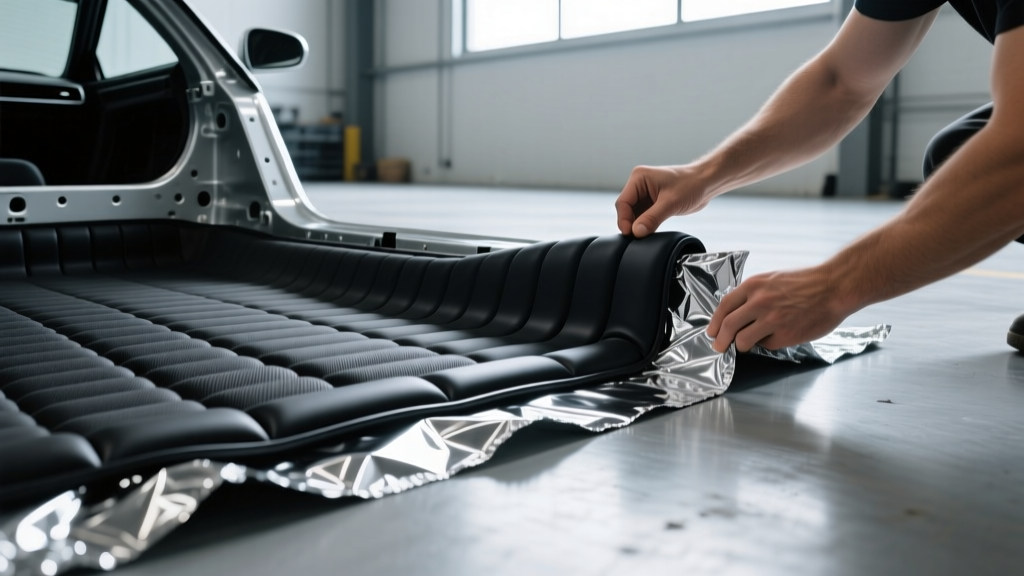
Top Car Noise Insulation Materials Analyzed
1. Butyl Rubber Constrained Layer Dampers (CLD)
Products like Dynamat Xtreme (67 mil, 0.45 lbs/sq ft) and Kilmat 80 mil (0.5 lbs/sq ft) represent the industry standard for CLD. These consist of a viscoelastic butyl base constrained by a stiff aluminum foil layer. When the metal panel bends, the butyl stretches and shears, converting kinetic energy into heat.
Performance Insight: CLD materials follow the law of diminishing returns. Testing by Second Skin Audio's NVH engineering team confirms that applying CLD to just 25% to 30% of a flat panel's surface area achieves roughly 90% of the maximum damping effect. Covering 100% of the floor pan with butyl adds 40+ pounds of useless weight to your vehicle without yielding proportional acoustic gains.
2. Mass Loaded Vinyl (MLV)
MLV is a limp-mass barrier loaded with barium sulfate or calcium silicate. Premium automotive grades like Second Skin Audio Luxury Liner Pro or SoundSkins Pro weigh between 1.0 and 1.5 lbs per square foot at 1/8-inch thickness. MLV is your primary defense against airborne exhaust drone and high-frequency tire noise.
Failure Mode Warning: MLV must never be glued directly to the vehicle's sheet metal. If rigidly coupled to the chassis, it will vibrate in sympathy with the metal, entirely negating its mass-blocking properties. It must be suspended or decoupled.
3. Closed-Cell Polyethylene Foam (CCF)
CCF serves as the critical decoupler in an automotive insulation stack. At 1/4-inch to 1/2-inch thickness, it provides a modest thermal R-value (approximately R-1.5 to R-3.0), but its acoustic job is to create an air gap between the vibrating chassis and the MLV barrier. CCF is entirely waterproof, making it mandatory for floor pans and wheel wells where moisture ingress is guaranteed.
Strategic Layering: The 3-Stage Performance Framework
To achieve OEM-luxury or better NVH levels, you cannot rely on a single material. You must engineer a composite stack. Follow this exact sequence from the bare metal outward:
- Stage 1: The Damper (Bare Metal)
Clean the sheet metal with isopropyl alcohol. Apply butyl CLD tiles in a 25% coverage grid pattern. Use a hard roller to apply 150+ PSI of pressure, ensuring the butyl pushes into the microscopic pores of the metal. Tip: Do not use asphalt-based mats; they off-gas toxic fumes in summer heat and lose their viscoelastic properties below 40°F. - Stage 2: The Decoupler (Over CLD)
Apply a 1/4" or 1/2" layer of Closed-Cell Foam (CCF) using a high-temperature spray adhesive. Cover 100% of the surface. This layer prevents the MLV from touching the metal and absorbs low-frequency standing waves. - Stage 3: The Mass Barrier (Over CCF)
Lay your Mass Loaded Vinyl (MLV) over the CCF. Do not glue the MLV down entirely; allow it to float slightly where possible to maximize its limp-mass characteristics. Seal all seams with acoustic aluminum tape to prevent high-frequency sound flanking.
The EV Paradigm Shift: Where Thermal R-Value Actually Matters
The transition to Electric Vehicles (EVs) in 2026 has radically altered automotive NVH requirements. Without an internal combustion engine to mask road noise, tire cavity resonance and wind noise become the dominant acoustic offenders. Furthermore, EV battery packs generate significant thermal loads.
This is where thermal R-value and acoustic performance finally intersect. While the floor pan requires acoustic mass, the roof and firewall require thermal management. For the roof skin, applying a layer of aluminized closed-cell foam provides an R-value of roughly 2.0, reflecting radiant solar heat and reducing HVAC load, while simultaneously dampening rain impact noise. For the firewall, ceramic-infused acoustic blankets provide both an STC rating of 30+ and a thermal resistance capable of withstanding 1,200°F radiant heat from adjacent high-voltage inverters and exhaust routing on hybrid platforms.
Cost vs. Performance ROI Breakdown
Budgeting for a full-vehicle treatment requires understanding where your money yields the highest decibel reduction per dollar.
- Butyl CLD Mats: $2.50 to $4.50 per sq. ft. (Highest ROI for eliminating low-frequency panel boom. Buy 40-60 sq. ft. for a mid-size sedan).
- Closed-Cell Foam (CCF): $1.25 to $2.50 per sq. ft. (Essential decoupler. Buy 80-100 sq. ft. for full cabin coverage).
- Mass Loaded Vinyl (MLV): $3.50 to $6.00 per sq. ft. (Most expensive, heaviest. Target only the floor pan, firewall, and rear deck for maximum airborne noise blocking. Buy 50 sq. ft.).
- Open-Cell Melamine/Jute: $1.50 to $3.00 per sq. ft. (Use exclusively in door cavities and headliner. Never use on the floor pan, as it acts as a sponge for water and causes rust).
A comprehensive, three-stage insulation build for a standard four-door vehicle typically requires between $450 and $750 in raw materials, plus 15 to 25 hours of labor for complete interior teardown and reassembly. By ignoring misleading R-value claims and focusing strictly on mass, damping, and decoupling metrics, you can engineer a cabin environment that rivals top-tier luxury marques.
Written by
Marcus ChenMarcus Chen is a licensed structural engineer (PE) and building materials analyst with over 12 years of experience across residential, commercial, and industrial construction. He holds a Master of Science in Civil Engineering from UC Berkeley and spent six years at Thornton Tomasetti before transitioning to independent consulting and technical writing. Marcus specializes in material selection for seismic-prone regions, concrete reinforcement strategies, and lifecycle cost analysis. His work has been cited by the American Concrete Institute (ACI) and the Structural Engineers Association of California (SEAOC). When he is not on a job site or at his desk, you will find him hiking the Sierra Nevada or restoring a 1920s craftsman bungalow in Oakland, CA.
More from Marcus Chen
View all
Construction Cost
How Much Did the Eiffel Tower Cost to Build?
How much did the Eiffel Tower cost to build in 1889? We adjust for inflation and compare its budget to modern skyscraper construction.
Aug 4, 2026

Fire Resistance
What Is a Fire Resistant Material? Testing & Certification Guide
Discover what is a fire resistant material through ASTM and UL testing. Learn how fire ratings, certifications, and assemblies work in construction.
Aug 4, 2026

Construction Cost
How Much Did the Burj Khalifa Cost to Build?
How much did the Burj Khalifa cost to build? We break down the $1.5B project and extract 5 money-saving strategies for your next build.
Jul 30, 2026