Armacell vs K-Flex Water Pipe Insulation: Product Line Deep Dive
Compare Armacell ArmaFlex and K-Flex Insul-Tube water pipe insulation. Deep dive into specs, 2026 pricing, failure modes, and ASHRAE compliance.
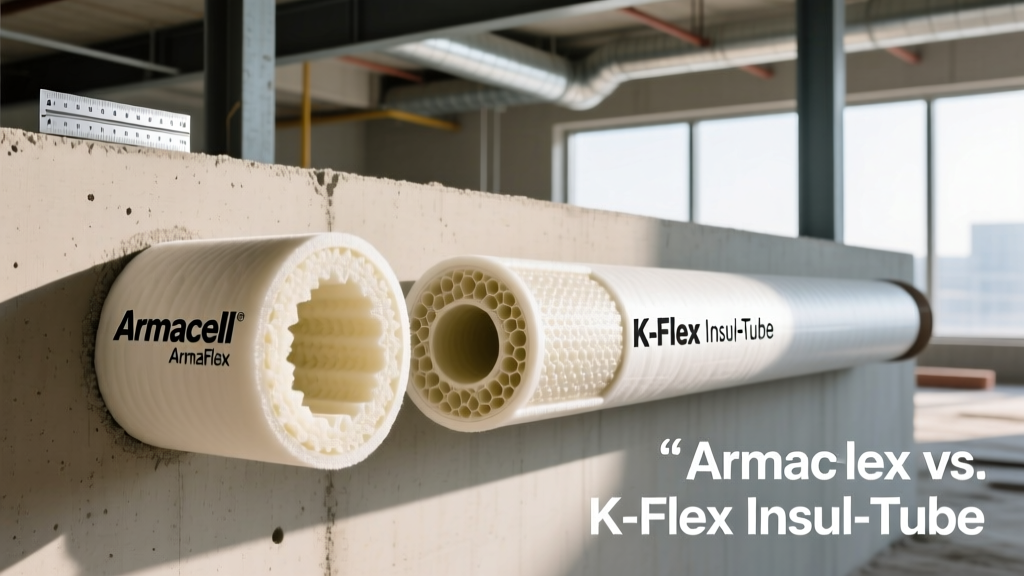
The Elastomeric Heavyweights: Armacell ArmaFlex vs. K-Flex Insul-Tube
When specifying closed-cell elastomeric foam for plumbing and HVAC applications, the market is effectively a duopoly. Armacell (creator of the original ArmaFlex) and K-Flex (manufacturer of Insul-Tube) dominate the commercial and high-end residential sectors. Selecting the right water pipe insulation is not merely about wrapping pipes to prevent freezing; it is a critical exercise in vapor retarder management, condensation control, and fire code compliance.
Both brands manufacture flexible, closed-cell elastomeric foam that inherently resists moisture vapor transmission. However, their specific product lines, adhesive ecosystems, and specialized formulations differ in ways that directly impact labor costs, long-term durability, and code compliance. This deep dive dissects the flagship tubular product lines from both manufacturers to help contractors and engineers make precise specifications.
Armacell ArmaFlex: Product Line Breakdown & Specs
Armacell’s flagship tubular offering is ArmaFlex InsulTube (and the closely related ArmaFlex AP). Manufactured without CFCs, HFCs, or HCFCs, it relies on a closed-cell structure that achieves a water vapor permeability of ≤0.03 perm-inches, effectively acting as its own vapor retarder.
ArmaFlex InsulTube vs. ArmaFlex AP
While both are elastomeric foams, the distinction lies in their specialized additives and target markets:
- ArmaFlex InsulTube: The premium commercial line. It features built-in Microban antimicrobial protection, which inhibits the growth of mold, mildew, and bacteria on the insulation surface. This is a critical specification for hospitals, schools, and food processing facilities where indoor air quality and surface hygiene are heavily scrutinized.
- ArmaFlex AP (Armaflex Pipe): The standard residential and light-commercial line. It lacks the Microban additive but offers identical thermal and vapor-retarding performance at a slightly lower price point.
- Thermal Conductivity (k): 0.245 BTU-in/hr·ft²·°F at 75°F mean temperature
- R-Value: ~4.1 to 4.6 per inch of thickness
- Service Temperature Range: -297°F to +220°F
- Flame/Smoke Rating: 25/50 (ASTM E84 / UL 723)
K-Flex Insul-Tube: Product Line Breakdown & Specs
K-Flex counters with the Insul-Tube product line, which matches Armacell in baseline thermal performance but differentiates itself through specialized low-smoke formulations and innovative installation accessories.
Standard Insul-Tube vs. Insul-Tube LS
K-Flex segments its tubular offerings based on fire safety and smoke toxicity requirements:
- Insul-Tube (Standard): The workhorse of the K-Flex lineup. It meets the standard 25/50 flame and smoke indices required for most plenum and non-plenum mechanical rooms.
- Insul-Tube LS (Low Smoke): Formulated specifically for mass transit, marine, and high-occupancy egress routes. The LS line is halogen-free and drastically reduces smoke density and toxicity during combustion, complying with strict ASTM E662 and IMO (International Maritime Organization) standards.
Head-to-Head Specification Matrix
Below is a direct comparison of the standard commercial tubular lines from both manufacturers based on 2026 technical data sheets.
| Feature | Armacell ArmaFlex InsulTube | K-Flex Insul-Tube |
|---|---|---|
| Base Material | Closed-cell elastomeric (NBR/PVC blend) | Closed-cell elastomeric (NBR/PVC blend) |
| Antimicrobial Treatment | Yes (Microban integrated) | No (Available on specific custom runs) |
| Standard Adhesive | ArmaFlex 520 (Solvent-based contact) | K-Flex 320 (Solvent-based contact) |
| Tape Alternative | ArmaFlex 520 Black Seam Tape | Insul-Tape (Double-sided acrylic) |
| ASTM Standard | ASTM C534 Type I | ASTM C534 Type I |
2026 Material Pricing & Installation Labor
Pricing for elastomeric water pipe insulation fluctuates with synthetic rubber and petroleum markets. As of early 2026, contractors should budget according to the following average wholesale material costs. Note that labor remains the most significant variable in total installed cost.
| Pipe Size & Wall Thickness | ArmaFlex Cost (per linear ft) | K-Flex Cost (per linear ft) | Est. Labor (per linear ft) |
|---|---|---|---|
| 1/2" ID x 3/8" Wall | $1.15 | $1.05 | $2.50 - $3.25 |
| 3/4" ID x 1/2" Wall | $1.65 | $1.55 | $2.75 - $3.50 |
| 1" ID x 1/2" Wall | $2.40 | $2.25 | $3.00 - $4.00 |
| 2" ID x 1" Wall | $5.80 | $5.50 | $4.50 - $6.00 |
Critical Failure Modes & Edge Cases
The physical foam rarely fails; the seams and the exterior environment do. Understanding these failure modes is what separates a master insulator from a novice.
Both Armacell 520 and K-Flex 320 are solvent-based contact adhesives. The most common cause of condensation drip (and subsequent Corrosion Under Insulation on metallic pipes) is joining seams before the adhesive solvents have flashed off. If you join the seam while the adhesive is still wet, the trapped solvents will slowly degrade the bond from the inside out. Always allow a 10 to 15-minute tack time (depending on ambient humidity) until the adhesive feels dry to the touch but aggressively grabs when pressed. For straight runs, K-Flex’s double-sided Insul-Tape eliminates this risk entirely by removing solvents from the equation.
The "Shark Fin" Effect on Fittings
When insulating elbows and tees, lazy installers will simply bend the tubular insulation around the 90-degree angle. This compresses the inner radius (thinning the insulation and reducing its R-value) and stretches the outer radius, creating a void. This void acts as a thermal bridge, leading to localized condensation. Proper technique requires miter-cutting the tube at 45-degree angles and gluing the pieces together to maintain uniform wall thickness.
UV Degradation in Sunlit Mechanical Rooms
Elastomeric foam is highly susceptible to ultraviolet radiation. If water pipe insulation is installed in a mechanical room with large skylights, or on exterior rooftops, the UV rays will break down the polymer chains. Within 6 to 12 months, the surface will begin to chalk, crack, and eventually disintegrate, destroying the vapor barrier. If UV exposure is unavoidable, the insulation must be coated with a UV-resistant acrylic coating (such as Armacell WB-800 or K-Flex Insul-Clad) immediately after installation.
Decision Framework: Which Line Should You Specify?
Choosing between Armacell and K-Flex requires aligning the product's unique traits with the project's specific constraints. Use this framework to finalize your specification:
- Specify Armacell ArmaFlex InsulTube when: The project is a healthcare facility, school, or cleanroom where the Microban antimicrobial additive provides a verifiable IAQ (Indoor Air Quality) benefit for the architectural review board.
- Specify K-Flex Insul-Tube LS when: The piping runs through mass transit tunnels, marine vessels, or high-rise egress stairwells where local fire marshals mandate low-smoke, zero-halogen (LSZH) materials to prevent toxic smoke inhalation during a fire event.
- Specify K-Flex with Insul-Tape when: Labor shortages are severe, and the project consists primarily of long, straight domestic cold-water runs. The tape system reduces seam-sealing labor time by up to 30% and eliminates VOC emissions in occupied spaces.
Industry Standards & Compliance
Regardless of the brand selected, the installation must comply with minimum thickness requirements dictated by energy and condensation codes. According to ASHRAE Standard 90.1, pipe insulation thickness is mandated based on the pipe's nominal diameter and the fluid's temperature range. For example, cold domestic water pipes (typically 60°F) generally require a minimum of 1/2-inch thickness to prevent condensation in humid climates, while heating water pipes (140°F+) require 1 to 1.5 inches for thermal conservation.
Furthermore, the U.S. Department of Energy emphasizes that proper insulation of both hot and cold water lines not only prevents freezing and condensation but can reduce hot water heat loss by up to 20%, allowing for lower water heater set-points and measurable energy savings. Always verify local mechanical codes, as jurisdictions in high-humidity zones (like Florida or Louisiana) often amend ASHRAE baselines to require thicker insulation on cold water lines to ensure the outer surface temperature remains above the local dew point.