Top Energy Efficient Insulation Materials Compared for 2026
Compare top energy efficient insulation materials for 2026. Analyze R-values, costs, and installation specs for spray foam, rigid foam, and mineral wool.

The 2026 Landscape of High-Performance Thermal Envelopes
Meeting the stringent continuous insulation (CI) mandates of the updated 2024 and 2026 International Energy Conservation Code (IECC) requires moving beyond standard fiberglass batts. Modern building envelopes demand materials that simultaneously manage thermal transfer, air leakage, and moisture diffusion. When selecting energy efficient insulation materials, architects and builders must evaluate the assembly as a holistic system rather than looking at isolated R-values. The transition away from high-global-warming-potential (GWP) blowing agents, driven by the EPA's AIM Act, has fundamentally altered the performance profiles and pricing of foam-based insulations entering the market this year.
Core Metrics: R-Value, Air Sealing, and Moisture Permeability
Evaluating high-performance insulation requires analyzing three intersecting metrics. First is the center-of-cavity R-value per inch, which dictates the physical thickness required to meet code. Second is air permeability; materials that double as air barriers eliminate the need for separate housewraps in certain assemblies. Third is vapor permeability, measured in perms. A material's perm rating dictates where it can be safely placed within a wall assembly to prevent interstitial condensation. According to the U.S. Department of Energy, improper vapor retarder placement is a leading cause of mold and structural rot in highly insulated modern homes.
Material Comparison Matrix
| Material Type | R-Value per Inch | Air Barrier? | Vapor Permeability | 2026 Avg. Cost (per bd ft) |
|---|---|---|---|---|
| Closed-Cell SPF (2 lb) | R-6.5 - R-7.0 | Yes (at 1.5"+) | Class II Retarder | $1.60 - $2.80 |
| Polyiso Rigid Board | R-6.0 - R-6.5 | Yes (if taped) | Varies by facer | $0.85 - $1.30 |
| High-Density Mineral Wool | R-4.2 - R-4.3 | No | Vapor Open (>50 perms) | $1.20 - $1.75 |
| Silica Aerogel Blanket | R-10.0 | No | Vapor Open | $5.00 - $8.50 |
Material Deep-Dive: Performance vs. Cost
Closed-Cell Spray Polyurethane Foam (ccSPF)
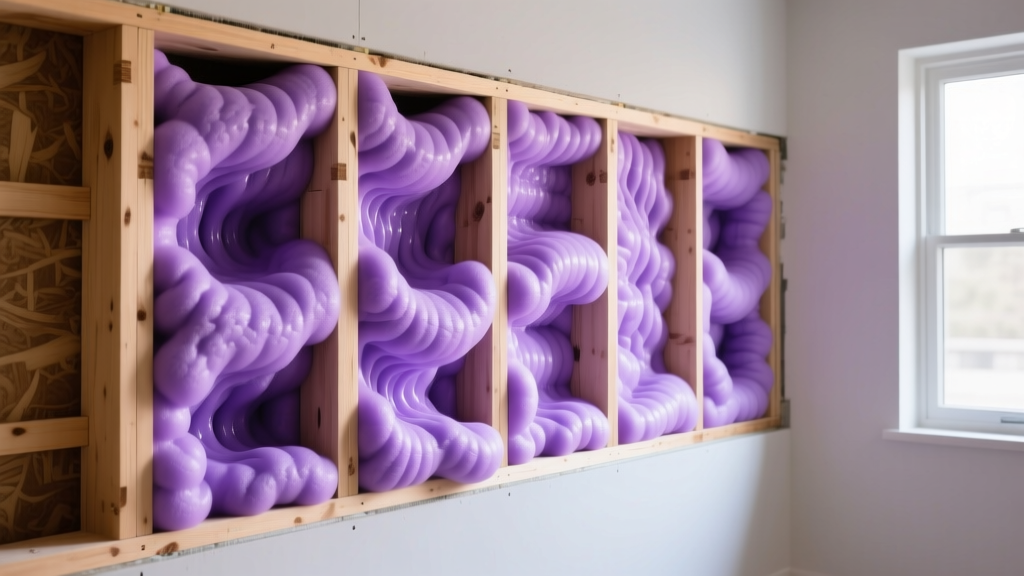
Two-pound closed-cell spray foam remains the undisputed leader for combined thermal resistance and structural enhancement. Modern formulations, such as Demilec's Heatlok Soya HFO, utilize hydrofluoroolefin (HFO) blowing agents. This transition, mandated by the EPA's HFC phase-down regulations, reduces the foam's global warming potential by over 99% compared to older HFC-245fa formulations, without sacrificing the R-6.5 per inch performance. Beyond insulation, 1.5 inches of ccSPF qualifies as an air barrier, and its rigid nature increases the racking strength of wood-framed walls by up to 300%. However, it is a Class II vapor retarder (approx. 1.5 perms at 2 inches), meaning interior drying potential is restricted.
Polyisocyanurate (Polyiso) Rigid Foam Boards
Polyiso offers the highest R-value per inch among rigid board insulations at standard room temperatures, typically rating R-6.0 to R-6.5. Products like Owens Corning FOAMULAR NXG or Carlisle Securock are staples in commercial and high-performance residential CI applications. However, builders must account for thermal drift. As detailed by Building Science Corporation, standard polyiso experiences a significant drop in thermal resistance in freezing temperatures because the pentane blowing agents diffuse out and are replaced by air. For cold-climate builds, specify 'cold-weather optimized' polyiso boards that utilize modified blowing agent blends to maintain R-6+ performance even at 0°F.
High-Density Mineral Wool Batts and Boards
Mineral wool, specifically high-density exterior boards like Rockwool Comfortboard 80, provides an R-value of R-4.3 per inch. While its thermal resistance is lower than foams, its building science benefits are unparalleled. It is entirely non-combustible (withstanding temperatures up to 2,150°F), hydrophobic (repels liquid water), and highly vapor-permeable. This vapor openness allows walls to dry to the exterior, making it the safest continuous insulation choice for double-stud walls or dense-pack cellulose cavities where interior moisture loads need an escape route.
Silica Aerogel Insulation Blankets
Aerogel products, such as Spaceloft, represent the absolute cutting edge of energy efficient insulation materials, delivering an astonishing R-10 per inch at just 10mm thick. Originally developed for aerospace, aerogel blankets are now used in high-end residential retrofits where preserving interior square footage is paramount, or as thermal break strips under balcony slabs and window bucks to eliminate localized thermal bridging. The prohibitive cost restricts its use to targeted applications rather than whole-wall coverage.
Climate Zone Decision Framework
Selecting the correct material requires aligning the insulation's vapor profile with your specific IECC Climate Zone.
- Zones 1-3 (Hot/Humid): The primary moisture drive is inward from the hot exterior. Use vapor-open exterior insulation like mineral wool, or ensure your interior finishes do not include Class I vinyl wallpapers. If using foil-faced polyiso on the exterior, the interior must remain highly vapor-permeable to allow inward drying.
- Zones 4-5 (Mixed): These zones experience both heating and cooling degree days. A 'flash and batt' approach works exceptionally well here: 1.5 inches of closed-cell spray foam (R-10) against the interior sheathing to seal air and control condensation, followed by open-cell foam or fiberglass to fill the remainder of the cavity.
- Zones 6-8 (Cold/Very Cold): The moisture drive is strongly outward in winter. You must install sufficient exterior continuous insulation to keep the structural sheathing above the dew point. The rule of thumb is that the exterior CI must provide at least 30% to 50% of the total assembly R-value. Use thick layers of vapor-open mineral wool or unfaced polyiso to allow the assembly to dry outward during the summer months.
Real-World Cost Analysis and ROI Timelines
When evaluating the cost of energy efficient insulation materials, look at the total installed cost per R-value achieved for a standard 2,000 square foot wall assembly.
| Material Strategy | Target R-Value | Estimated Material Cost | Energy Payback Period |
|---|---|---|---|
| 2" Mineral Wool CI + R-15 Batts | R-23.6 | $4,800 - $5,500 | 7 - 9 Years |
| 2" Polyiso CI + R-15 Batts | R-27.0 | $3,900 - $4,600 | 5 - 7 Years |
| Full Cavity 5" ccSPF (2 lb) | R-32.5 | $8,500 - $11,000 | 10 - 14 Years |
While closed-cell spray foam provides the highest absolute R-value and eliminates air infiltration, the diminishing returns on energy savings push its ROI timeline past a decade. For most production builders and cost-conscious custom builds, a hybrid approach utilizing rigid polyiso or mineral wool for continuous exterior insulation, combined with standard cavity fill, yields the fastest financial return while strictly adhering to modern energy codes.
Frequently Asked Questions
Does closed-cell spray foam off-gas after installation?
Modern HFO-blown closed-cell foams have drastically reduced VOC profiles compared to older chemistries. While there is a slight off-gassing period during the 24-to-48-hour curing phase, properly mixed and applied 2 lb foam becomes inert plastic. Builders must ensure the site is vacated during installation and ventilated for 48 hours post-application to allow aerosolized particulates and trace amines to clear.
Can I use mineral wool instead of rigid foam for continuous insulation?
Yes, and it is highly recommended in high-performance, vapor-open assemblies like Passive House builds. Because mineral wool boards (like Rockwool Comfortboard 80) are rigid, hydrophobic, and vapor-permeable, they allow the wall to dry to the exterior. However, because mineral wool has a lower R-value per inch (R-4.3) than polyiso (R-6.5), you will need to increase the thickness of the CI layer by approximately 30% to achieve the same thermal resistance.
How do I prevent thermal bridging at wall studs?
Wood studs have an R-value of roughly R-1.25 per inch, meaning a 2x6 stud acts as a thermal bridge through an R-21 cavity. To break this bridge, you must install a continuous layer of insulation on the exterior of the sheathing. Even 1 inch of exterior polyiso or mineral wool significantly raises the interior surface temperature of the wall, reducing condensation risk and improving overall effective R-value by up to 20%.
Written by
Sarah WhitfieldSarah Whitfield is a chartered quantity surveyor (MRICS) and construction cost analyst with 15 years of experience in material pricing, procurement strategy, and project budgeting. She earned her degree in Construction Management from the University of Reading (UK) and has worked on projects ranging from $2M custom homes to $180M mixed-use developments across North America and Europe. Sarah currently leads cost estimating for BuildMat Insight, maintaining a proprietary database of 4,000+ material price points updated quarterly. She is a frequent contributor to RSMeans cost data panels and has presented at the International Cost Engineering Council (ICEC) congress. Based in Denver, CO, Sarah is an avid trail runner and volunteer mentor for Women in Construction.
More from Sarah Whitfield
View all
Wood & Lumber
What Are the Different Types of Wood? A Builder's Guide
Compare structural softwoods, finish hardwoods, and engineered lumber. Analyze Janka ratings, MOE values, and 2026 pricing for construction.
Aug 4, 2026

Walls & Panels
Steel Framing vs Wood Framing: Corrosion and Moisture Defense
Compare steel framing vs wood framing for moisture resistance. Learn about galvanized coatings, condensation risks, and corrosion protection strategies.
Jul 21, 2026

Stone & Masonry
How to Cut Stone Veneer: Wet Saw vs Grinder Comparison
Compare the best tools for cutting stone veneer. We review wet saws, angle grinders, and chop saws to help you achieve clean, chip-free cuts.
Jul 21, 2026