Lightweight Insulation Materials: 2026 Cost Analysis
Compare 2026 costs for lightweight insulation materials like aerogel, VIPs, and Neopor. Includes R-value per dollar, hidden structural savings, and ROI.

The Economics of Weight: Why Specify Lightweight Insulation?
When evaluating building envelopes, contractors and architects typically focus on R-value per dollar. However, in 2026, the calculus for commercial retrofits, high-performance residential builds, and space-constrained projects increasingly favors lightweight insulation materials. The upfront material cost per square foot for advanced lightweight options like silica aerogel and vacuum insulation panels (VIPs) is undeniably higher than traditional batts or rigid foams. Yet, a true cost analysis must account for structural dead-load reductions, freight volume savings, and labor efficiencies in tight cavities.
According to the U.S. Department of Energy, selecting the right insulation type requires balancing thermal resistance, air sealing, and physical footprint. Lightweight materials excel where spatial constraints and weight limits dictate the design, such as in parapet walls, shipping container architecture, and historic masonry retrofits where interior square footage cannot be sacrificed.
2026 Quick Cost Snapshot
- Highest R-Value per Inch: Vacuum Insulation Panels (R-30 to R-50/inch) at $9.50 - $14.00/sq ft.
- Best Flexibility & Moisture Resistance: Silica Aerogel Blankets (R-10.3/inch) at $4.10 - $4.80/sq ft.
- Best Budget Lightweight Option: Graphite Polystyrene / GPS (R-5.0/inch) at $0.85 - $1.10/sq ft.
2026 Material Cost Breakdown: Lightweight Insulation Matrix
The table below outlines the current market pricing, thermal performance, and physical weight characteristics of the leading lightweight insulation materials available in 2026. Pricing reflects material-only costs for commercial volumes (pallet/tractor-trailer quantities); residential LTL (less-than-truckload) purchases will carry a 15-25% premium.
| Material Type | Brand Example | R-Value / Inch | Cost / Sq Ft | Weight / Sq Ft (at R-20) |
|---|---|---|---|---|
| Silica Aerogel Blanket | Aspen Spaceloft | R-10.3 | $4.10 - $4.80 | ~0.4 lbs |
| Vacuum Insulation Panel | va-Q-tec / Kingspan | R-30 to R-50 | $9.50 - $14.00 | ~0.8 lbs |
| Graphite Polystyrene (GPS) | BASF Neopor | R-5.0 | $0.85 - $1.10 | ~1.2 lbs |
| Foil-Faced Polyiso | Carlisle / Owens Corning | R-6.0 (Aged) | $0.65 - $0.90 | ~1.5 lbs |
Deep Dive: Premium Lightweight Options
Silica Aerogel Blankets (e.g., Aspen Spaceloft)
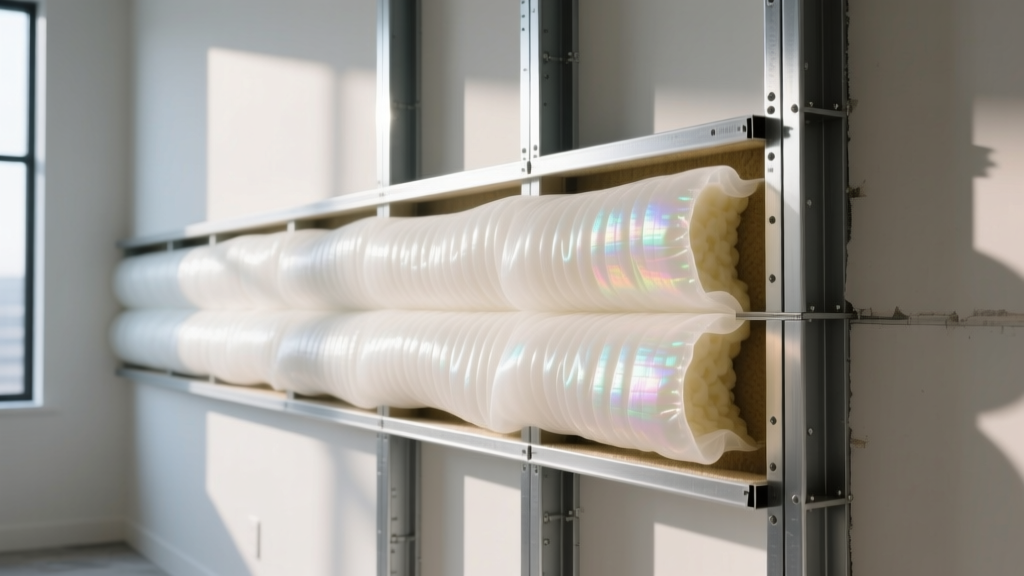
Aerogel blankets represent the pinnacle of flexible, lightweight thermal resistance. Composed of silica nanoparticles that trap air in a nanoporous matrix, these blankets achieve an R-value of 10.3 per inch while remaining highly vapor-permeable and completely hydrophobic.
Cost & Installation Reality: At roughly $4.50 per square foot, aerogel is a premium investment. However, labor costs are significantly lower than rigid boards. Installers can cut Spaceloft with standard utility knives and wrap it around complex geometries, HVAC ducts, and structural steel flanges without leaving thermal bridges. Fastening is typically achieved using plastic cap nails or specialized construction adhesives, eliminating the need for expensive mechanical track systems required by heavy mineral wool boards.
Vacuum Insulation Panels (VIPs)
VIPs consist of a fumed silica or fiberglass core encased in a gas-tight metallic or metallized polymer envelope, evacuated to a near-vacuum. This eliminates gaseous conduction, yielding an astonishing R-30 to R-50 per inch. A mere 1-inch VIP provides the same thermal resistance as 5 to 8 inches of polyiso.
The Puncture Penalty: The primary cost risk with VIPs is their fragility. If a panel is punctured by a stray nail or sharp aggregate during installation, it loses its vacuum and its R-value plummets to roughly R-4 per inch. To mitigate this, manufacturers encapsulate VIPs in protective XPS or EPS shells. When budgeting for VIPs, project managers must include a 3% to 5% contingency for on-site panel replacement and specify non-penetrating adhesive mounting systems rather than mechanical screws.
Mid-Tier Lightweight: Graphite Polystyrene (GPS) vs. Polyiso
For projects where aerogel and VIPs exceed the budget, Graphite Polystyrene (GPS) and Polyisocyanurate (Polyiso) offer excellent lightweight characteristics at a fraction of the cost.
GPS, widely known by the brand name Neopor, integrates graphite particles into the EPS matrix to reflect radiant heat, boosting its R-value to a stable R-5.0 per inch. Unlike Polyiso, which suffers from thermal drift (dropping from an initial R-6.5 to an aged R-5.6 as blowing gases diffuse out over 5-10 years), GPS maintains its R-value indefinitely. According to continuous insulation guidelines published by the Pacific Northwest National Laboratory's Building America Solution Center, maintaining long-term R-value stability is critical for meeting modern energy codes without over-engineering the initial wall thickness.
Polyiso remains the lightest rigid board option by volume and is highly cost-effective at under $0.90 per square foot, but its susceptibility to moisture absorption and thermal drift makes GPS the superior choice for below-grade or high-humidity lightweight applications.
Hidden Costs and Structural Offsets
Evaluating lightweight insulation materials strictly on a 'cost per R-value' basis ignores significant secondary financial benefits that manifest during the structural and logistical phases of construction.
- Structural Dead Load Savings: In commercial flat-roof assemblies, replacing heavy traditional insulation and thick concrete pavers with lightweight VIPs and aerogels can reduce the roof dead load by 10 to 15 lbs per square foot. Structural engineers can then downsize roof joists and steel framing, frequently yielding a net structural savings of $1.00 to $1.80 per square foot, effectively subsidizing the premium cost of the advanced insulation.
- Freight and Logistics: Because aerogel achieves R-30 in roughly 3 inches of thickness, a single tractor-trailer can carry three times the thermal capacity of standard fiberglass batts. In 2026, with freight rates remaining volatile, this volume reduction cuts shipping costs by up to 40% for remote or high-altitude build sites.
- Interior Square Footage Preservation: In high-value commercial real estate or urban residential retrofits, preserving interior leasable space is paramount. Using 1 inch of VIPs instead of 4 inches of mineral wool to achieve code-mandated continuous insulation preserves 3 inches of interior perimeter. At $50 per square foot in leasable value, the ROI on VIPs is realized immediately upon project completion.
Expert Rule of Thumb: Never specify VIPs or Aerogel for standard, unconstrained wood-framed walls. The premium is unjustifiable when standard cavity batts suffice. Reserve lightweight advanced materials for 'thermal bottleneck' zones: parapet walls, balcony slab transitions, structural column wraps, and historic masonry retrofits where adding 6 inches of interior foam is architecturally unacceptable.
Decision Framework: Sourcing in 2026
Supply chains for advanced materials have matured significantly. Silica aerogel, once restricted to aerospace and pipeline applications, is now readily available through major commercial building envelope distributors. When sourcing lightweight insulation materials for your next project, adhere to the following procurement checklist:
- Request Aged R-Value Data: For any foam-based lightweight board (Polyiso, XPS), demand the LTTR (Long-Term Thermal Resistance) rating, not the initial day-one rating.
- Verify Vapor Permeability: Aerogel blankets are vapor-open (perm rating > 0.6), making them ideal for historic brick retrofits where the masonry must dry to the interior. VIPs and foil-faced Polyiso are vapor-closed and require careful dew-point analysis to prevent interstitial condensation.
- Factor in Specialized Fasteners: Budget an additional $0.15 to $0.30 per square foot for thermal-break washers and low-profile cap fasteners designed specifically to minimize thermal bridging through thin, high-R lightweight layers.
Ultimately, the decision to utilize lightweight insulation materials hinges on spatial constraints, structural load limits, and the premium placed on interior volume. By looking beyond the initial invoice price and calculating the holistic project savings in freight, steel tonnage, and leasable footprint, project teams can justify the investment in advanced building science.
Written by
Sarah WhitfieldSarah Whitfield is a chartered quantity surveyor (MRICS) and construction cost analyst with 15 years of experience in material pricing, procurement strategy, and project budgeting. She earned her degree in Construction Management from the University of Reading (UK) and has worked on projects ranging from $2M custom homes to $180M mixed-use developments across North America and Europe. Sarah currently leads cost estimating for BuildMat Insight, maintaining a proprietary database of 4,000+ material price points updated quarterly. She is a frequent contributor to RSMeans cost data panels and has presented at the International Cost Engineering Council (ICEC) congress. Based in Denver, CO, Sarah is an avid trail runner and volunteer mentor for Women in Construction.
More from Sarah Whitfield
View all
Wood & Lumber
What Are the Different Types of Wood? A Builder's Guide
Compare structural softwoods, finish hardwoods, and engineered lumber. Analyze Janka ratings, MOE values, and 2026 pricing for construction.
Aug 4, 2026

Walls & Panels
Steel Framing vs Wood Framing: Corrosion and Moisture Defense
Compare steel framing vs wood framing for moisture resistance. Learn about galvanized coatings, condensation risks, and corrosion protection strategies.
Jul 21, 2026

Stone & Masonry
How to Cut Stone Veneer: Wet Saw vs Grinder Comparison
Compare the best tools for cutting stone veneer. We review wet saws, angle grinders, and chop saws to help you achieve clean, chip-free cuts.
Jul 21, 2026