2026 Cost Guide: Materials That Are Insulators for Residential
Compare the 2026 installed costs of materials that are insulators, from spray foam to mineral wool, with ROI and R-value breakdowns for homes.

The True Cost of Materials That Are Insulators in 2026
When evaluating materials that are insulators for residential envelopes, builders and homeowners frequently make the mistake of looking exclusively at material costs per square foot. In 2026, the true financial impact of an insulation system is determined by the intersection of material pricing, specialized labor requirements, air-sealing capabilities, and long-term thermal performance. A cheap batt insulation that leaves a 15% thermal bridging gap will ultimately cost more in lifecycle energy losses than a premium continuous insulation system.
This cost analysis breaks down the exact pricing, installation nuances, and hidden edge cases of the primary materials that are insulators used in modern residential construction. All pricing reflects Q1 2026 national averages for both material-only (DIY) and professional installed metrics.
Comparative Cost Matrix: Material vs. Installed Pricing
The table below outlines the baseline costs for standard residential applications. Note that installed costs include labor, basic air-sealing prep, and standard waste factors (typically 10-15%).
| Insulation Type | Product Benchmark | R-Value per Inch | Material Cost (per sq ft) | Installed Cost (per sq ft) |
|---|---|---|---|---|
| Fiberglass Batt | Owens Corning EcoTouch | R-3.1 to R-3.4 | $0.55 - $0.75 | $1.50 - $2.20 |
| Mineral Wool Batt | ROCKWOOL Comfortbatt | R-4.2 to R-4.3 | $1.10 - $1.30 | $2.50 - $3.25 |
| Open-Cell SPF | Icynene Classic Max | R-3.5 to R-3.8 | $0.45 - $0.65 (board ft) | $1.10 - $1.60 (board ft) |
| Closed-Cell SPF | Demilec Heatlok XT 2.0 | R-6.5 to R-7.0 | $1.00 - $1.40 (board ft) | $2.20 - $3.10 (board ft) |
| Rigid XPS Board | FOAMULAR 250 (1-inch) | R-5.0 | $0.80 - $1.00 | $1.80 - $2.50 |
| Rigid Polyiso | Hunter Panels Xci 286 | R-6.0 to R-6.5 | $0.90 - $1.15 | $2.10 - $2.80 |
Batts and Blankets: Fiberglass vs. Mineral Wool Economics
Fiberglass remains the most ubiquitous of all materials that are insulators due to its low upfront cost. However, its economic advantage shrinks when factoring in installation precision. Standard R-15 fiberglass batts (3.5 inches thick) cost roughly $0.65 per square foot. If an installer compresses an R-19 batt (6.25 inches) into a standard 2x4 wall cavity to 'make it fit', the R-value plummets to approximately R-13 due to the reduction in trapped air pockets. You pay for R-19 but receive R-13 performance.
Mineral wool, such as ROCKWOOL Comfortbatt, costs nearly double the material price of fiberglass at $1.20 per square foot. Yet, it offers a higher density (R-4.2 per inch), superior acoustic dampening, and a fire resistance rating that exceeds 2,000°F without melting. From a labor perspective, mineral wool is friction-fit and does not sag over time, reducing the callback rate for drywall bulges and thermal gaps.
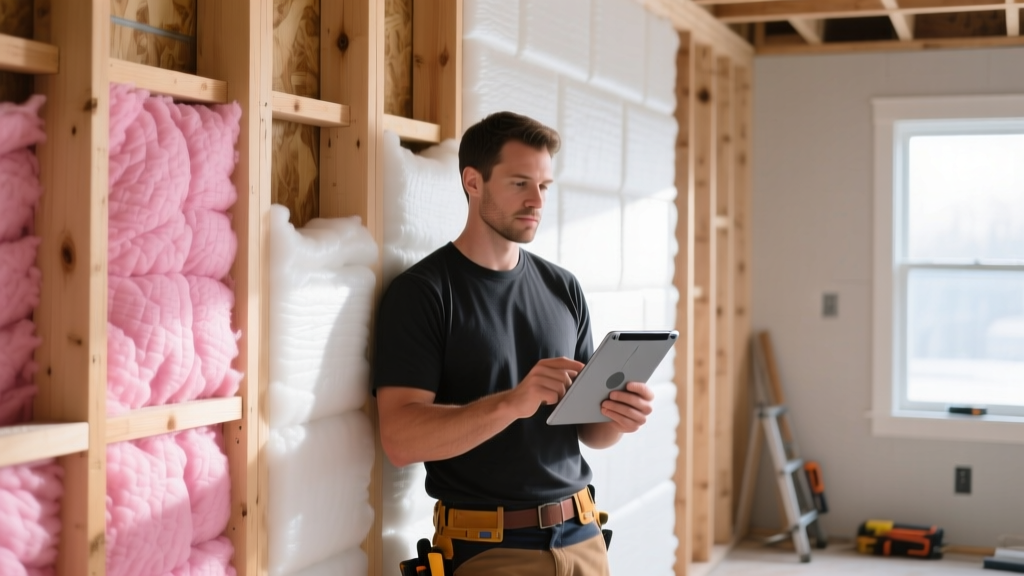
Spray Polyurethane Foam (SPF): The Premium Envelope
When analyzing materials that are insulators, Spray Polyurethane Foam (SPF) is unique because it serves as both the thermal barrier and the air sealant. SPF is priced by the board foot (1 square foot, 1 inch thick).
Open-Cell vs. Closed-Cell Financials
- Open-Cell (Low Density): Priced around $0.55 per board foot installed. It expands up to 100 times its liquid volume, easily filling irregular cavities and sealing around wiring. However, it is vapor-permeable and requires an additional vapor retarder in cold climates (Climate Zones 5 and above).
- Closed-Cell (Medium Density): Priced around $2.50 per board foot installed. It provides a structural racking strength increase to the wall assembly and acts as a Class II vapor retarder at just 1.5 inches thick. The high upfront cost is often offset by eliminating the need for separate vapor barriers and reducing the HVAC tonnage required for the home.
Rigid Foam Boards and the Thermal Drift Edge Case
Rigid foam boards are the standard for continuous exterior insulation (ci), which is required in many 2026 building codes to mitigate thermal bridging through wood studs. Extruded Polystyrene (XPS) and Polyisocyanurate (Polyiso) are the primary contenders.
Polyiso offers the highest R-value per inch (R-6.5) at a competitive material cost of $1.00 per square foot for 1-inch panels. However, buyers must account for thermal drift. According to research from the Building America Solution Center, the blowing agents used in polyiso can condense in extreme cold, causing the effective R-value to drop by 20% to 30% when exterior temperatures fall below 50°F. If you are building in a northern climate, XPS (which maintains a stable R-5.0 in freezing temps) or mineral wool boards are superior investments despite the higher baseline cost.
Calculating the Payback Period: An ROI Framework
To determine which materials that are insulators make financial sense for your specific project, use the Simple Payback Period formula:
Payback (Years) = Additional Insulation Cost / Annual Energy Savings
Scenario: Upgrading a 2,500 sq ft exterior wall assembly in Climate Zone 5 from R-13 (standard fiberglass) to R-21 (mineral wool + 1-inch exterior XPS). The upgraded materials and labor add $3,200 to the build. Based on current regional utility rates and U.S. Department of Energy heating load models, this upgrade saves $410 annually on HVAC costs. The simple payback is 7.8 years. Given that the insulation will last 50+ years, the lifecycle ROI is highly positive, not including the increased resale value of a high-performance home.
Hidden Costs That Derail Insulation Budgets
When drafting your material takeoffs, ensure you have line items for the following ancillary costs that frequently cause budget overruns:
- Acoustic Isolation Upgrades: Standard insulation does little for sound transmission. Upgrading interior partition walls to ROCKWOOL Safe'n'Sound adds roughly $0.45 per square foot in material costs but drastically improves the Sound Transmission Class (STC) rating.
- SPF Off-Gassing and Re-Entry: Closed-cell spray foam requires the site to be vacated for 24 to 48 hours during and after application. For custom builds, this can delay drywallers and trim carpenters, adding carrying costs to the construction loan.
- Disposal and Waste Management: Rigid foam boards generate massive volume waste during cutting. Budget for an additional dumpster pull or dedicated trailer space specifically for foam offcuts, which cannot be compacted easily.
Strategic Sourcing: How to Lower Your Insulation Spend
Procurement strategy heavily influences the final cost of materials that are insulators. Instead of purchasing batts from big-box retail, set up a commercial account with specialized distributors like Foundation Building Materials (FBM) or ABC Supply. Buying in full bunk quantities (typically 1,000 to 1,500 square feet) yields a 12% to 18% discount over retail pricing. Furthermore, schedule your SPF application during the shoulder seasons (early spring or late fall); many foam contractors lower their per-board-foot rates by 5% to 10% to keep their crews busy outside the peak summer construction rush.
Written by
Priya KapoorPriya Kapoor is a real estate market analyst and construction economics researcher with expertise in housing affordability, development feasibility, and infrastructure investment. She holds a Master of Regional Planning from Cornell University and previously worked as a senior analyst at CBRE's Investment Properties group, where she modeled returns for $4B in mixed-use development pipelines. Priya now runs an independent research practice advising developers, municipalities, and REITs on construction cost forecasting and market timing. She publishes the quarterly "BuildMat Market Pulse" report tracking material price indices across 12 commodity categories. Based in Austin, TX, Priya serves on the board of Habitat for Humanity Austin and is a marathon runner.
More from Priya Kapoor
View all
Construction Cost
Cost to Build a 1600 Sq Ft Home in 2026: Full Breakdown
Accurate 2026 cost to build a 1600 sq ft home—material, labor, and regional pricing breakdowns included. Plan your budget with real-time estimates.
Aug 11, 2026

Wood & Lumber
Name the Types of Wood for Pressure Treatment and Preservation
Learn how to name the types of wood best suited for pressure treatment. Compare species treatability, chemical retention levels, and 2026 preservation costs.
Aug 4, 2026

Stone & Masonry
Stone Veneer Suppliers Lindenhurst: 2026 Cost Analysis
Analyze 2026 stone veneer costs in Lindenhurst, NY. Compare local supplier pricing, delivery fees, and Suffolk County installation labor rates.
Aug 4, 2026