Selecting the Best Thermal Insulation Material: A Pro Framework
Discover the professional selection framework for the best thermal insulation material. Compare R-values, moisture dynamics, and costs for modern builds.

The Myth of the Universal 'Best' Insulation
There is no single best thermal insulation material. The optimal choice for a vented attic in a hot-humid climate like Florida will cause catastrophic moisture accumulation if used in an unvented cathedral ceiling in Minnesota. Professional builders and architects do not select insulation based on marketing claims or nominal R-values alone. Instead, they use a multi-variable selection framework that weighs effective thermal resistance, moisture dynamics, fire performance, and lifecycle environmental impact.
This guide provides the exact decision-making framework used by building science professionals to specify insulation systems that meet the rigorous demands of modern energy codes and long-term durability standards.
Pillar 1: Effective Thermal Resistance vs. Nominal R-Value
The most common mistake in material selection is relying solely on the center-of-cavity nominal R-value printed on the packaging. Real-world thermal performance is dictated by effective R-value, which accounts for thermal bridging, installation quality, and temperature-dependent degradation.
The Cold-Temperature Polyiso Penalty
Polyisocyanurate (polyiso) is widely specified for continuous exterior insulation due to its high nominal R-value (typically R-6.5 per inch at 75°F). However, the blowing agents trapped in the closed cells of polyiso condense at lower temperatures. According to extensive testing by building science researchers, the R-value of standard polyiso can drop to R-4.5 or lower per inch when exterior temperatures fall below 25°F.
Conversely, Extruded Polystyrene (XPS) and Expanded Polystyrene (EPS) do not suffer from this cold-temperature penalty. In fact, their thermal resistance slightly improves as temperatures drop. For continuous exterior insulation in IECC Climate Zones 5 and above, specifying XPS or EPS often yields a higher effective winter R-value than polyiso, despite polyiso's higher laboratory rating at room temperature. The Department of Energy emphasizes that understanding these temperature-dependent properties is critical for accurate energy modeling.
Pillar 2: Moisture Dynamics and Vapor Permeability
Insulation materials dictate the drying potential of a wall or roof assembly. Selecting a material with the wrong vapor permeability profile traps moisture, leading to sheathing rot and mold. Materials are categorized by their perms (water vapor transmission rate):
- Vapor Impermeable (Class I, < 0.1 perms): Closed-cell spray polyurethane foam (ccSPF), foil-faced polyiso, XPS.
- Vapor Semi-Impermeable (Class II, 0.1 - 1.0 perms): Unfaced XPS, certain kraft-faced fiberglass batts.
- Vapor Open (Class III, > 1.0 perms): Mineral wool, unfaced fiberglass, cellulose, EPS.
The Dew Point Calculation Rule
When using vapor-impermeable insulation on the exterior of a wall assembly, the exterior R-value must be high enough to keep the structural sheathing above the dew point during winter. If the sheathing drops below the dew point, interior moisture migrating outward will condense on the cold wood. As detailed in the Building Science Corporation's guidelines on vapor barriers, the ratio of exterior to interior R-value must scale with the severity of the climate zone. In Climate Zone 6, at least 38% of the total wall R-value must be on the exterior of the sheathing to prevent condensation.
Pillar 3: Application-Specific Decision Matrix
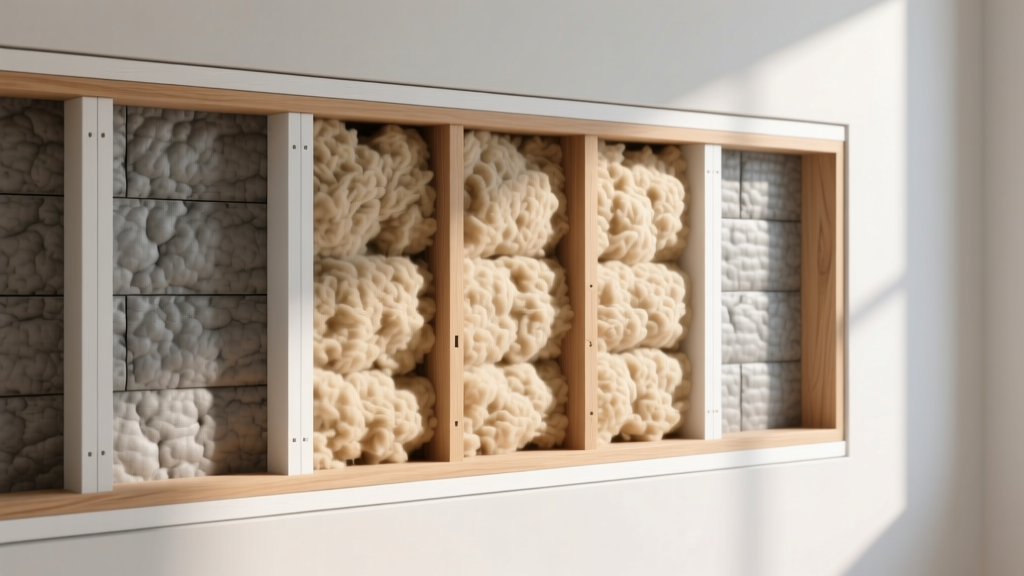
The best thermal insulation material shifts entirely based on the specific building assembly. Use this matrix to narrow down your material shortlist based on application constraints.
| Assembly Type | Optimal Material Choice | Key Technical Justification |
|---|---|---|
| Vented Attic Floor | Blown-in Cellulose or Fiberglass | Conforms to irregular joist bays; high R-value per dollar; cellulose offers superior air-sealing and fire-retardant properties. |
| Exterior Continuous (ci) | Mineral Wool (e.g., Rockwool Comfortboard 80) | Vapor open (allows outward drying); non-combustible (simplifies NFPA 285 compliance); maintains R-value in extreme cold. |
| Below-Grade Foundation | EPS or XPS (e.g., Owens Corning FOAMULAR NGX) | Closed-cell structure resists water absorption and hydrostatic pressure; retains R-value when buried in damp soil. |
| Unvented Cathedral Ceiling | Flash-and-Batt (ccSPF + Fiberglass) | 2 inches of closed-cell foam acts as an air/vapor barrier to prevent condensation at the roof deck, while cheaper batts fill the depth. |
Pillar 4: Environmental Impact and Blowing Agents
Modern material selection must account for Global Warming Potential (GWP). Historically, XPS and closed-cell spray foam relied on HFC blowing agents (like HFC-134a), which have a GWP over 1,400 times that of CO2. This meant the embodied carbon of the insulation could take 50+ years of operational energy savings to offset.
The industry has shifted toward Hydrofluoroolefin (HFO) blowing agents. Products like Owens Corning FOAMULAR NGX use HFOs with a GWP of less than 1. When specifying rigid foams or spray foam, always verify the technical data sheet for the specific blowing agent used. Selecting HFO-based or vapor-open mineral insulation drastically reduces the embodied carbon footprint of the building envelope.
The 5-Step Professional Selection Workflow
To systematically identify the best thermal insulation material for your specific project, execute this five-step workflow:
- Define the Climate Zone and Code Baseline: Identify your IECC Climate Zone and the local code amendments. Determine the minimum required R-values for both cavity and continuous insulation.
- Run a Dew Point Analysis: Use software like WUFI or a steady-state dew point calculator. Input your proposed interior and exterior R-values to ensure the structural sheathing remains above the dew point during the coldest design month.
- Evaluate Drying Potential: Ensure the assembly can dry in at least one direction. If you use an interior vapor retarder (like a Class I vinyl wallpaper or polyethylene), the exterior insulation must be highly vapor-open (e.g., mineral wool or unfaced EPS).
- Assess Structural and Fastening Loads: If using thick exterior continuous insulation (over 2 inches), standard nails will not suffice for cladding attachment. You must specify structural screws (e.g., Simpson Strong-Tie or FastenMaster) engineered for the specific insulation thickness and shear loads.
- Calculate Lifecycle ROI: Compare the upfront material and labor costs against the potential for HVAC downsizing. A highly optimized, airtight envelope with premium insulation often allows for a 20-30% reduction in HVAC tonnage, offsetting the insulation premium.
Final Specification Directives
Selecting the best thermal insulation material requires moving beyond basic R-value comparisons. By prioritizing effective thermal resistance in extreme temperatures, aligning vapor permeability with the assembly's drying potential, and accounting for the GWP of blowing agents, you ensure the building envelope performs efficiently and durably for decades. Always cross-reference manufacturer technical data sheets with independent building science research before finalizing your specifications.
Written by
Priya KapoorPriya Kapoor is a real estate market analyst and construction economics researcher with expertise in housing affordability, development feasibility, and infrastructure investment. She holds a Master of Regional Planning from Cornell University and previously worked as a senior analyst at CBRE's Investment Properties group, where she modeled returns for $4B in mixed-use development pipelines. Priya now runs an independent research practice advising developers, municipalities, and REITs on construction cost forecasting and market timing. She publishes the quarterly "BuildMat Market Pulse" report tracking material price indices across 12 commodity categories. Based in Austin, TX, Priya serves on the board of Habitat for Humanity Austin and is a marathon runner.
More from Priya Kapoor
View all
Construction Cost
Cost to Build a 1600 Sq Ft Home in 2026: Full Breakdown
Accurate 2026 cost to build a 1600 sq ft home—material, labor, and regional pricing breakdowns included. Plan your budget with real-time estimates.
Aug 11, 2026

Wood & Lumber
Name the Types of Wood for Pressure Treatment and Preservation
Learn how to name the types of wood best suited for pressure treatment. Compare species treatability, chemical retention levels, and 2026 preservation costs.
Aug 4, 2026

Stone & Masonry
Stone Veneer Suppliers Lindenhurst: 2026 Cost Analysis
Analyze 2026 stone veneer costs in Lindenhurst, NY. Compare local supplier pricing, delivery fees, and Suffolk County installation labor rates.
Aug 4, 2026