Cheap Insulation Materials Compared: R-Value vs Cost in 2026
Compare the best cheap insulation materials for 2026. We break down R-value, installed costs, and failure modes for fiberglass, cellulose, and EPS foam.

The True Cost of Budget Insulation: R-Value vs. Installed Price
When sourcing budget-friendly thermal barriers, contractors and DIYers often conflate low upfront material costs with long-term thermal efficiency. In 2026, with energy codes tightening and utility rates climbing, selecting cheap insulation materials requires a strict analysis of R-value per dollar, vapor permeability, and installation labor. A material that costs $0.30 per square foot but requires $1.50 in specialized labor or fails due to moisture intrusion is ultimately more expensive than a mid-tier alternative. According to the U.S. Department of Energy, the effectiveness of any insulation material is heavily dependent on proper installation and climate zone compatibility. This guide compares the four most cost-effective insulation materials on the market, breaking down exact pricing, thermal performance, and critical failure modes.
Always calculate the 'installed cost' rather than just the material cost. Blown-in cellulose has a remarkably low material cost, but requires renting a hopper blower ($150-$250/day) and a two-person crew, which can double the effective price per square foot for small projects.
2026 Material Comparison Matrix: Pricing & Thermal Performance
The table below outlines current market averages for the most affordable insulation categories. Pricing reflects national averages for Q1 2026 and may fluctuate based on regional supply chain variables.
| Material Type | Material Cost (per sq ft) | Installed Cost (per sq ft) | R-Value per Inch | Vapor Permeability |
|---|---|---|---|---|
| Fiberglass Batts | $0.45 - $0.65 | $1.10 - $1.50 | R-3.1 to R-3.4 | High (unless Kraft-faced) |
| Blown-In Cellulose | $0.35 - $0.50 | $0.85 - $1.20 | R-3.2 to R-3.8 | High |
| EPS Rigid Foam | $0.40 - $0.60 | $0.95 - $1.40 | R-3.6 to R-4.0 | Medium (Semi-permeable) |
| Perforated Radiant Foil | $0.15 - $0.30 | $0.50 - $0.80 | N/A (Radiant Control) | High (if perforated) |
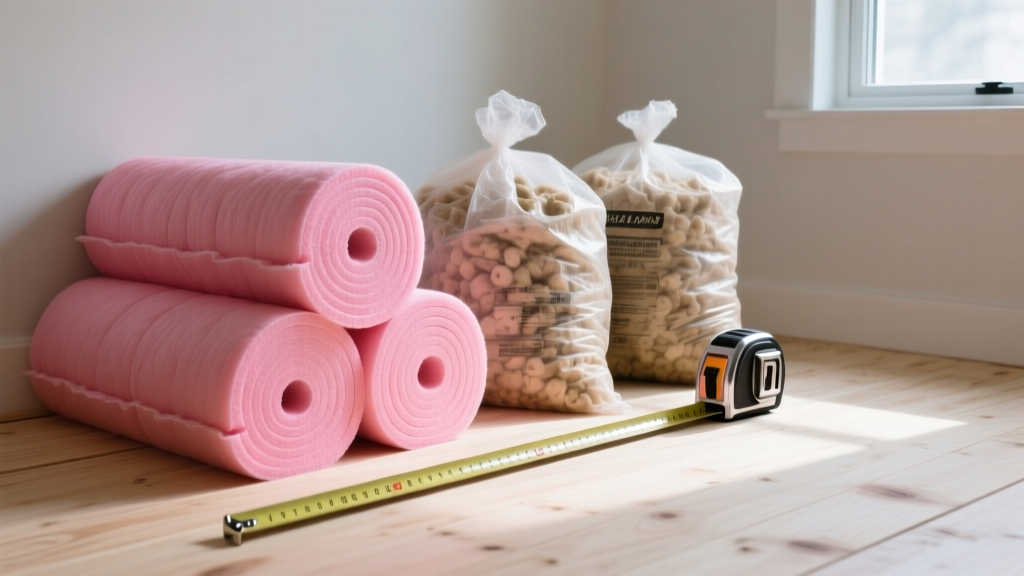
Deep Dive: Top 4 Budget Insulation Materials
1. Fiberglass Batts (The Baseline Budget Option)
Fiberglass remains the undisputed volume leader in budget insulation. Products like Knauf EcoBatt Kraft or Owens Corning PINK are widely available and require no specialized equipment to install. The Federal Trade Commission mandates strict R-value labeling on these products, making comparison shopping straightforward.
- Best Application: Standard 16-inch on-center wood framing in new construction or open-wall renovations.
- The R-15 Upgrade: For 2x4 walls, standard R-13 batts are exactly 15 inches wide. Upgrading to R-15 batts (which are manufactured at 15.5 inches) provides a superior friction fit, eliminating the micro-gaps at the edges that cause thermal bridging and convective heat loss.
- Failure Mode - Compression: Stuffing an R-19 batt (6.25 inches thick) into a standard 2x4 wall cavity (3.5 inches deep) does not yield R-19. The compression increases thermal conductivity, dropping the effective R-value to roughly R-13 while wasting material costs.
2. Blown-In Cellulose (Best for Retrofits & Air Sealing)
Made from recycled newsprint treated with borate for fire and pest resistance, cellulose (such as Greenfiber) is exceptionally cheap at the material level. Its primary advantage is its ability to flow around wiring, plumbing, and irregular framing, creating a monolithic thermal barrier that fiberglass batts cannot match.
- Best Application: Attic floor blow-ins and dense-pack closed wall cavities.
- Density Requirements: For open-blown attic applications, cellulose must be installed at a minimum density of 1.5 pounds per cubic foot (pcf). For dense-pack wall cavities, the target is 3.5 pcf to prevent settling.
- Failure Mode - Settling: If installed too loosely in an attic, cellulose can settle by up to 20% over the first two years, leaving the top plates of exterior walls exposed and creating massive thermal leaks.
3. Expanded Polystyrene (EPS) Rigid Foam
EPS is the white, beaded foam board commonly used in packaging, but construction-grade EPS (like Insulfoam) is a highly effective, low-cost continuous insulation. Unlike XPS or Polyiso, EPS does not suffer from thermal drift (the loss of R-value over time as blowing gases escape), meaning its R-3.8 per inch rating is permanent.
- Best Application: Exterior continuous insulation, basement rim joists, and under-slab applications (using Type II or higher).
- Type I vs. Type II: Type I EPS has a compressive strength of 15 psi and is very cheap, but it crumbles easily and is unsuitable for load-bearing applications. Type II (22 psi) costs roughly 15% more but is mandatory for under-concrete slab insulation.
- Failure Mode - Solvent Degradation: EPS is highly reactive to petroleum-based solvents. Using standard construction adhesives or spray foams containing volatile organic compounds (VOCs) will literally melt the foam board on contact. Always use EPS-compatible adhesives.
4. Perforated Radiant Barrier (The Climate-Specific Wildcard)
Radiant barriers do not have a traditional R-value; instead, they reflect up to 97% of radiant heat transfer. They are incredibly cheap but highly misunderstood. They only work when facing an air space and are only effective in hot, sunny climates (IECC Climate Zones 1 through 3).
- Best Application: Stapled to the underside of roof rafters in vented attics in the Southern United States.
- Failure Mode - Moisture Trapping: You must use perforated radiant barrier foil in attics. Non-perforated foil acts as a Class I vapor retarder. In a vented attic, humidity rising from the living space will hit the cold foil, condense, and rot the roof decking.
Decision Framework: Matching Material to the Project
Selecting the right cheap insulation material depends entirely on the geometry and accessibility of your project. Use this framework to make your purchasing decision:
Project Type A: Unfinished Attic Floor
Winner: Blown-In Cellulose.
Why: It covers irregular joist spacing and buries top plates seamlessly. Fiberglass batts leave gaps at the edges and are difficult to cut around HVAC ductwork and chimneys.
Project Type B: New Construction Wood Framing
Winner: Fiberglass Batts (R-15 for 2x4 walls).
Why: Lowest labor cost. Framers or insulation subs can install thousands of square feet per day without specialized machinery.
Project Type C: Basement Rim Joists & Concrete Walls
Winner: EPS Rigid Foam.
Why: Cellulose and fiberglass will absorb ambient basement moisture and harbor mold. EPS is semi-impermeable and can be sealed with EPS-compatible spray foam to create an airtight, moisture-resistant barrier.
Critical Installation Failures to Avoid
Budget materials leave zero margin for error. Because they lack the advanced moisture-management properties of premium closed-cell spray foam, cheap insulation materials demand strict adherence to building science principles.
Never install Kraft-faced fiberglass batts (which have a built-in vapor retarder) on the exterior side of a wall assembly in a mixed or heating climate. If moisture penetrates the exterior cladding, it will hit the Kraft paper, condense inside the wall cavity, and rot the OSB sheathing. In retrofit scenarios, always use unfaced batts and rely on interior latex paint as your vapor control layer.
Ultimately, the cheapest insulation material is the one that performs correctly for the lifespan of the building. By matching the specific physical properties of fiberglass, cellulose, EPS, or radiant barriers to your exact climate zone and framing geometry, you can achieve premium thermal performance on a strict budget.
Written by
Priya KapoorPriya Kapoor is a real estate market analyst and construction economics researcher with expertise in housing affordability, development feasibility, and infrastructure investment. She holds a Master of Regional Planning from Cornell University and previously worked as a senior analyst at CBRE's Investment Properties group, where she modeled returns for $4B in mixed-use development pipelines. Priya now runs an independent research practice advising developers, municipalities, and REITs on construction cost forecasting and market timing. She publishes the quarterly "BuildMat Market Pulse" report tracking material price indices across 12 commodity categories. Based in Austin, TX, Priya serves on the board of Habitat for Humanity Austin and is a marathon runner.
More from Priya Kapoor
View all
Construction Cost
Cost to Build a 1600 Sq Ft Home in 2026: Full Breakdown
Accurate 2026 cost to build a 1600 sq ft home—material, labor, and regional pricing breakdowns included. Plan your budget with real-time estimates.
Aug 11, 2026

Wood & Lumber
Name the Types of Wood for Pressure Treatment and Preservation
Learn how to name the types of wood best suited for pressure treatment. Compare species treatability, chemical retention levels, and 2026 preservation costs.
Aug 4, 2026

Stone & Masonry
Stone Veneer Suppliers Lindenhurst: 2026 Cost Analysis
Analyze 2026 stone veneer costs in Lindenhurst, NY. Compare local supplier pricing, delivery fees, and Suffolk County installation labor rates.
Aug 4, 2026