What Materials Make Good Insulators From Heat? Selection Framework
Discover what materials make good insulators from heat. Use our selection framework comparing R-values, costs, and applications for optimal thermal control.

The Physics of Thermal Resistance: Beyond Basic R-Values
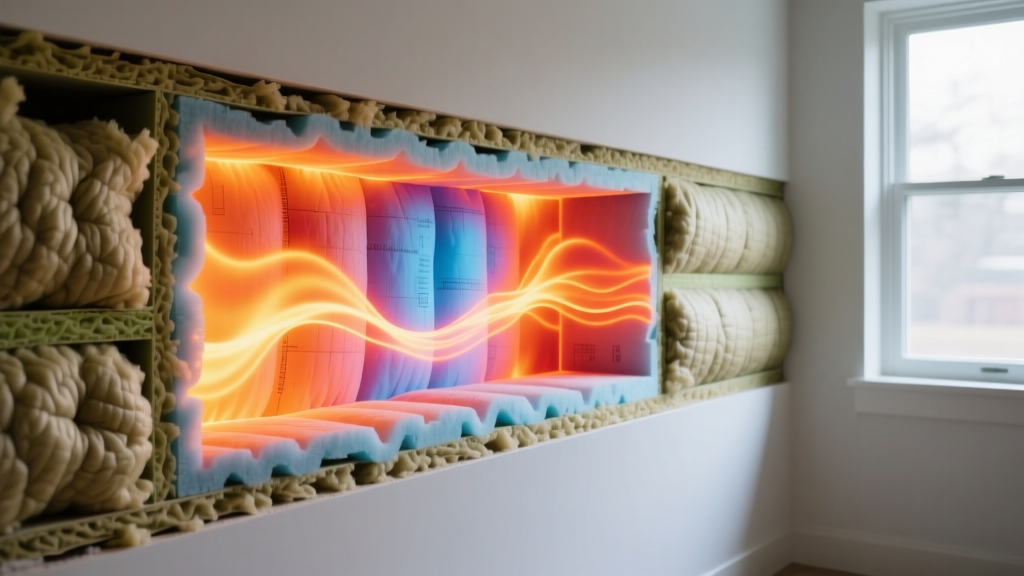
When evaluating what materials make good insulators from heat, the construction industry defaults to R-value (thermal resistance). However, relying solely on center-of-cavity R-value leads to severe performance gaps in modern building envelopes. Heat transfers via conduction, convection, and radiation. A true selection framework must account for thermal bridging through framing, air leakage (convection), and the material's emissivity.
According to the U.S. Department of Energy, the effective 'whole-wall' R-value of a standard 2x6 wood-framed wall with R-19 fiberglass batts is often closer to R-14 due to thermal bridging at the studs, plates, and headers. Therefore, selecting an insulator requires matching the material's physical properties—vapor permeability, density, and air-sealing capabilities—to the specific hygrothermal demands of the assembly.
Material Matrix: Thermal Performance and 2026 Cost Data
The following matrix breaks down the primary commercial and residential insulators, comparing their thermal resistance per inch, vapor characteristics, and current installed material costs.
| Insulation Material | R-Value per Inch | Vapor Permeability | Est. Material Cost (2026) | Primary Mechanism |
|---|---|---|---|---|
| Fiberglass Batts (High-Density) | 3.6 - 4.3 | High (Permeable) | $0.60 - $1.20 / sq ft | Traps air in glass fibers |
| Closed-Cell Spray Foam (ccSPF) | 6.5 - 7.0 | Low (Class II Retarder) | $1.50 - $3.00 / board ft | Traps blowing gas in cells |
| Polyisocyanurate (Polyiso) | 6.0 - 6.8 (at 75°F) | Very Low (Foil-faced) | $0.75 - $1.25 / board ft | Reflective foil + gas cells |
| Mineral Wool (Stone Wool) | 4.0 - 4.3 | High (Permeable) | $1.10 - $1.60 / sq ft | Dense stone fiber matrix |
| Expanded Polystyrene (EPS) | 3.6 - 4.2 | Moderate | $0.40 - $0.80 / board ft | Traps air in beads |
| Aerogel Blanket (e.g., Spaceloft) | 10.0 - 10.3 | Moderate (Breathable) | $3.50 - $5.50 / sq ft | Nanoporous silica structure |
The Selection Framework: Matching Material to Assembly
Choosing the right material requires a systematic approach based on the Building Science Corporation's principles of enclosure design. Use this decision tree to specify materials based on spatial, moisture, and structural constraints.
1. Space-Constrained Assemblies (Exterior Retrofits & Rim Joists)
When cavity depth is limited, maximizing R-value per inch is critical.
- Primary Selection: Closed-cell spray foam (ccSPF) or Polyisocyanurate rigid boards.
- Application: Rim joists, cathedral ceilings, and exterior continuous insulation (ci).
- Technical Caveat: ccSPF provides structural racking strength and acts as a vapor retarder, eliminating the need for separate air/vapor barriers in mixed-humid climates. However, it is highly sensitive to installation temperature; substrate must be above 60°F for proper adhesion and cell structure formation.
2. High-Moisture and Below-Grade Zones
Below-grade walls and slabs are in direct contact with damp soil. Materials here must resist bulk water and maintain R-value when wet.
- Primary Selection: Extruded Polystyrene (XPS) or High-Density EPS (Type II or IX).
- Application: Foundation walls, under-slab insulation, and plaza decks.
- Technical Caveat: While XPS has a higher initial R-value (R-5.0/inch), its blowing agents diffuse over time, and it absorbs more moisture long-term than properly graded EPS. For deep foundations, 2-inch EPS Type IX (R-8.4 total) often outperforms XPS over a 50-year lifecycle due to zero thermal drift and lower moisture retention.
3. Fire-Rated and Acoustic Partitions
Commercial shaft walls and multi-family demising walls require non-combustible materials that also dampen sound transmission.
- Primary Selection: Mineral Wool (e.g., ROCKWOOL Comfortboard 80 or Safe'n'Sound).
- Application: Interior partition walls, exterior continuous insulation in high-fire-risk zones (WUI).
- Technical Caveat: Mineral wool is inherently fire-resistant (withstanding temperatures up to 2,150°F) and its high density (8 lbs/ft³ for exterior boards) significantly improves Sound Transmission Class (STC) ratings compared to lightweight fiberglass.
Always align the material's vapor permeability with the dominant seasonal vapor drive. In cold climates (IECC Zones 5-8), use low-perm materials (like foil-faced polyiso or interior ccSPF) on the interior warm side to prevent interstitial condensation. In hot-humid climates (Zones 1-3), the vapor drive reverses; use vapor-permeable materials (like mineral wool or unfaced fiberglass) and place the vapor retarder on the exterior.
Advanced Edge Cases and Material Failures
Specifying what materials make good insulators from heat also requires understanding where specific materials fail under real-world conditions.
The Polyiso Thermal Drift Phenomenon
Polyisocyanurate is widely specified for exterior continuous insulation due to its high R-value and foil facers. However, the blowing gases inside the closed cells condense at low temperatures. At 25°F (-4°C), the effective R-value of polyiso drops from 6.8 to approximately 5.2 per inch. In Climate Zones 6 and above, energy modelers must use the material's cold-weather Long-Term Thermal Resistance (LTTR) rating to prevent undersizing the exterior insulation layer, which can lead to sheathing condensation.
Fiberglass Compression and Convective Looping
Fiberglass batts rely on trapped, stagnant air for thermal resistance. If a 5.5-inch R-19 batt is compressed into a 2x4 wall cavity (3.5 inches), its R-value does not scale linearly; it drops to roughly R-12. Furthermore, in tall wall cavities without proper air sealing, temperature differentials create convective loops within the batt, degrading performance by up to 30%. Always pair fiberglass with a dedicated fluid-applied or taped membrane air barrier.
Calculating the Thermal ROI: Cost vs. Energy Savings
To determine the financial viability of upgrading from a code-minimum insulator to a high-performance alternative, use the Simple Payback Period formula:
Payback Period (Years) = (Incremental Material + Labor Cost) / (Annual Energy Savings per Square Foot)
For example, upgrading an attic from code-minimum R-38 blown fiberglass ($0.85/sq ft) to R-60 open-cell spray foam ($2.20/sq ft) in a 1,500 sq ft attic yields an incremental cost of roughly $2,025. If local energy modeling (via RESNET-certified software) projects $310 in annual HVAC savings based on current utility rates, the payback period is 6.5 years. According to the Environmental Protection Agency, properly air-sealing and insulating these bypasses yields the highest ROI of any envelope upgrade, often outperforming window replacements by a factor of three.
Next-Generation Insulators: Aerogels and Vacuum Panels
For ultra-high-performance retrofits where wall thickness cannot be altered, silica aerogel blankets (like Aspen Aerogels Spaceloft) offer R-10.3 per inch at a mere 10mm thickness. While currently cost-prohibitive for whole-home applications ($4.00+ per sq ft), they are the definitive solution for insulating historic masonry facades, structural steel columns, and tight mechanical chases where traditional rigid foams simply will not fit. As manufacturing scales through 2026, expect aerogel-infused plasters and vacuum insulation panels (VIPs) to transition from commercial anomalies to viable residential solutions for passive house certifications.
Written by
Marcus ChenMarcus Chen is a licensed structural engineer (PE) and building materials analyst with over 12 years of experience across residential, commercial, and industrial construction. He holds a Master of Science in Civil Engineering from UC Berkeley and spent six years at Thornton Tomasetti before transitioning to independent consulting and technical writing. Marcus specializes in material selection for seismic-prone regions, concrete reinforcement strategies, and lifecycle cost analysis. His work has been cited by the American Concrete Institute (ACI) and the Structural Engineers Association of California (SEAOC). When he is not on a job site or at his desk, you will find him hiking the Sierra Nevada or restoring a 1920s craftsman bungalow in Oakland, CA.
More from Marcus Chen
View all
Construction Cost
How Much Did the Eiffel Tower Cost to Build?
How much did the Eiffel Tower cost to build in 1889? We adjust for inflation and compare its budget to modern skyscraper construction.
Aug 4, 2026

Fire Resistance
What Is a Fire Resistant Material? Testing & Certification Guide
Discover what is a fire resistant material through ASTM and UL testing. Learn how fire ratings, certifications, and assemblies work in construction.
Aug 4, 2026

Construction Cost
How Much Did the Burj Khalifa Cost to Build?
How much did the Burj Khalifa cost to build? We break down the $1.5B project and extract 5 money-saving strategies for your next build.
Jul 30, 2026