Which Material Is the Best Insulator for Sound Control and Acoustics?
Discover which material is the best insulator for sound control. Compare STC ratings, costs, and acoustic strategies for mineral wool, MLV, and fiberglass.

The Dual Meaning of 'Insulator': Thermal vs. Acoustic
When builders and homeowners ask, "which material is the best insulator," they are almost exclusively thinking about winter heating bills and summer cooling loads. But in the specialized field of acoustic engineering and sound control, the definition of an insulator shifts dramatically. Thermal insulation works by trapping pockets of air to slow conductive heat transfer. Acoustic insulation, however, must manage kinetic energy, mass, and structural vibration.
A material that is a superstar for thermal resistance (R-value) might be entirely useless for blocking sound transmission. To answer the question of which material is the best insulator for sound control, we must abandon the R-value metric entirely and evaluate materials based on density, internal friction, and decoupling capabilities.
Decoding the Metrics: STC vs. NRC
Before selecting a material, you must define the acoustic problem. Sound control relies on two distinct metrics, and the "best" material depends on which metric you are trying to optimize:
- Sound Transmission Class (STC): Measures a partition's ability to block sound from traveling from one room to another. A standard interior wall has an STC of 33 (you can hear normal speech). A luxury hotel wall targets an STC of 50+ (loud speech is inaudible).
- Noise Reduction Coefficient (NRC): Measures a material's ability to absorb sound within a room, reducing echo and reverberation. NRC ranges from 0.0 (perfect reflection, like concrete) to 1.0 (perfect absorption).
Material Showdown: Which Material Is the Best Insulator for Sound?
Based on 2026 building material performance data and Building Science Corporation enclosure guidelines, here is how the top acoustic materials compare when installed in a standard 2x4 wood-framed wall cavity.
| Material | Density (pcf) | STC Boost (in 2x4 wall) | NRC Rating | 2026 Cost / Sq Ft |
|---|---|---|---|---|
| Mineral Wool (e.g., Rockwool Safe'n'Sound) | 2.5 | +5 to +7 | 1.05 | $1.25 - $1.50 |
| Fiberglass (e.g., Owens Corning QuietZone) | 1.2 | +3 to +5 | 0.95 | $0.85 - $1.10 |
| Mass Loaded Vinyl (1 lb/sqft MLV) | N/A (Limp Mass) | +25 to +30* | 0.00 | $2.80 - $3.50 |
| Closed-Cell Spray Foam | 2.0 | +1 to +2 | 0.05 | $3.00 - $4.50 |
| Open-Cell Spray Foam | 0.5 | +2 to +3 | 0.70 | $1.50 - $2.25 |
*Note: MLV STC boost assumes it is properly decoupled using resilient channels or sound isolation clips, not just stapled to a stud.
1. Mineral Wool: The Heavyweight Champion
If forced to answer which material is the best insulator for overall interior sound control, mineral wool takes the top spot. Unlike exterior mineral wool boards (which boast densities of 8 pcf or higher for structural rigidity), acoustic mineral wool batts like Rockwool Safe'n'Sound are engineered at roughly 2.5 pcf. This specific, lower density creates a highly porous, fibrous matrix. When sound waves enter this matrix, the air particles vibrate against the stone wool fibers, creating friction that converts acoustic energy into trace amounts of heat. It excels at dampening mid-to-high frequency noises like speech and television audio.
2. Mass Loaded Vinyl (MLV): The Flanking Blocker
MLV is not a traditional "batt" insulation; it is a limp mass barrier. It does not absorb sound (NRC of 0.0); it reflects and dampens it. MLV is the undisputed best insulator for low-frequency, structure-borne noise like bass from a subwoofer or the rumble of a nearby highway. However, it only works if it is mechanically decoupled from the drywall. If you screw MLV directly to a stud alongside drywall, you create a rigid bridge, negating its acoustic benefits.
3. Spray Foam: The Thermal Star, Acoustic Dud
Many homeowners mistakenly believe that because closed-cell spray foam is an incredible thermal insulator (R-7 per inch), it must be great for sound. This is a costly error. Closed-cell foam cures into a rigid, dense plastic. Rather than absorbing sound, it acts as a structural bridge, transmitting low-frequency vibrations directly from the drywall to the studs. Open-cell foam is slightly better due to its spongy texture, but it still falls far short of fibrous mineral wool or fiberglass for acoustic damping.
The 'If-Then' Soundproofing Decision Framework
Selecting the right material requires matching the assembly to the specific noise profile. Use this framework based on National Institute of Building Sciences (NIBS) acoustical design principles:
Scenario A: Shared Condo / Bedroom Wall
The Problem: Hearing neighbors talking or TVs through the partition.
The Fix: Decouple the wall using resilient channels. Fill the 2x4 cavity with Mineral Wool. Add a layer of MLV over the channels, followed by 5/8-inch Type X drywall. Target STC: 55.
Scenario B: Dedicated Home Theater
The Problem: Bass frequencies escaping the room and internal echo ruining audio clarity.
The Fix: Use staggered-stud or double-stud framing (true decoupling). Fill cavities with Mineral Wool. Apply Green Glue damping compound between two layers of 5/8-inch drywall. Treat internal reflection points with fabric-wrapped fiberglass acoustic panels (NRC 1.0).
Scenario C: HVAC and Plumbing Noise
The Problem: Air rush noise from ducts or water hammer from PVC/cast iron drain lines.
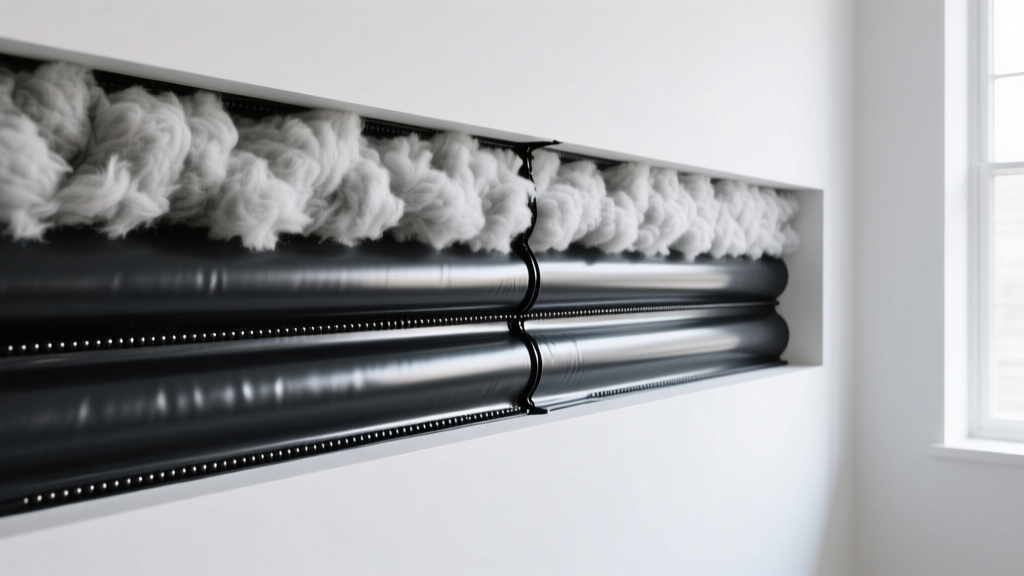
The Fix: Do not use wall batts here. Wrap ductwork and drain pipes in 1 lb MLV combined with a closed-cell foam decoupling layer. Seal all duct joints with mastic to prevent air leakage noise.
Scenario D: Exterior Traffic / Aircraft Noise
The Problem: High-decibel, broad-spectrum noise penetrating the exterior envelope.
The Fix: Acoustic insulation in the wall cavity won't solve this alone. You must upgrade the weakest link: the windows. Install laminated glass (STC 35+). In the walls, use Open-Cell Spray Foam to perfectly seal micro-gaps, combined with exterior continuous mineral wool board.
Critical Installation Failures That Ruin STC Ratings
You can buy the most expensive acoustic materials on the market, but a single installation error will drop your wall's STC rating by 10 to 15 points. Sound behaves like water; it will find the path of least resistance. Avoid these common failure modes:
WARNING: The Compression Myth
Never forcefully compress a thicker batt (like an R-19 or R-30) into a standard 2x4 (3.5-inch) wall cavity to "pack it tight." Compressing fibrous insulation destroys the air pockets required for acoustic friction. It actually turns the insulation into a solid acoustic bridge, increasing sound transmission. Always buy batts sized exactly for the cavity depth.
- Flanking Paths at the Top Plate: If the drywall on both sides of a wall meets at the top plate without an acoustic break, sound will travel up one wall, across the top plate, and down the other. Fix: Stagger the drywall layers or use acoustic sealant at the top plate junction.
- Back-to-Back Electrical Boxes: Installing electrical outlets directly opposite each other on a shared wall creates a massive hole in your acoustic barrier. Fix: Stagger outlets by at least 24 inches, and wrap the back of the electrical boxes with MLV or apply acoustic putty pads.
- Missing Acoustic Sealant: Standard latex caulk hardens and cracks, transmitting vibration. You must use a non-hardening, viscoelastic acoustic sealant (like OSI SC-175 or Tremco) at the perimeter of the drywall, where it meets the floor and ceiling. A 1/8-inch gap left unsealed at the bottom of a 10-foot wall will reduce the wall's overall STC by up to 20%.
Summary: Making the Final Material Selection
Determining which material is the best insulator for sound control ultimately depends on your specific architectural assembly and budget. For standard interior partitions where speech privacy is the goal, mineral wool batts offer the highest ROI, combining excellent NRC and STC improvements at roughly $1.35 per square foot. For low-frequency impact noise and high-performance home theaters, Mass Loaded Vinyl paired with mechanical decoupling is non-negotiable. By prioritizing mass, damping, and decoupling over simple thermal R-values, you can engineer interior spaces that deliver true acoustic comfort.
Written by
Sarah WhitfieldSarah Whitfield is a chartered quantity surveyor (MRICS) and construction cost analyst with 15 years of experience in material pricing, procurement strategy, and project budgeting. She earned her degree in Construction Management from the University of Reading (UK) and has worked on projects ranging from $2M custom homes to $180M mixed-use developments across North America and Europe. Sarah currently leads cost estimating for BuildMat Insight, maintaining a proprietary database of 4,000+ material price points updated quarterly. She is a frequent contributor to RSMeans cost data panels and has presented at the International Cost Engineering Council (ICEC) congress. Based in Denver, CO, Sarah is an avid trail runner and volunteer mentor for Women in Construction.
More from Sarah Whitfield
View all
Wood & Lumber
What Are the Different Types of Wood? A Builder's Guide
Compare structural softwoods, finish hardwoods, and engineered lumber. Analyze Janka ratings, MOE values, and 2026 pricing for construction.
Aug 4, 2026

Walls & Panels
Steel Framing vs Wood Framing: Corrosion and Moisture Defense
Compare steel framing vs wood framing for moisture resistance. Learn about galvanized coatings, condensation risks, and corrosion protection strategies.
Jul 21, 2026

Stone & Masonry
How to Cut Stone Veneer: Wet Saw vs Grinder Comparison
Compare the best tools for cutting stone veneer. We review wet saws, angle grinders, and chop saws to help you achieve clean, chip-free cuts.
Jul 21, 2026