What Typical Materials Used in a Class F Insulation System Include
Discover what typical materials used in a Class F insulation system include, comparing R-values, firestop F-ratings, and high-temp mechanical performance.

The 'Class F' Designation in Building Insulation: Clearing the Confusion
When reviewing mechanical, electrical, and fire-safety specifications, engineers and contractors frequently ask what typical materials used in a Class F insulation system include. In the building construction and industrial sectors, the term 'Class F' is a notorious point of confusion because it applies to two entirely distinct performance categories depending on the context. It either refers to F-Rated firestop penetration systems (which maintain the fire and thermal continuity of insulated wall/floor assemblies) or Class F (155°C) high-temperature mechanical insulation used in industrial and commercial boiler rooms.
Understanding which 'Class F' your project requires is critical for maintaining target R-values and passing municipal inspections. Below, we break down the exact materials, thermal performance metrics, and R-value degradation curves for both systems.
F-Rated Firestop Insulation Systems (ASTM E814)
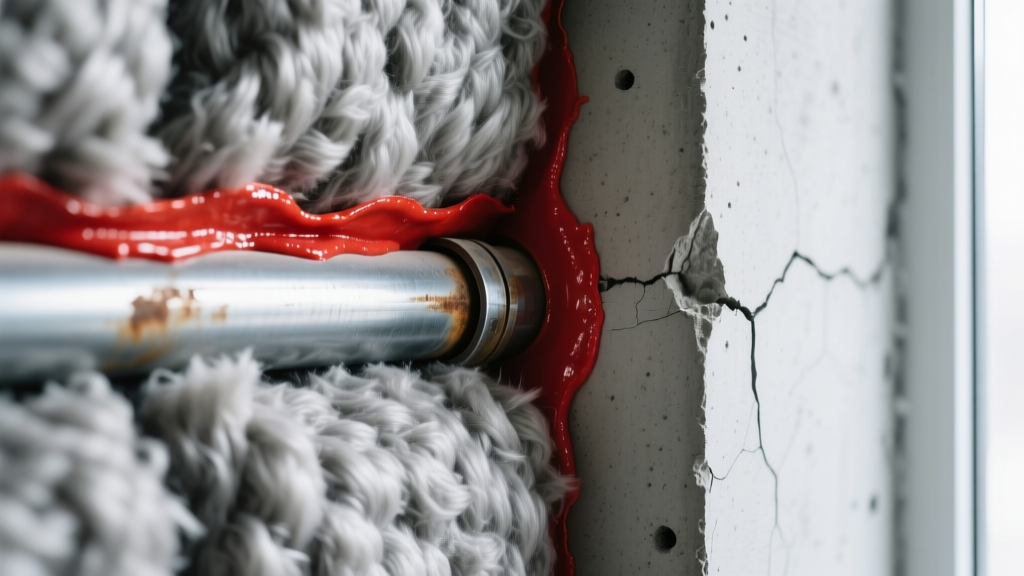
In commercial framing and fire-rated assemblies, an 'F-Rating' (Flame Rating) dictates the number of hours a firestop system can prevent flame passage through a penetration. When insulated pipes or HVAC ducts penetrate a fire-rated wall, the insulation itself must be part of the firestop system to prevent thermal bridging and smoke leakage. According to ASTM E814 testing standards, the materials used here must withstand intense heat while maintaining their structural integrity.
High-Density Mineral Wool & Intumescent Matrices
The backbone of most F-rated insulated penetration systems is high-density, non-combustible mineral wool. Unlike standard thermal batts, firestop mineral wool (such as ROCKWOOL Safe or Thermafiber FireBarrier) is manufactured to a minimum density of 8.0 lbs/ft³ (128 kg/m³). This density prevents the material from slumping or melting when exposed to temperatures exceeding 2,000°F (1,093°C).
- Base Insulation: Mineral wool batts cut 1-inch wider than the penetration to ensure a friction fit.
- Sealant Matrix: Intumescent elastomeric sealants (e.g., 3M Fire Barrier Sealant FD 150+) that expand up to 5 times their volume when heated, sealing off micro-gaps that standard foam would melt away from.
- R-Value Impact: Mineral wool provides an R-value of approximately R-4.0 to R-4.2 per inch. However, in firestop applications, the primary goal is thermal continuity rather than maximizing R-value.
Class F (155°C) High-Temperature Mechanical Insulation
In mechanical and electrical engineering, 'Class F' refers to thermal insulation systems rated for continuous operation at 155°C (311°F). This classification is standard for high-temperature steam lines, industrial exhaust ducts, and heavy-duty electrical conduit runs where standard fiberglass or polyisocyanurate would melt, off-gas, or lose all thermal resistance.
Calcium Silicate and High-Temp Fiberglass
To achieve stable R-values at 155°C and above, specifiers rely on inorganic, rigid, or semi-rigid materials that do not rely on organic binders (which burn off at high temperatures).
- Calcium Silicate (e.g., Johns Manville Thermo-1200): A rigid, pre-formed pipe and block insulation. It offers an R-value of roughly R-2.5 per inch at mean temperatures of 300°F. Its primary advantage is high compressive strength (150 psi), allowing it to support pipe weights without crushing.
- High-Temperature Fiberglass (e.g., Owens Corning Fiberglas 800 Series): A semi-rigid blanket insulation utilizing acrylic or high-temp silicone binders. It provides an R-value of R-3.1 to R-3.5 per inch and is highly flexible, making it ideal for irregularly shaped mechanical equipment.
- Ceramic Fiber Blankets: Used for extreme heat (up to 2,300°F), though typically overkill for standard Class F 155°C requirements. R-value is approximately R-1.5 per inch at elevated temperatures.
Thermal Performance & R-Value Matrix
| Material Type | Max Continuous Temp | R-Value per Inch (at 75°F) | R-Value per Inch (at 300°F) |
|---|---|---|---|
| High-Density Mineral Wool | 2,150°F (1,176°C) | R-4.2 | R-3.1 |
| Calcium Silicate | 1,200°F (649°C) | R-2.6 | R-2.1 |
| High-Temp Fiberglass | 850°F (454°C) | R-3.5 | R-2.8 |
| Ceramic Fiber Blanket | 2,300°F (1,260°C) | R-1.6 | R-1.1 |
R-Value Degradation at Elevated Temperatures
A critical mistake in specifying Class F mechanical insulation is assuming the published R-value remains constant. As the U.S. Department of Energy notes, R-value is inversely proportional to thermal conductivity, which increases as the mean temperature of the material rises.
For high-temperature piping systems, you must calculate the R-value based on the mean temperature (the average of the hot pipe surface temperature and the ambient room temperature). If a steam pipe operates at 400°F in a 70°F mechanical room, the mean temperature is 235°F. At this mean temperature, standard polyisocyanurate (which degrades and off-gases above 250°F) is entirely unsuitable. High-temp fiberglass or calcium silicate must be used, and the engineer must apply a thermal degradation multiplier (typically a 15% to 25% reduction in R-value) to ensure the exterior jacket remains below the 140°F OSHA touch-safety threshold.
2026 Specification and Cost Framework
Budgeting for Class F insulation systems requires accounting for both the raw material costs and the specialized labor required for firestop or high-temp metal jacketing. Below is a current pricing framework for commercial projects.
| System / Material | Unit Cost (Material Only) | Installed Cost (Approx.) | Primary Application |
|---|---|---|---|
| Firestop Mineral Wool (8lb) | $1.80 - $2.40 / sq ft | $4.50 - $6.00 / sq ft | F-Rated Wall Penetrations |
| Intumescent Sealant (30oz) | $22.00 - $35.00 / tube | N/A (Priced per penetration) | Annular Space Sealing |
| Calcium Silicate (2-inch Pipe) | $8.50 - $12.00 / lin ft | $18.00 - $26.00 / lin ft | High-Temp Steam Lines |
| High-Temp Fiberglass Blanket | $2.10 - $3.20 / sq ft | $5.50 - $8.00 / sq ft | Exhaust Ducts & Turbines |
Frequently Asked Questions
Can standard spray foam be used in an F-Rated insulation system?
No. Standard closed-cell or open-cell polyurethane spray foam is highly combustible and will melt or ignite during a fire event, creating a chimney effect that pulls smoke and flames through the penetration. F-Rated systems strictly require non-combustible mineral wool paired with tested intumescent sealants.
Does Class F mechanical insulation require a vapor retarder?
For hot piping systems (above ambient temperature), a vapor retarder is generally not required because the thermal gradient drives moisture outward, away from the pipe surface. However, if the system operates intermittently and drops below the ambient dew point during shutdown cycles, an outer aluminum or PVC jacket with sealed seams is necessary to prevent moisture ingress and subsequent corrosion under insulation (CUI).
How do I verify the F-Rating of a specific penetration?
Every F-Rated system must be installed exactly as specified in the manufacturer's UL Directory or approved engineering judgment (EJ). You cannot mix and match mineral wool brands with different intumescent sealants unless the specific combination has been tested and published in a UL system design number.
Written by
Priya KapoorPriya Kapoor is a real estate market analyst and construction economics researcher with expertise in housing affordability, development feasibility, and infrastructure investment. She holds a Master of Regional Planning from Cornell University and previously worked as a senior analyst at CBRE's Investment Properties group, where she modeled returns for $4B in mixed-use development pipelines. Priya now runs an independent research practice advising developers, municipalities, and REITs on construction cost forecasting and market timing. She publishes the quarterly "BuildMat Market Pulse" report tracking material price indices across 12 commodity categories. Based in Austin, TX, Priya serves on the board of Habitat for Humanity Austin and is a marathon runner.
More from Priya Kapoor
View all
Construction Cost
Cost to Build a 1600 Sq Ft Home in 2026: Full Breakdown
Accurate 2026 cost to build a 1600 sq ft home—material, labor, and regional pricing breakdowns included. Plan your budget with real-time estimates.
Aug 11, 2026

Wood & Lumber
Name the Types of Wood for Pressure Treatment and Preservation
Learn how to name the types of wood best suited for pressure treatment. Compare species treatability, chemical retention levels, and 2026 preservation costs.
Aug 4, 2026

Stone & Masonry
Stone Veneer Suppliers Lindenhurst: 2026 Cost Analysis
Analyze 2026 stone veneer costs in Lindenhurst, NY. Compare local supplier pricing, delivery fees, and Suffolk County installation labor rates.
Aug 4, 2026