Car Hood Insulation Material Comparison: Foam vs MLV vs Heat Shields
Compare the best car hood insulation material options. Analyze closed-cell foam, MLV, and radiant heat shields for thermal and acoustic control.

The Physics of Under-Hood Thermal and Acoustic Management
Modern and classic vehicle engines operate at extreme thermal thresholds, frequently pushing under-hood ambient temperatures past 220°F (104°C) near the exhaust manifolds. When selecting a car hood insulation material, the objective is twofold: mitigate radiant heat transfer to protect the hood's exterior paint and structural adhesives, and dampen airborne mechanical noise (typically 50 Hz to 2,000 Hz) from reaching the cabin. Unlike residential building insulation, automotive applications demand materials that resist moisture absorption, withstand high-frequency vibrations, and utilize high-tack, heat-resistant pressure-sensitive adhesives (PSAs).
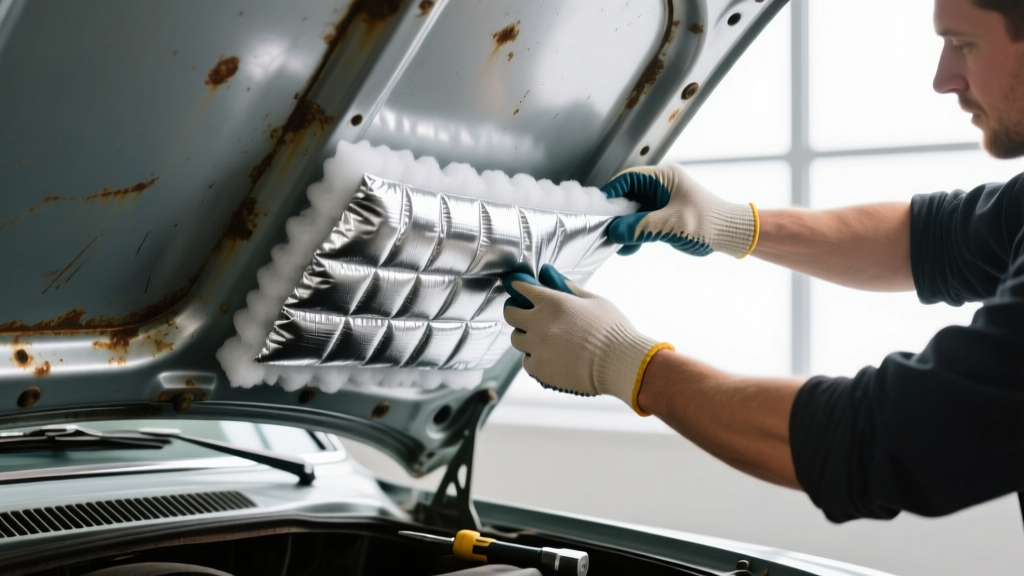
Material Matrix: Comparing the Top 3 Car Hood Insulation Materials
The table below synthesizes the physical properties of the three primary material categories used in automotive hood insulation. Thermal resistivity is measured relative to standard building insulation types, while acoustic performance references laboratory testing frameworks similar to ASTM E90 standards for airborne sound transmission.
| Material Category | Core Composition | Primary Function | Weight (per sq ft) | Max Temp Tolerance | Cost Estimate (2026) |
|---|---|---|---|---|---|
| Closed-Cell Polyethylene Foam | Cross-linked PE with foil facing | Thermal barrier & high-frequency acoustic absorption | 0.15 - 0.25 lbs | 250°F - 350°F | $2.50 - $4.00 |
| Mass Loaded Vinyl (MLV) Composite | Barium sulfate infused PVC + foam | Low-frequency acoustic blocking & secondary thermal mass | 1.00 - 2.00 lbs | 180°F - 220 inder hood insulation material installation requires strict adherence to surface preparation protocols. The most common failure mode in aftermarket installations is adhesive delamination caused by outgassing or thermal cycling. Automotive paint clear coats can off-gas volatile organic compounds (VOCs) when subjected to high heat, which breaks down the chemical bond of standard acrylic PSAs.
The 4-Step Preparation Protocol
FAQ: Common Under-Hood Insulation QuestionsDoes adding insulation to the hood cause the engine to overheat?No. Engine cooling is managed by the radiator, water pump, and thermostat, which dissipate heat into the ambient air passing through the front grille. The hood insulation material only traps the radiant heat that has already escaped the engine block, preventing it from baking the hood's exterior paint. In fact, by keeping under-hood ambient temperatures slightly more stable, it can improve cold-start air density calculations in modern mass-air-flow (MAF) sensor systems. Can I use residential fiberglass batts under my car hood?Absolutely not. Residential fiberglass acts as a sponge for moisture, oil mist, and road grime. Once saturated, it loses all thermal resistance, adds significant dead weight, and creates a severe fire hazard if it contacts the exhaust manifold. Always use closed-cell automotive foams or specialized MLV composites that are inherently hydrophobic and non-flammable. Written by Marcus ChenMarcus Chen is a licensed structural engineer (PE) and building materials analyst with over 12 years of experience across residential, commercial, and industrial construction. He holds a Master of Science in Civil Engineering from UC Berkeley and spent six years at Thornton Tomasetti before transitioning to independent consulting and technical writing. Marcus specializes in material selection for seismic-prone regions, concrete reinforcement strategies, and lifecycle cost analysis. His work has been cited by the American Concrete Institute (ACI) and the Structural Engineers Association of California (SEAOC). When he is not on a job site or at his desk, you will find him hiking the Sierra Nevada or restoring a 1920s craftsman bungalow in Oakland, CA. More from Marcus ChenView all Construction Cost How Much Did the Eiffel Tower Cost to Build?How much did the Eiffel Tower cost to build in 1889? We adjust for inflation and compare its budget to modern skyscraper construction. Aug 4, 2026  Fire Resistance What Is a Fire Resistant Material? Testing & Certification GuideDiscover what is a fire resistant material through ASTM and UL testing. Learn how fire ratings, certifications, and assemblies work in construction. Aug 4, 2026  Construction Cost How Much Did the Burj Khalifa Cost to Build?How much did the Burj Khalifa cost to build? We break down the $1.5B project and extract 5 money-saving strategies for your next build. Jul 30, 2026 |