Rigid Foam Board Insulation: EPS vs XPS vs Polyiso Selection Guide
Compare EPS, XPS, and polyiso rigid foam board insulation. Learn R-values, cold-weather performance, 2026 pricing, and exact product selections.
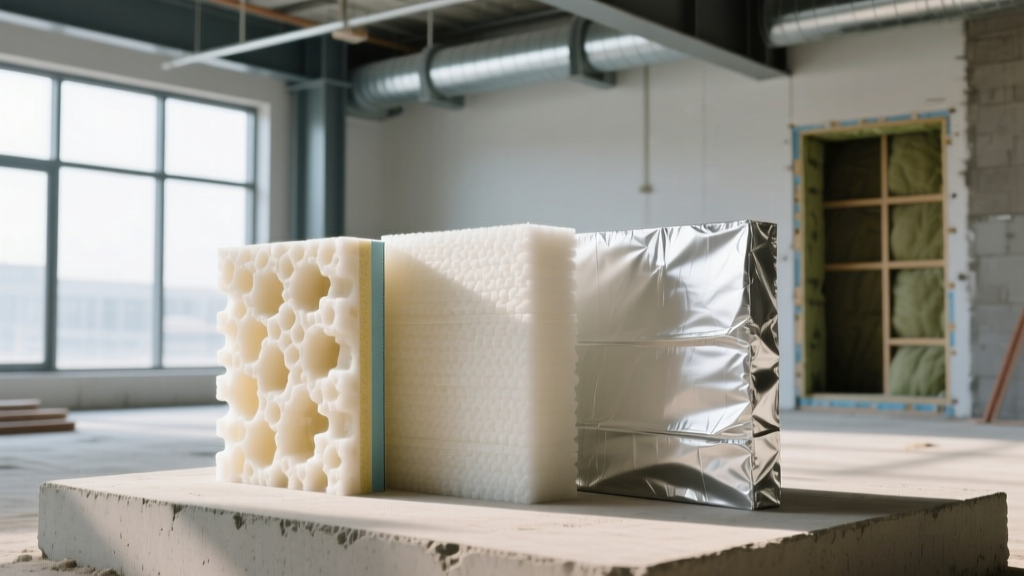
The Big Three: EPS, XPS, and Polyiso Taxonomy
Selecting the correct rigid foam board insulation requires moving beyond basic R-value per inch. The three dominant chemistries—Expanded Polystyrene (EPS), Extruded Polystyrene (XPS), and Polyisocyanurate (Polyiso)—behave fundamentally differently under moisture exposure, extreme cold, and structural loading. Misidentifying these material properties leads to compressed sub-slab insulation, condensation inside wall cavities, and severe thermal bridging. According to the Department of Energy, rigid foam provides continuous insulation that mitigates thermal bridging through framing, but its efficacy relies entirely on matching the specific polymer chemistry to the building assembly's hygrothermal profile.
- EPS: High permeability, lowest cost, stable R-value in extreme cold. Best for under-slab and exterior sub-grade.
- XPS: Low permeability, high moisture resistance, moderate cost. Best for below-grade foundation walls and inverted roofs.
- Polyiso: Highest R-value at room temperature, foil-faced, susceptible to thermal drift in cold climates. Best for above-grade continuous exterior insulation and roof decks.
Deep Dive: Material Properties & Failure Modes
Expanded Polystyrene (EPS): The Density-Driven Workhorse
EPS is manufactured by expanding spherical polystyrene beads using steam and pentane, fusing them into a closed-cell matrix. Unlike XPS, EPS does not rely on high-GWP blowing agents trapped inside the cells, meaning its R-value (typically R-3.6 to R-4.2 per inch) remains entirely stable regardless of temperature fluctuations or aging.
The most common failure mode with EPS is structural crushing due to specifying the wrong density grade. EPS is categorized by Type based on ASTM C578:
- Type I (1.0 lb/ft³ density): 10 psi compressive strength. Suitable for interior wall cavities and low-load attic floors. Will crush under concrete slabs.
- Type II (1.5 lb/ft³ density): 13 psi compressive strength. Standard for residential exterior sheathing and light-duty roof applications.
- Type IX (2.0 lb/ft³ density): 25 psi compressive strength. The mandatory specification for under-slab foundations, heavy commercial roofs, and geofoam applications. Products like Insulfoam EPS Type IX support heavy point loads without permanent deformation.
Because EPS is vapor semi-permeable (approx. 3-5 perms at 1 inch), it allows building assemblies to dry to the exterior, making it a preferred choice for wood-framed wall retrofits where moisture entrapment is a concern.
Extruded Polystyrene (XPS) & The HFC Phase-Down
XPS is extruded through a die, creating a uniform, tightly packed closed-cell structure with a smooth plastic skin. This skin grants XPS exceptional moisture resistance (water absorption < 0.3% by volume per ASTM C272) and a high initial R-value of R-4.5 to R-5.0 per inch. It is the undisputed standard for below-grade foundation waterproofing and plaza decks.
However, the XPS market is undergoing a massive chemical shift. Historically, XPS relied on HFC-134a as a blowing agent, which has a Global Warming Potential (GWP) nearly 1,400 times that of CO2. Under the EPA's AIM Act regulations, manufacturers have transitioned to next-generation Hydrofluoroolefins (HFOs). When specifying XPS in 2026, look for next-gen products like Owens Corning FOAMULAR NGX or Dow STYROFOAM Brand XPS, which utilize low-GWP blowing agents while maintaining the critical sub-grade moisture resistance required for frost-protected shallow foundations.
Polyisocyanurate (Polyiso) & The Cold-Weather R-Value Drop
Polyiso offers the highest nominal R-value of the three (R-5.6 to R-6.5 per inch) due to the low thermal conductivity of the blowing gases (typically pentane or cyclopentane) trapped in its cells. It is almost exclusively faced with aluminum foil, which acts as a Class I vapor retarder and a radiant barrier.
The Critical Edge Case: Polyiso suffers from 'thermal drift' or the 'condensation curve.' As outdoor temperatures drop below 40°F (4°C), the blowing gases inside the polyiso cells begin to condense into a liquid. This drastically reduces the gas's insulating properties, causing the R-value to plummet from R-6.5 down to R-4.5 per inch at 0°F (-18°C). Building scientists heavily document this phenomenon; in cold climates (Zones 5 and above), relying on polyiso's labeled R-value for condensation control calculations can lead to interstitial dew point failures. For cold-climate exterior continuous insulation, EPS or mineral wool is often a safer hygrothermal choice.
Selection Matrix: Matching Foam to Application
| Application | Optimal Material | Why It Wins | Specific Product Example |
|---|---|---|---|
| Under-Slab Foundation | EPS Type IX | 25 psi compressive strength; stable R-value; lowest cost per psi. | Insulfoam EPS Type IX |
| Below-Grade Exterior Wall | XPS (Next-Gen) | Near-zero water absorption; survives wet soil without R-value loss. | FOAMULAR NGX 250 |
| Above-Grade Wall Sheathing (Zone 4+) | EPS or Unfaced Polyiso | Vapor permeable; allows outward drying of wall assembly. | R-Tech EPS or Carlisle Securock |
| Commercial Flat Roof Deck | Polyiso (Cover Board) | Highest R-value per inch; foil facer resists hot asphalt adhesion. | Johns Manville Thermax NH |
2026 Cost Breakdown & ROI Considerations
Pricing for rigid foam fluctuates with petroleum and chemical feedstock markets. Below are the average national material costs per board foot (1 square foot at 1-inch thickness) for Q1 2026. Installed costs will add $0.50 to $1.50 per square foot depending on fastening requirements and labor rates.
EPS (Type II)
$0.42 - $0.55
per board foot (material only)
XPS (250 Grade)
$0.85 - $1.10
per board foot (material only)
Polyiso (Foil-Faced)
$0.95 - $1.30
per board foot (material only)
ROI Insight: While EPS is the cheapest upfront, using it in a below-grade application where it absorbs moisture will result in a 30-40% loss in effective R-value, driving up HVAC loads and negating the initial material savings. Always calculate lifecycle cost based on the in-situ R-value, not the laboratory-tested dry R-value.
Critical Installation Gotchas & Edge Cases
Even the most carefully selected rigid foam will fail if installed incorrectly. Avoid these common field errors:
- Fastener Thermal Bridging: When mechanically attaching exterior rigid foam, the steel or plastic fasteners act as thermal bridges. A standard steel screw can reduce the effective R-value of a continuous insulation layer by up to 15%. Use thermal washers or specify adhesive-only attachment methods where wind-load calculations permit.
- Seam Taping Protocols: Unsealed joints allow air infiltration and moisture drive. For foil-faced polyiso, use only acrylic or foil-backed tapes (e.g., Zip System tape or 3M All Weather Flashing Tape). Standard duct tape will degrade and fail within 18 months of UV or moisture exposure.
- UV Degradation Timelines: All rigid foams degrade rapidly under ultraviolet light. XPS and EPS will begin to chalk, yellow, and lose surface structural integrity within 30 to 60 days of direct sun exposure. Polyiso foil facers protect the core, but the edges remain vulnerable. If the building envelope will be exposed for longer than 30 days before cladding installation, the foam must be covered with a temporary weather-resistive barrier or painted with a water-based latex protective coating.
- Solvent Incompatibility: Never use solvent-based adhesives, roofing cements, or spray foams containing uncured solvents directly against EPS. The solvents will chemically melt the polystyrene beads, destroying the board. Always use adhesives explicitly labeled as 'EPS compatible' or 'foam-safe.'
For comprehensive hygrothermal modeling and advanced assembly details, referencing building science literature from institutions like Building Science Corporation is critical before finalizing your continuous insulation strategy.