R30 Insulation Brand Deep-Dive: Owens Corning vs. Rockwool vs. Knauf
Compare top R30 insulation brands for 2026. Deep-dive into Owens Corning, Rockwool, and Knauf product lines, pricing, specs, and installation edge cases.
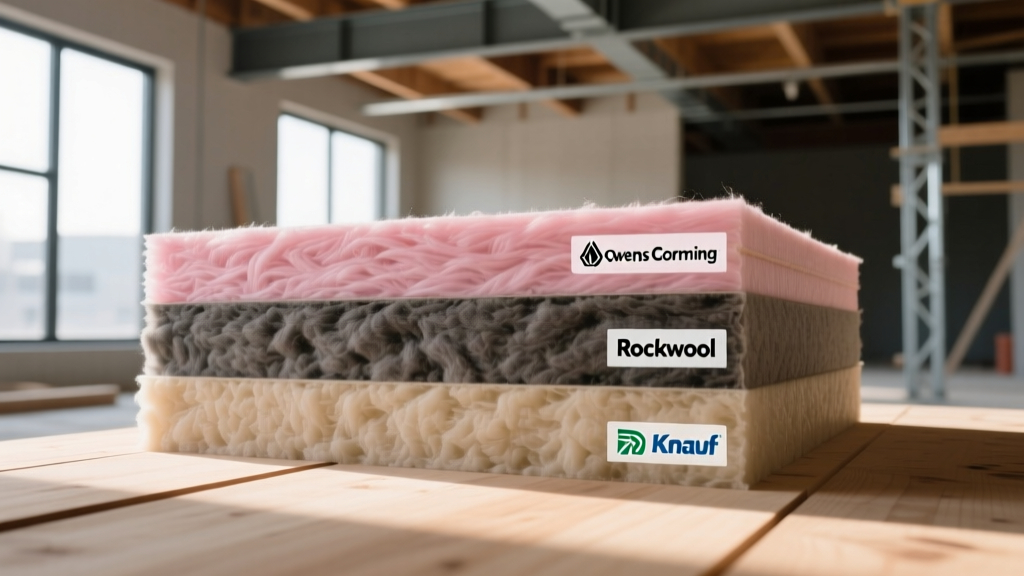
The R-30 Standard: What It Actually Means for Your Build
Specifying R30 insulation for ceiling cavities, cathedral roofs, or deep-wall assemblies requires navigating a complex matrix of material densities, framing depths, and binder technologies. Under the latest IECC energy codes, R-30 is the baseline mandate for ceiling insulation in Climate Zones 3 through 8, making it one of the most high-volume SKUs in residential and light-commercial construction. However, not all R-30 batts are manufactured equally. The thermal resistance is achieved through different structural mechanisms—trapping air in spun glass fibers versus trapping air in dense, spun basalt rock.
According to the U.S. Department of Energy, R-value measures thermal resistance, but real-world performance hinges on installation quality, material density, and moisture management. A high-density R-30 batt designed for a 2x8 cavity (7.25 inches deep) performs vastly differently under compression than a standard-density R-30 batt meant for a 2x10 cavity (9.25 inches deep). This deep-dive dissects the three dominant R30 insulation product lines on the market in 2026: Owens Corning Pink Next Gen, Rockwool Comfortbatt, and Knauf EcoBatt.
Brand Matrix: Owens Corning vs. Rockwool vs. Knauf
The following matrix compares the flagship R-30 product lines across critical performance and economic metrics. Pricing reflects early 2026 national averages for unfaced batts before regional distributor markups.
| Feature | Owens Corning Pink Next Gen | Rockwool Comfortbatt | Knauf EcoBatt Glasswool |
|---|---|---|---|
| Material Base | Fiberglass (Silica Sand) | Mineral Wool (Basalt & Slag) | Fiberglass (Recycled Glass) |
| Nominal Thickness | 8.25" (Standard) / 7.25" (HD) | 7.25" (High Density) | 8.25" (Standard) |
| Density (pcf) | 0.5 - 1.2 pcf | 2.5 - 3.0 pcf | 0.6 - 1.0 pcf |
| Avg. Cost per Sq. Ft. | $1.15 - $1.35 | $1.70 - $2.10 | $1.05 - $1.25 |
| STC Rating (per batt) | STC 39 (in 2x6 wall) | STC 45 (in 2x6 wall) | STC 38 (in 2x6 wall) |
| Fire Resistance | Non-combustible (ASTM E136) | Fire-resistant up to 2,150°F | Non-combustible (ASTM E136) |
| Binder Technology | Bio-based Acrylic | Thermosetting Resin | ECOSE (Bio-based) |
Product Line Deep-Dives
Owens Corning Pink Next Gen Fiberglas (R-30)
Owens Corning’s Next Gen line represents a significant shift in fiberglass manufacturing, utilizing a bio-based acrylic binder that eliminates formaldehyde and significantly reduces airborne dust during installation. The R-30 Next Gen batts feature advanced fiber recovery. When pulled from the compressed packaging, they expand to their full 8.25-inch thickness faster and more reliably than legacy fiberglass products. This rapid recovery is critical for maintaining the stated R-value; a batt that fails to fully expand leaves microscopic gaps at the top of the cavity, creating convective thermal loops.
Best Application: Standard attic floors, unconditioned vented attics, and floor assemblies where budget and thermal performance are the primary drivers, and acoustic separation is secondary.
Rockwool Comfortbatt (R-30)
Rockwool approaches R-30 through mineral wool, spinning basalt rock and steel slag at extreme temperatures. The resulting R-30 Comfortbatt is remarkably dense (nearly 3.0 pcf). This density provides two distinct advantages: superior acoustic mass (blocking low-frequency sound transmission) and rigid friction-fit capabilities. Installers frequently note that Rockwool R-30 batts grip standard 16-inch on-center wood framing so tightly that wire supports or staple guns are entirely unnecessary, even in overhead cathedral ceiling applications.
Furthermore, mineral wool is inherently hydrophobic. If a roof leak occurs, Rockwool will not wick water or hold moisture against the wood framing, allowing the cavity to dry out without losing its structural integrity or R-value.
Best Application: Party walls in multi-family builds, home theaters, cathedral ceilings requiring overhead friction-fit, and exterior walls in high-humidity or wildfire-prone zones.
Knauf EcoBatt Glasswool (R-30)
Knauf’s EcoBatt line leverages ECOSE Technology, a revolutionary bio-based binder derived from rapidly renewable plant materials rather than petroleum-based chemicals. The result is a dark brown, exceptionally soft fiberglass batt that is highly forgiving on the skin and lungs during installation. Knauf’s R-30 EcoBatt is often the most cost-effective option in this tier, making it the default choice for high-volume production builders who need to meet IECC thermal mandates without inflating the framing budget.
Best Application: Large-scale production housing, budget-conscious renovations, and standard ceiling planes where the installer’s comfort and material cost are heavily weighted.
A frequent and costly error on job sites is forcing a standard-density 8.25-inch R-30 fiberglass batt into a 7.25-inch 2x8 framing cavity. According to building science principles outlined by the Environmental Protection Agency, compressing fiberglass destroys the trapped air pockets that provide thermal resistance. Compressing an 8.25" R-30 batt into a 7.25" cavity drops the effective R-value to approximately R-26. If your framing depth is strictly 7.25 inches, you must specify a High-Density R-30 batt specifically engineered for that exact depth, or switch to mineral wool which resists compression degradation far better.
Moisture Dynamics and Vapor Retarders
When installing R30 insulation, the vapor retarder strategy must align with the material’s permeability. Fiberglass batts (Owens Corning and Knauf) are highly vapor-permeable. In cold climates (Zones 5 and above), if you are using unfaced R-30 batts in a ceiling assembly, you must install a separate Class I or II vapor retarder (like 6-mil poly or a smart membrane like Intello) on the warm-in-winter side to prevent interior moisture from condensing on the cold roof sheathing.
Mineral wool (Rockwool) is also vapor-permeable but handles bulk water differently. Because it does not absorb water, it is the superior choice for assemblies where drying potential to the exterior is limited, or in high-moisture environments like bathroom ceilings or indoor pool enclosures. Pairing Rockwool R-30 with a variable-permeability smart membrane allows the assembly to dry inward during summer months while blocking winter vapor drive.
Decision Framework: Which R-30 Line Fits Your Project?
Use the following framework to specify the correct product line based on your project’s specific constraints:
- Choose Owens Corning Pink Next Gen if: You are insulating a standard vented attic floor, want a balance of high thermal performance and low cost, and your framing depth allows for a full 8.25-inch expansion (e.g., 2x10 joists or raised-heel trusses).
- Choose Rockwool Comfortbatt if: You are insulating overhead cathedral ceilings (where friction-fit prevents sagging), building acoustic separation walls, working in a high-fire-risk zone (WUI), or dealing with a 7.25-inch 2x8 cavity that requires high-density material to achieve R-30 without compression penalties.
- Choose Knauf EcoBatt if: You are managing a large-scale production build where material cost per square foot is the primary KPI, your installers prefer a softer, low-itch material, and you are targeting green building certifications like LEED or NGBS that reward bio-based binder technologies.
The Continuous Insulation (ci) Factor
Finally, remember that cavity R-30 insulation only addresses the spaces between the framing. Wood framing accounts for roughly 20% to 25% of a wall or ceiling surface area, and wood conducts heat roughly four times faster than insulation. To eliminate this thermal bridging and achieve the true effective R-value required by modern energy codes, R-30 cavity insulation should be paired with continuous exterior or interior rigid foam insulation. Specifying R-30 without addressing thermal bridging leaves up to 20% of your building envelope thermally compromised.