Choosing Insulation in the Crawl Space: A Material Taxonomy Guide
Compare rigid foam, spray foam, and mineral wool for insulation in the crawl space. Learn material taxonomy, R-values, and moisture management.
The Paradigm Shift: From Vented to Conditioned Crawl Spaces
Historically, building codes mandated vented crawl spaces to allow ground moisture to evaporate. However, modern building science has definitively proven that venting often introduces more moisture than it removes, particularly in humid climates. When warm, humid summer air enters a cool crawl space, it condenses on cold surfaces, leading to mold, wood rot, and structural degradation. Consequently, the industry standard has shifted toward unvented, conditioned crawl spaces. Selecting the correct insulation in the crawl space is no longer just about thermal resistance; it is an exercise in moisture management, air sealing, and material taxonomy.
According to the Pacific Northwest National Laboratory's Building America Solution Center, an unvented crawl space requires insulation at the perimeter walls rather than the floor above. This integrates the crawl space into the home's conditioned envelope, protecting plumbing from freezing and stabilizing floor temperatures. However, the success of this strategy relies entirely on selecting materials that can withstand high-humidity, below-grade environments.
Material Matrix: Rigid Foam, Spray Foam, and Mineral Wool
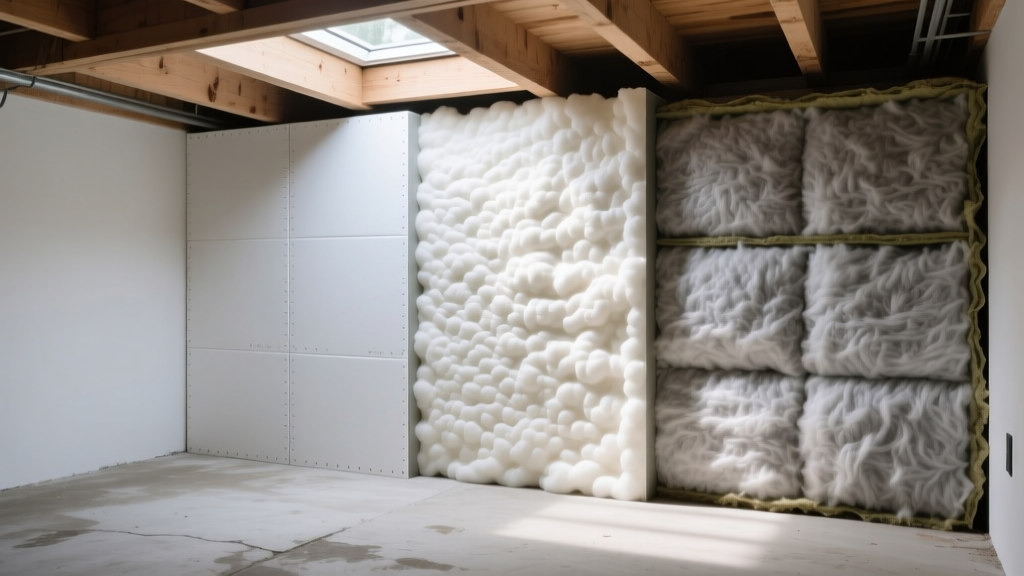
Not all insulation materials survive the harsh microclimate of a crawl space. The taxonomy of crawl space insulation is divided into three primary categories: extruded polystyrene (XPS), closed-cell spray polyurethane foam (ccSPF), and mineral wool. Fiberglass and open-cell foams are categorically excluded from modern best practices due to their moisture retention properties.
| Material Type | R-Value per Inch | Perm Rating (1") | Best Application | Primary Vulnerability |
|---|---|---|---|---|
| XPS (e.g., Owens Corning FOAMULAR NGX) | R-5.0 | ~1.0 | Below-grade foundation walls, dirt floor perimeters | Thermal drift over 15+ years; off-gassing of blowing agents |
| Closed-Cell SPF (e.g., Carlisle, Demilec) | R-6.5 | <0.1 (Class II) | Rim joists, complex masonry walls, irregular surfaces | High upfront cost; requires professional application |
| Polyisocyanurate (Polyiso) | R-6.0 | ~1.5 | Above-grade interior stem walls | Severe R-value loss and delamination if exposed to liquid water |
| Mineral Wool (e.g., ROCKWOOL Comfortbatt) | R-4.2 | Vapor Permeable | Interior walls (ONLY when paired with a continuous Class I vapor barrier) | Does not act as an air or vapor barrier on its own |
Extruded Polystyrene (XPS): The Below-Grade Standard
XPS remains the most common material for insulating crawl space foundation walls. Its closed-cell structure resists liquid water absorption, making it ideal for masonry walls that may experience minor hydrostatic pressure. For a standard 3-foot crawl space wall, installing 2 inches of XPS yields R-10. In 2026, manufacturers have largely transitioned to next-generation blowing agents (like HFOs) to reduce the global warming potential (GWP) of XPS, as seen in products like FOAMULAR NGX. Installation requires mechanical fastening or compatible foam board adhesive, and all seams must be sealed with mastic or specialized tape to prevent air infiltration.
Closed-Cell Spray Foam (ccSPF): The Ultimate Air Barrier
When dealing with irregular rubble stone foundations, brick piers, or complex rim joist assemblies, ccSPF is the superior choice. At R-6.5 per inch, a 2-inch layer provides R-13 while simultaneously acting as a Class II vapor retarder and a complete air barrier. ccSPF adheres directly to masonry and wood, eliminating the thermal bridging and convective loops that can occur behind rigid foam boards if they are not perfectly sealed. The U.S. Department of Energy highlights spray foam's effectiveness in sealing the critical rim joist area, which is notoriously difficult to insulate with rigid boards.
Mineral Wool: The Fire-Resistant Alternative
Mineral wool (stone wool) is non-combustible, hydrophobic, and vapor-permeable. It is sometimes used on crawl space walls in fire-prone areas or where local codes mandate non-combustible insulation. However, because it is vapor-permeable, it must be paired with a continuous, sealed polyethylene vapor barrier on the ground and wrapped up the walls behind the mineral wool to prevent ground moisture from migrating into the batts.
Never install fiberglass batts between floor joists in a vented crawl space, or against crawl space walls without a perfect vapor barrier. Fiberglass acts like a filter, trapping dust and moisture. In humid conditions, the moisture condenses within the batts, adding weight that causes the insulation to sag and fall. More critically, the trapped moisture presses directly against the wooden subfloor and rim joists, accelerating wood rot and mold growth. This legacy practice is responsible for millions of dollars in structural repairs annually.
Moisture Dynamics and Vapor Retarder Classifications
Insulation in the crawl space is only half the system; the ground vapor retarder is the other. The International Residential Code (IRC) requires a minimum 6-mil polyethylene sheeting (Class I vapor retarder, <0.1 perm) covering 100% of the exposed earth in an unvented crawl space.
For high-performance retrofits, building scientists recommend upgrading to a 10-mil or 12-mil reinforced cross-laminated polyethylene liner. The liner must be run up the foundation walls and sealed to the wall insulation or the concrete itself using double-sided butyl tape and termination bars. According to research published by Building Science Corporation, sealing the ground vapor barrier to the wall insulation creates a continuous capillary break, preventing soil moisture from bypassing the insulation and entering the conditioned space.
Cost Breakdown and ROI for Crawl Space Retrofits
Budgeting for crawl space insulation requires factoring in both material costs and the specialized labor required for air sealing and vapor barrier installation. Below is a 2026 pricing matrix for a standard 1,000-square-foot crawl space with 3-foot foundation walls (300 linear feet of wall area).
| Component | Material Cost (per sq. ft.) | Installed Cost (per sq. ft.) | Total Est. for 1,000 sq. ft. footprint |
|---|---|---|---|
| 2" XPS Wall Insulation (300 sq. ft. wall) | $1.60 - $2.10 | $3.50 - $4.50 | $1,050 - $1,350 |
| 2" ccSPF Wall Insulation (300 sq. ft. wall) | $2.50 - $3.20 | $4.50 - $6.00 | $1,350 - $1,800 |
| 12-mil Reinforced Ground Vapor Barrier | $0.45 - $0.70 | $1.50 - $2.50 | $1,500 - $2,500 |
| Rim Joist Air Sealing (ccSPF) | N/A | $8.00 - $12.00 (per linear ft) | $800 - $1,200 |
Step-by-Step Selection Framework
To determine the exact material taxonomy for your project, apply this decision framework based on your foundation type and climate zone:
- Assess the Foundation Geometry: If the walls are smooth poured concrete or clean CMU blocks, XPS rigid foam is the most cost-effective choice. If the walls are irregular rubble stone, brick, or feature numerous pipe penetrations, specify ccSPF to guarantee an airtight seal.
- Evaluate the Water Table: If the crawl space experiences seasonal standing water or active hydrostatic weeping, XPS is mandatory. Polyiso and mineral wool will absorb water, lose R-value, and harbor mold. You must also address exterior drainage before insulating.
- Address the Rim Joist: Regardless of the wall insulation chosen, the rim joist (where the wood floor framing meets the masonry wall) must be air-sealed. Use 2 inches of ccSPF or carefully cut XPS blocks sealed with canned spray foam and mastic.
- Condition the Space: In Climate Zones 4 and higher, an unvented crawl space requires a method of air exchange. This is typically achieved by installing a small supply register from the HVAC system or a dedicated, humidistat-controlled exhaust fan to maintain relative humidity below 60%.
Frequently Asked Questions
Can I use faced polyiso boards on my crawl space walls?
Polyiso is highly susceptible to moisture absorption. While the foil facing acts as a vapor retarder, any cuts, edges, or fastener holes expose the foam core to ground moisture. XPS or ccSPF are vastly superior for below-grade or near-grade applications.
Do I need to remove existing fiberglass batts from the floor joists?
Yes. When converting to an unvented, wall-insulated crawl space, the floor insulation becomes redundant and can actually trap moisture against the subfloor if the space becomes conditioned. Remove all legacy fiberglass batts to allow the wood structure to dry evenly.