Do It Yourself Spray Foam Insulation: Performance Specs & R-Values
Compare performance specs, R-values, and fire ratings for do it yourself spray foam insulation kits to ensure code compliance and thermal efficiency.
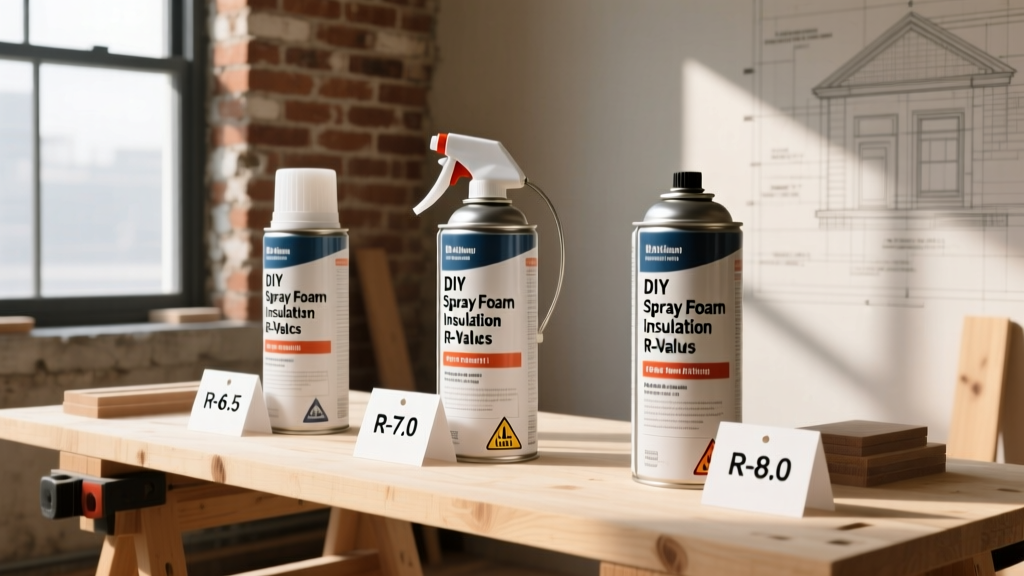
Open-Cell vs. Closed-Cell: The Core Specification Divide
When evaluating do it yourself spray foam insulation, the primary performance fork is the cellular structure. DIY kits are strictly divided into open-cell (low-density) and closed-cell (medium-to-high-density) formulations. Understanding the exact physical specifications of each is mandatory for building code compliance and long-term thermal performance.
| Specification | DIY Open-Cell (0.5 lb/ft³) | DIY Closed-Cell (2.0 lb/ft³) |
|---|---|---|
| Core R-Value (per inch) | R-3.5 to R-3.8 | R-6.0 to R-6.8 |
| Vapor Permeability | High (>10 perms) | Low (<1.5 perms at 2 inches) |
| Expansion Ratio | 30:1 to 100:1 | 2:1 to 3:1 |
| Structural Rigidity | None (flexible) | Adds racking strength to walls |
| Sound Dampening (STC) | Excellent (absorbs mid/high frequencies) | Poor (reflects sound, transmits bass) |
Closed-cell foam achieves its higher R-value through the use of blowing agents (historically HFC-245fa, transitioning to newer HFO blends in 2026 kits) trapped within the sealed microscopic cells. Open-cell foam uses water as a blowing agent, creating a porous, breathable matrix that excels in acoustic damping but offers inferior thermal resistance per inch.
Decoding R-Value and Thermal Drift in Low-Pressure Kits
A critical specification often misunderstood by DIYers is the difference between professional high-pressure rigs and consumer low-pressure kits. Professional rigs mix the A-side (isocyanate) and B-side (polyol resin) at pressures exceeding 1,500 PSI, creating a highly uniform cell structure. DIY kits, such as the Dow Froth-Pak or Touch 'n Seal series, rely on low-pressure dispensing (typically 150-250 PSI) and static-mix nozzles.
Due to the lower mixing pressure and less uniform cell structure, DIY closed-cell kits typically yield an effective R-value 5% to 10% lower than professional-grade closed-cell foam. While a pro rig might achieve R-7.0 per inch, a DIY kit like the Touch 'n Seal 602 will realistically yield R-6.2 at 1 inch, experiencing thermal drift down to R-5.8 at 3 inches of thickness as the blowing agents slowly diffuse out and are replaced by air over time.
According to testing protocols outlined by the U.S. Department of Energy, insulation performance must be evaluated at the installed thickness, not just the initial laboratory peak. Always calculate your required cavity depth using the aged R-value (typically measured at 180 days post-application), not the day-one specification.
Real-World Yield and Coverage Specifications
Kit yields are marketed in 'board feet' (one board foot equals a 12" x 12" x 1" cured volume). However, real-world application introduces a mandatory waste factor. When applying a 200-board-foot closed-cell kit (e.g., Froth-Pak 200) into a standard 2x6 wall cavity (5.5 inches deep), you must account for:
- Hose Purging: 5-10 board feet lost during initial startup and mid-job nozzle changes.
- Overspray and Trimming: Closed-cell foam expands slightly past the stud face; trimming it flush wastes approximately 10% of the volume.
- Substrate Irregularities: Wiring, plumbing, and uneven masonry increase the actual volume required.
Calculation Rule: Multiply your net cavity volume by 1.20 to determine the required kit size. A wall requiring exactly 160 board feet of foam will require a 200-board-foot kit to ensure complete coverage without running dry mid-cavity.
Fire Ratings, Smoke Development, and Code Compliance
Raw spray polyurethane foam is highly combustible. The Environmental Protection Agency (EPA) and International Residential Code (IRC) strictly mandate that exposed spray foam cannot be left as an interior finish. All DIY kits are tested to ASTM E84 (Standard Test Method for Surface Burning Characteristics of Building Materials).
Most DIY kits achieve an ASTM E84 Class 1 rating (Flame Spread Index < 25, Smoke Developed Index < 450). However, this only qualifies the foam to be left exposed in unoccupied spaces like attics or crawlspaces if an ignition barrier (like 1.5 inches of mineral wool or specific intumescent paints) is applied. For living spaces, a 15-minute thermal barrier (typically 1/2-inch gypsum drywall) is legally required over the foam. Never leave DIY spray foam exposed in a basement or garage.
Vapor Permeability and Moisture Management Specs
Moisture mismanagement is the leading cause of structural rot in spray-foam-insulated buildings. The vapor permeability specification (measured in perms per ASTM E96) dictates where the foam can be safely applied.
Closed-Cell Vapor Retarder Classes
Closed-cell DIY foam acts as a vapor retarder, but its classification depends entirely on the installed thickness:
- Under 1.0 inch: Class III Vapor Retarder (1.0 to 10 perms). Insufficient for condensation control in cold climates.
- 1.0 to 1.5 inches: Class II Vapor Retarder (0.1 to 1.0 perms). Adequate for moderate climate zones (Zones 3 and 4).
- Over 1.5 inches: Class I Vapor Retarder (< 0.1 perms). Acts as a complete vapor barrier, required for cold climates (Zones 5, 6, and 7) to prevent interior moisture from condensing inside the wall sheathing.
Critical Edge Case: Never apply closed-cell DIY foam to the interior side of a masonry or brick wall in a cold climate. Brick absorbs rain and snowmelt; if the interior is sealed with a Class I vapor barrier, the moisture has no drying path and will degrade the brick through freeze-thaw spalling. Use open-cell foam or rigid mineral wool in these specific assemblies.
Application Temperature Specifications and Failure Modes
The chemical reaction of polyurethane is highly sensitive to ambient and substrate temperatures. Ignoring the manufacturer's thermal specifications will result in catastrophic yield loss and poor adhesion.
| Parameter | Minimum Spec | Optimal Spec | Failure Mode if Violated |
|---|---|---|---|
| Tank Temperature | 65°F (18°C) | 75°F - 80°F (24°C - 27°C) | Low pressure, poor mixing, 'frothy' uncured foam, up to 40% yield loss. |
| Substrate Temp | 50°F (10°C) | 60°F - 80°F (15°C - 27°C) | Poor adhesion, foam shrinking and pulling away from studs (delamination). |
| Ambient Humidity | N/A | < 60% RH | Open-cell foam relies on moisture to cure; excessive humidity causes rapid, uncontrolled expansion and brittle cell structures. |
To achieve optimal specs, DIYers must store the tanks indoors for 48 hours prior to use. If applying in an unheated garage or crawlspace during winter, use a dedicated tank heater or build an insulated enclosure around the cylinders with a thermostatically controlled ceramic heater. Never use an open flame or heat gun to warm the tanks, as the propellants are highly flammable.
Troubleshooting Spec Mismatches in the Field
Even with the correct kit, application errors alter the physical specifications of the cured foam. Use this diagnostic matrix to identify and correct field failures.
| Visual Symptom | Specification Violated | Corrective Action |
|---|---|---|
| Foam is dark brown, crusty, and brittle. | Substrate temperature too high (>100°F) or chemical ratio imbalance. | Scrape and discard. Cool the substrate. Shake tanks vigorously for 60 seconds before resuming. |
| Foam is sticky, tacky, and smells strongly of ammonia. | Tank temperature too low (<65°F) causing incomplete mixing. | Stop application. Warm tanks to 75°F. Purge the nozzle and hose by spraying into a waste bag for 5 seconds before resuming. |
| Foam shrinks and pulls away from the wood framing after 24 hours. | Applied too thick in a single pass (exceeds 3-inch max pass spec). | Cut out shrunken sections. Re-apply in 2-inch lifts, allowing 10 minutes of cooling time between passes to prevent exothermic overheating. |
By strictly adhering to the performance ratings, thermal drift data, and application specifications outlined above, do it yourself spray foam insulation can achieve near-professional thermal envelopes. Success relies entirely on respecting the chemical limitations of low-pressure dispensing and rigorously managing the vapor and thermal boundaries of the building assembly.