Selecting Construction Insulation Materials for Sound and Thermal Isolation
Master the selection framework for construction insulation materials for sound and thermal isolation. Compare R-values, STC ratings, and assembly costs.

The Physics Divide: Why Thermal and Acoustic Goals Conflict
When architects and builders specify construction insulation materials for sound and thermal isolation, they frequently encounter a fundamental physics conflict. Thermal insulation relies on minimizing heat transfer through conduction and convection, which requires trapping still air or low-conductivity gases within a lightweight, porous matrix. Acoustic isolation, conversely, relies on mass, damping, and mechanical decoupling to block airborne and impact noise.
A material that excels at thermal resistance (like rigid closed-cell spray foam) can actively degrade acoustic performance by creating a rigid structural bridge that transmits vibration between wall studs and drywall. Conversely, heavy, dense materials that block sound may offer minimal thermal resistance per inch. Therefore, selecting the right material requires a dual-performance framework that evaluates the entire wall or floor assembly, rather than treating the cavity fill as a standalone solution.
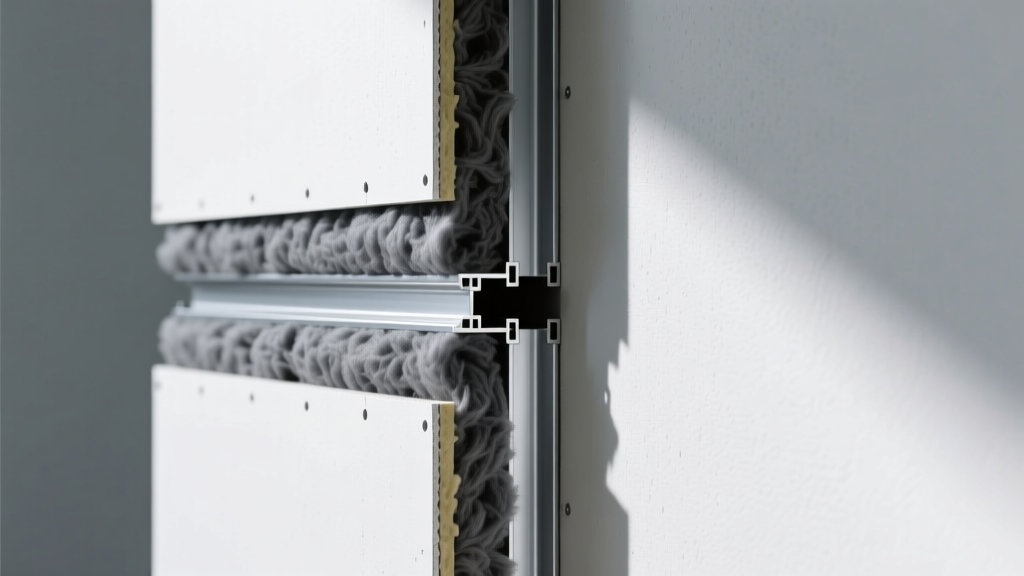
Material Performance Matrix: Density, R-Value, and STC
The following matrix evaluates common cavity insulation materials based on their physical properties and their specific contributions to thermal resistance (R-Value) and Sound Transmission Class (STC) in a standard 2x4 wood-framed assembly with 1/2-inch drywall.
| Material Type | Density (pcf) | R-Value / Inch | STC Contribution (2x4 Wall) | Vapor Permeability | Approx. Cost (per bd ft) |
|---|---|---|---|---|---|
| Mineral Wool (Acoustic Batt) | 2.5 - 3.0 | R-4.2 | +8 to +10 STC | High | $0.85 - $1.10 |
| Fiberglass (Standard Kraft) | 0.5 - 0.8 | R-3.2 - R-3.4 | +2 to +4 STC | High | $0.40 - $0.55 |
| Open-Cell Spray Foam | 0.4 - 0.6 | R-3.5 - R-3.8 | +4 to +6 STC | High | $0.60 - $0.80 |
| Closed-Cell Spray Foam | 1.7 - 2.2 | R-6.0 - R-7.0 | -2 to 0 STC (Rigid Coupling) | Low (Vapor Barrier) | $1.20 - $1.60 |
| Dense-Pack Cellulose | 3.0 - 3.5 | R-3.6 - R-3.8 | +6 to +8 STC | High | $0.70 - $0.90 |
As highlighted by the U.S. Department of Energy, while R-value dictates thermal code compliance, the density and damping characteristics of the material dictate its acoustic utility. Mineral wool and dense-pack cellulose consistently outperform lightweight fiberglass in acoustic damping due to their higher mass and complex fiber matrices.
The 4-Step Selection Framework for Dual-Performance Assemblies
Step 1: Define the Primary Threat Vector
Determine whether the assembly is primarily driven by extreme climate loads (requiring maximum continuous exterior insulation and high cavity R-values) or by strict acoustic codes (such as multi-family residential IIC/STC 50+ requirements). If thermal is primary, prioritize closed-cell foam or high-density fiberglass with exterior rigid mineral wool. If acoustic is primary, prioritize decoupling mechanisms (resilient channels, staggered studs) paired with high-density mineral wool.
Step 2: Prioritize Assembly Decoupling Over Cavity Fill
The most common error in soundproofing is over-investing in the cavity insulation while ignoring mechanical coupling. The 'Mass-Spring-Mass' principle dictates that the insulation acts as the 'spring' to dampen resonance. If the drywall is rigidly screwed to the same studs as the adjacent room, low-frequency sound will flank through the framing regardless of the cavity fill. Always specify resilient channels (RC-1) or staggered-stud framing before upgrading from standard fiberglass to premium acoustic mineral wool.
Step 3: Match Material Density to the Frequency Profile
High-frequency noise (voices, television) is easily absorbed by lightweight, porous materials like standard fiberglass or open-cell spray foam. Low-frequency noise (HVAC rumble, footfalls, bass) requires high-density materials that resist compression. For spaces adjacent to mechanical rooms or home theaters, specify mineral wool boards (e.g., Rockwool Safe'n'Sound or Owens Corning Thermafiber SAFB) with a minimum density of 2.5 pounds per cubic foot (pcf).
Step 4: Manage Vapor and Moisture Dynamics
Acoustic insulation is often installed in interior partition walls where vapor drive is not a concern. However, when specifying construction insulation materials for sound and thermal isolation in exterior walls, vapor permeability is critical. High-density acoustic batts are highly vapor-permeable. If paired with an interior vapor-retarding paint or membrane, moisture can trap within the cavity. Consult the ENERGY STAR Seal and Insulate Guide to ensure your air and thermal control layers align correctly with your acoustic fill.
Never use closed-cell spray foam in a decoupled party wall or ceiling assembly for soundproofing. While it offers superior R-value per inch, its rigid, adhesive nature structurally bonds the drywall to the framing, completely bypassing the decoupling mechanism and transmitting impact noise. Use open-cell foam or semi-rigid mineral wool to maintain the necessary acoustic 'spring'.
Scenario-Based Decision Guide
Apply this framework to common building assemblies to optimize both material selection and labor costs.
- Exterior Walls (Mixed-Humid Climate): Use 2x6 framing with R-23 dense-pack cellulose or unfaced mineral wool batts. Add 2 inches of exterior semi-rigid mineral wool (R-8.4) to eliminate thermal bridging and add exterior mass for traffic noise reduction.
- Interior Multi-Family Party Walls: Staggered-stud framing on a single 2x6 bottom plate. Fill the 2x4 stud cavities with 3-inch acoustic mineral wool (unfaced). Finish both sides with two layers of 5/8-inch Type X gypsum board, utilizing a viscoelastic damping compound (e.g., Green Glue) between the drywall layers. Target STC: 58+.
- Floor/Ceiling Assemblies (Impact Noise): Cavity insulation alone cannot stop impact noise (IIC). Specify open-cell spray foam or lightweight fiberglass in the joist bays to absorb airborne resonance, but rely on a decoupled ceiling system (isolation hangers and resilient channel) and a thick acoustic underlayment above the subfloor to address the actual impact vectors.
Cost Analysis and Installation Tolerances
Premium acoustic and thermal materials carry a 30% to 60% material premium over standard fiberglass batts. However, the labor cost to install mineral wool or dense-pack cellulose is virtually identical to standard batts, provided the framing is plumb and spaced correctly. According to building envelope research published by the Whole Building Design Guide (WBDG), a 5% gap in cavity insulation can reduce thermal performance by up to 20% and severely compromise acoustic flanking paths.
"Compression is the enemy of thermal performance, but gaps are the enemy of acoustic performance. If an R-19 batt is forced into a 2x4 wall, it loses R-value. If an acoustic batt is cut an inch too short, the resulting air gap will leak high-frequency sound directly through the assembly, rendering the expensive material useless."
When estimating project budgets for 2026, allocate approximately $1.10 to $1.50 per square foot for high-performance mineral wool cavity fill, including labor. Ensure that electrical boxes on partition walls are staggered on opposite sides of the stud bay and wrapped in acoustic sealant or putty pads to prevent sound leakage through the drywall penetrations.
Written by
Marcus ChenMarcus Chen is a licensed structural engineer (PE) and building materials analyst with over 12 years of experience across residential, commercial, and industrial construction. He holds a Master of Science in Civil Engineering from UC Berkeley and spent six years at Thornton Tomasetti before transitioning to independent consulting and technical writing. Marcus specializes in material selection for seismic-prone regions, concrete reinforcement strategies, and lifecycle cost analysis. His work has been cited by the American Concrete Institute (ACI) and the Structural Engineers Association of California (SEAOC). When he is not on a job site or at his desk, you will find him hiking the Sierra Nevada or restoring a 1920s craftsman bungalow in Oakland, CA.
More from Marcus Chen
View all
Construction Cost
How Much Did the Eiffel Tower Cost to Build?
How much did the Eiffel Tower cost to build in 1889? We adjust for inflation and compare its budget to modern skyscraper construction.
Aug 4, 2026

Fire Resistance
What Is a Fire Resistant Material? Testing & Certification Guide
Discover what is a fire resistant material through ASTM and UL testing. Learn how fire ratings, certifications, and assemblies work in construction.
Aug 4, 2026

Construction Cost
How Much Did the Burj Khalifa Cost to Build?
How much did the Burj Khalifa cost to build? We break down the $1.5B project and extract 5 money-saving strategies for your next build.
Jul 30, 2026