Choosing the Right Air Conditioning Insulation Material in 2026
Select the optimal air conditioning insulation material using our 2026 framework. Compare elastomeric, fiberglass, and phenolic foam for HVAC systems.

The 4-Pillar Selection Framework for HVAC Insulation
Selecting the correct air conditioning insulation material requires moving beyond basic R-value comparisons. HVAC systems operate across extreme temperature gradients—from 40°F chilled water lines to 140°F heating loops—while battling severe vapor drive in humid environments. According to the ASHRAE Handbook, improper material selection is the primary cause of condensation, mold proliferation, and thermal bridging in commercial mechanical rooms. To engineer a fail-proof system, evaluate materials against four non-negotiable pillars:
- Thermal Conductivity (k-value): Measured in BTU·in/(h·ft²·°F). Lower values indicate superior thermal resistance per inch of thickness, critical for tight mechanical chases.
- Water Vapor Transmission (WVT): Measured in perm-inches. For below-ambient systems (chilled water, refrigerant), the insulation must act as its own vapor retarder or require a flawless secondary jacket.
- Fire and Smoke Ratings: Must meet ASTM E84 (Surface Burning Characteristics). Most commercial codes mandate a maximum Flame Spread Index (FSI) of 25 and Smoke Developed Index (SDI) of 50 for exposed plenum applications.
Operating Temperature Range: Materials degrade or off-gas when pushed beyond their engineered thermal limits.
Material Comparison Matrix: Elastomeric vs. Fiberglass vs. Phenolic
The market is dominated by three primary material families. Below is a technical matrix comparing the 2026 industry standards for each category.
| Property | Closed-Cell Elastomeric (e.g., AP ArmaFlex) | Fiberglass Duct Wrap (e.g., JM Microlite L) | Phenolic Foam Board (e.g., Kingspan Kooltherm) |
|---|---|---|---|
| ASTM Standard | ASTM C534 | ASTM C553 / C991 | ASTM C1126 |
| k-value (at 75°F) | 0.25 | 0.23 | 0.16 |
| WVT (perm-in) | 0.02 (Inherent) | High (Requires FSK Facing) | 0.02 (With Foil Facing) |
| ASTM E84 Rating | 25 FSI / 50 SDI | 25 FSI / 50 SDI (FSK faced) | Class 0 (FSI < 25) |
| Max Temp Limit | 220°F (105°C) | 450°F (232°C) | 250°F (120°C) |
| Material Cost (2026) | $1.20 - $2.00 / sq ft | $0.60 - $1.10 / sq ft | $2.50 - $4.50 / sq ft |
Application-Specific Decision Tree
Use this decision framework to match the air conditioning insulation material to the specific mechanical application. The U.S. Department of Energy emphasizes that matching vapor retarder placement to the climate zone and system temperature is critical for preventing interstitial condensation.
1. Chilled Water Piping (40°F - 50°F)
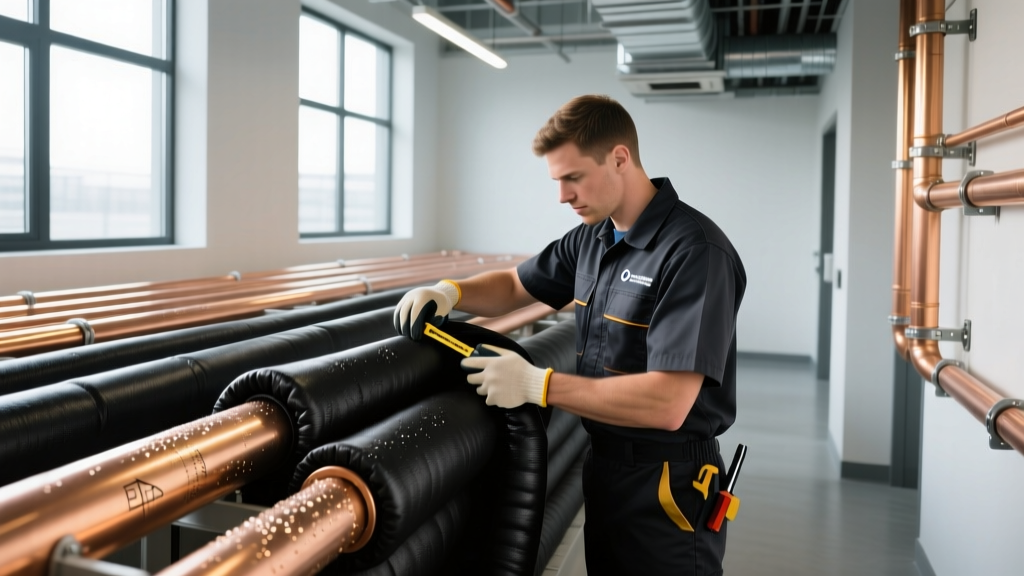
- Primary Choice: Closed-cell elastomeric foam (tubular or sheet). The inherent vapor barrier prevents moisture ingress that destroys open-cell materials.
- Alternative: Phenolic foam with factory-applied aluminum foil facing. Use only in straight runs where rigid board can be sealed with specialized aluminum tape at the joints.
- Required Thickness: 1.5 inches for 4-inch pipes; 2.0 inches for 8-inch pipes (based on ASHRAE 90.1 minimums for Climate Zones 4+).
2. VRF Refrigerant Lines (Variable Refrigerant Flow)
- Primary Choice: Elastomeric foam with factory-applied UV coating (e.g., Armacell Black UV). Standard elastomeric degrades and chalks within 14 months when exposed to direct sunlight on exterior walls.
- Seam Protocol: All longitudinal seams must be sealed with 520-grade contact adhesive and 3-inch wide elastomeric tape. Stapling is strictly prohibited as it punctures the vapor envelope.
3. Supply Air Ductwork (55°F)
- Primary Choice: Fiberglass duct wrap with FSK (Foil-Scrim-Kraft) facing. The FSK acts as the Class 1 vapor retarder.
- Installation Rule: Never compress fiberglass wrap at duct hangers. Compression reduces the R-value from R-8 to R-3 locally, creating a cold spot that will sweat in high-humidity return air environments.
In below-ambient systems, vapor drive moves from the warm, humid ambient air toward the cold pipe. If you use an open-cell material (like standard mineral wool or unfaced fiberglass) without a continuous, zero-perm outer jacket, water vapor will penetrate the insulation, condense on the cold pipe, and saturate the material. Wet insulation loses up to 85% of its thermal resistance and causes rapid galvanic corrosion on steel pipes and CUI (Corrosion Under Insulation) on stainless lines.
2026 Installed Cost Breakdown and ROI Timelines
Material cost is only one variable; labor intensity drastically alters the total installed cost. Elastomeric foam requires meticulous gluing and taping, whereas fiberglass wrap is faster to deploy but requires careful tensioning and stapling of the facing.
| Material System | Material Cost (per linear ft of 4" pipe) | Labor Cost (per linear ft) | Total Installed Cost | Expected Lifespan |
|---|---|---|---|---|
| Elastomeric Sheet (1.5") | $4.50 | $6.20 | $10.70 | 15-20 Years |
| Fiberglass Wrap (2" w/ FSK) | $2.10 | $3.40 | $5.50 | 10-15 Years |
| Phenolic Board (1.5" Foil) | $6.80 | $5.50 | $12.30 | 20-25 Years |
While phenolic and elastomeric systems carry a 60% to 120% premium over fiberglass upfront, the ROI is typically realized within 4.5 years in commercial facilities through the elimination of mold remediation, pipe replacement, and reduced chiller energy loads caused by wet insulation.
Critical Installation Failure Modes to Avoid
Even the highest-specification air conditioning insulation material will fail if installed incorrectly. Field audits reveal three recurring failure modes:
1. Elastomeric Seam Adhesive Starvation
Installers frequently apply contact adhesive to only one surface (the pipe or the insulation) rather than both. Elastomeric contact cement requires a dual-coat application, allowed to become tacky (usually 3 to 10 minutes depending on ambient humidity), before pressing together. Single-coat applications result in microscopic gapping that draws in moisture via capillary action.
2. Fiberglass Compression at Hangers
When fiberglass duct wrap is crushed between the duct and a metal hanger strap, the trapped air pockets—which provide the actual thermal resistance—are eliminated. Specify insulated hanger shields (e.g., Mason Industries or Kinetics Noise Control) that maintain the full thickness of the insulation profile at support points.
3. Ignoring the 24-Hour Cure Time for PVC Jackets
When applying PVC or aluminum exterior jackets over elastomeric insulation on outdoor chilled water lines, the adhesives used to seal the jacket seams off-gas solvents. If the insulation is immediately sealed in an airtight metal jacket without allowing a 24-hour solvent flash-off period, the trapped solvents will chemically attack and melt the closed-cell structure of the elastomeric foam beneath it.
For comprehensive handling guidelines and safety data regarding fiberglass and mineral wool products, always consult the North American Insulation Manufacturers Association (NAIMA) technical bulletins before commencing large-scale mechanical installations.
Written by
Sarah WhitfieldSarah Whitfield is a chartered quantity surveyor (MRICS) and construction cost analyst with 15 years of experience in material pricing, procurement strategy, and project budgeting. She earned her degree in Construction Management from the University of Reading (UK) and has worked on projects ranging from $2M custom homes to $180M mixed-use developments across North America and Europe. Sarah currently leads cost estimating for BuildMat Insight, maintaining a proprietary database of 4,000+ material price points updated quarterly. She is a frequent contributor to RSMeans cost data panels and has presented at the International Cost Engineering Council (ICEC) congress. Based in Denver, CO, Sarah is an avid trail runner and volunteer mentor for Women in Construction.
More from Sarah Whitfield
View all
Wood & Lumber
What Are the Different Types of Wood? A Builder's Guide
Compare structural softwoods, finish hardwoods, and engineered lumber. Analyze Janka ratings, MOE values, and 2026 pricing for construction.
Aug 4, 2026

Walls & Panels
Steel Framing vs Wood Framing: Corrosion and Moisture Defense
Compare steel framing vs wood framing for moisture resistance. Learn about galvanized coatings, condensation risks, and corrosion protection strategies.
Jul 21, 2026

Stone & Masonry
How to Cut Stone Veneer: Wet Saw vs Grinder Comparison
Compare the best tools for cutting stone veneer. We review wet saws, angle grinders, and chop saws to help you achieve clean, chip-free cuts.
Jul 21, 2026