What Is Insulating Material? Cost Breakdown and ROI Analysis
Understand what is insulating material, how different types perform, and analyze the true costs, R-values, and long-term ROI for your building project.

Defining the Core: What Is Insulating Material?
At its most fundamental level, insulation is a material engineered to impede the transfer of heat. When asking what is insulating material from a building science perspective, the answer lies in thermodynamics. Heat naturally flows from warmer areas to cooler ones via conduction (direct contact), convection (fluid/air movement), and radiation (electromagnetic waves). Insulating materials work primarily by trapping millions of microscopic pockets of gas—usually air or specialized blowing agents—to severely restrict conductive and convective heat flow.
Key Performance Metrics
- R-Value: Measures thermal resistance. The higher the number, the better the material resists heat flow.
- U-Factor: The inverse of R-value, measuring the rate of heat transfer. Lower is better (commonly used for windows and whole-wall assemblies).
- Perm Rating: Measures moisture vapor transmission. Class I (vapor retarder) is <0.1 perm; Class III is 1-10 perms.
The effectiveness of any insulating material is not just about its raw R-value per inch, but how it interacts with air leakage and moisture. According to the U.S. Department of Energy, poor air sealing can reduce the effective performance of even the highest-rated insulation by up to 40% due to convective looping.
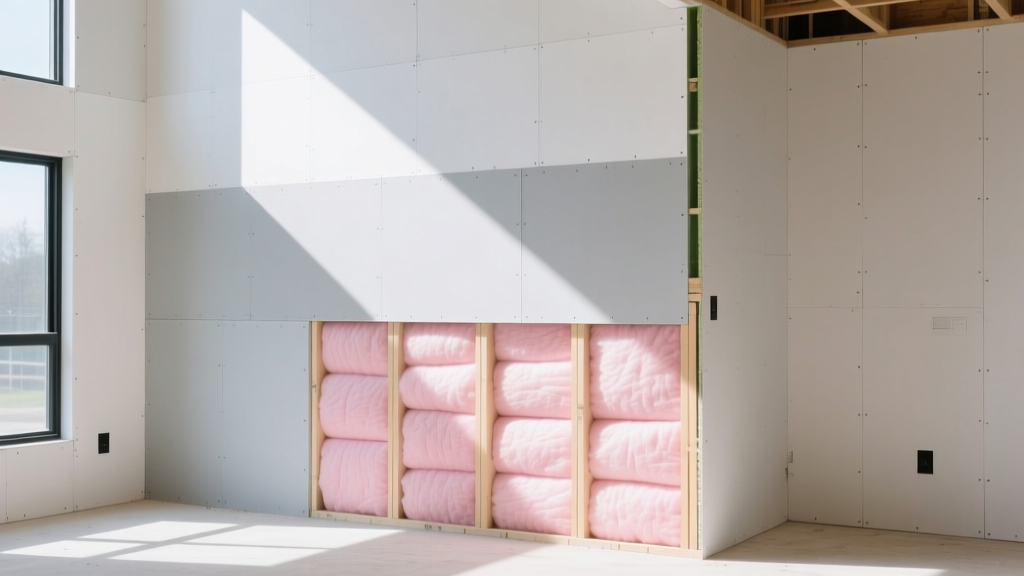
The Cost Matrix: Material Pricing and Installation
Pricing for insulation fluctuates based on petroleum costs, supply chain dynamics, and regional labor rates. As of 2026, the following matrix reflects national averages for both material and professional installation costs in standard residential and light-commercial applications.
| Material Type | R-Value per Inch | Installed Cost (per sq. ft.) | Primary Use Case |
|---|---|---|---|
| Fiberglass Batts (R-15) | 3.1 - 3.4 | $1.80 - $2.60 | Standard 2x4 wall cavities |
| Mineral Wool (Stone Wool) | 4.0 - 4.3 | $2.80 - $3.90 | Fire-rated assemblies, soundproofing |
| Open-Cell Spray Foam | 3.5 - 3.8 | $3.80 - $5.20 | Interior rooflines, irregular cavities |
| Closed-Cell Spray Foam | 6.0 - 7.0 | $6.50 - $9.00 | Flood zones, structural racking, high R |
| Polyiso Rigid Board | 6.0 - 6.5 (aged) | $3.20 - $4.80 | Continuous exterior insulation (ci) |
| XPS Rigid Board | 5.0 | $2.90 - $4.10 | Below-grade foundations, under-slab |
Hidden Costs and Failure Modes in Insulation Projects
The initial invoice for insulation materials rarely captures the true cost of a thermal envelope. Building professionals must account for failure modes that degrade performance over time, ultimately costing more in energy losses and remediation.
1. Thermal Bridging and Whole-Wall R-Value
A common miscalculation is assuming a wall with R-15 cavity insulation performs at R-15. Wood studs, top plates, and corners create thermal bridges—paths of least resistance for heat. The Building Science Corporation notes that standard 2x4 framing at 16 inches on center reduces the "whole-wall" R-value by roughly 20%. To mitigate this, continuous insulation (ci) like polyiso sheathing is required by modern energy codes, adding $1.50 to $2.50 per square foot to the exterior envelope cost.
2. Air Sealing Deficits
Fiberglass and mineral wool are highly air-permeable. If the drywall and subfloor are not meticulously sealed with acoustic sealant or fluid-applied membranes, wind washing will strip the thermal boundary of its effectiveness. Budgeting an additional $0.50 to $1.00 per square foot for comprehensive air sealing (such as the ENERGY STAR Seal and Insulate protocols) is non-negotiable for batt insulation.
3. Moisture Trapping with Closed-Cell Foam
Closed-cell spray foam acts as a Class I vapor retarder. If applied to the interior of an older, unventilated masonry wall or a roof deck with a minor leak, it traps moisture against the structural sheathing, leading to concealed rot. The remediation cost for rotted roof sheathing can exceed $15,000, entirely wiping out any energy savings.
Real-World Edge Case: The "Flash and Batt" Hybrid Approach
For projects demanding high performance without the exorbitant cost of full-depth closed-cell foam, the "flash and batt" method offers a superior ROI. This technique involves spraying 1.5 to 2 inches of closed-cell foam directly against the exterior sheathing (the "flash"), followed by filling the remainder of the cavity with standard R-15 fiberglass batts.
- The Physics: The 1.5-inch foam layer provides roughly R-10 and acts as a perfect air and vapor barrier, preventing condensation on the cold sheathing.
- The Cost: Drops from $8.00/sq. ft. (full foam) to approximately $4.50/sq. ft.
- The Result: A highly efficient, code-compliant wall assembly that costs nearly half as much as a pure spray-foam build.
Calculating ROI: When Does Insulation Pay for Itself?
To determine the financial viability of upgrading insulation, use the Simple Payback Period formula:
Payback Period (Years) = Total Installed Cost / Annual Energy Savings
Scenario Analysis: Upgrading a 2,400 sq. ft. home in Climate Zone 5 from code-minimum R-13 walls to R-21 walls using dense-pack cellulose.
- Incremental Cost: $2,800 over standard batts.
- Annual Energy Savings: Estimated at $410 per year based on current utility rates.
- Base Payback: 6.8 years.
However, this calculation ignores HVAC downsizing. By tightening the envelope and increasing R-values, the peak heating and cooling loads drop. In this scenario, the builder can install a 2.5-ton heat pump instead of a 3-ton unit, saving $1,800 in upfront equipment costs. Factoring in the equipment savings, the effective payback period drops to just 2.4 years, after which the insulation generates pure net-positive cash flow.
Strategic Purchasing: Specifying the Right Products
When procuring materials, avoid generic specifications. Demand specific product lines that guarantee consistent density and R-value retention:
- Fiberglass: Specify Owens Corning EcoTouch Pink Next Gen or Knauf EcoBatt. These utilize bio-based binders that eliminate off-gassing and maintain loft (thickness) better than older acrylic formulations.
- Mineral Wool: ROCKWOOL Comfortbatt remains the industry standard for its 4.2 R-value per inch and inherent fire resistance (withstands temperatures up to 2,150°F).
- Exterior Continuous Insulation: Huber Zip System R-Sheathing combines structural sheathing, water-resistive barrier, and polyiso foam in one panel, drastically reducing labor costs compared to installing separate layers.
Frequently Asked Questions
Is higher R-value always worth the extra cost?
No. Insulation follows the law of diminishing returns. Upgrading from R-0 to R-10 yields massive energy savings. Upgrading from R-40 to R-50 yields marginal savings that rarely justify the material cost. Always run a Manual J load calculation to find the optimal economic R-value for your specific climate zone.
What is insulating material made of in eco-friendly options?
Sustainable alternatives include cellulose (85% recycled newsprint treated with borates for fire/pest resistance), sheep's wool (naturally moisture-managing), and cork (harvested without killing the tree, offering excellent acoustic and thermal properties). Cellulose typically costs between $2.20 and $3.50 per square foot installed and offers an excellent carbon-negative profile.
Written by
David NakamuraDavid Nakamura is a licensed architect (AIA) and construction technology writer focused on sustainable building methods, mass timber engineering, and high-performance building envelopes. He holds a Master of Architecture from the University of Washington and is a certified Passive House Consultant (CPHC). David spent eight years at the Seattle firm Mithun, where he led the design of three LEED Platinum projects, before founding his own practice specializing in net-zero residential design. He serves on the editorial advisory board of GreenBuilder Magazine and has authored peer-reviewed papers on cross-laminated timber (CLT) connections for the Journal of Structural Engineering. In his spare time, David teaches woodworking at Pratt Fine Arts Center and kayaks the Puget Sound.
More from David Nakamura
View all
Construction Cost
Labor Cost to Build a Deck Per Sq Ft: 2026 Installation Guide
Discover the exact labor cost to build a deck per sq ft in 2026. This installation guide breaks down contractor rates, complexity factors, and hidden fees.
Aug 4, 2026

Construction Cost
How Much Does It Cost to Build a 3 Bedroom House? Financing Guide
Learn exactly how much it costs to build a 3 bedroom house and explore 2026 financing options, construction loan types, and budget frameworks for your build.
Aug 4, 2026

Construction Cost
Cost to Build a Tennis Court: 2026 Guide
How much does it cost to build a tennis court in 2026? Breakdowns for asphalt, concrete, and synthetic surfaces plus fencing and lighting.
Jul 30, 2026