Spray Foam Insulation Kits Lifespan: Durability and Failure Analysis
Analyze the real-world lifespan of DIY spray foam insulation kits. Discover durability limits, common failure modes, and how to maximize kit longevity.
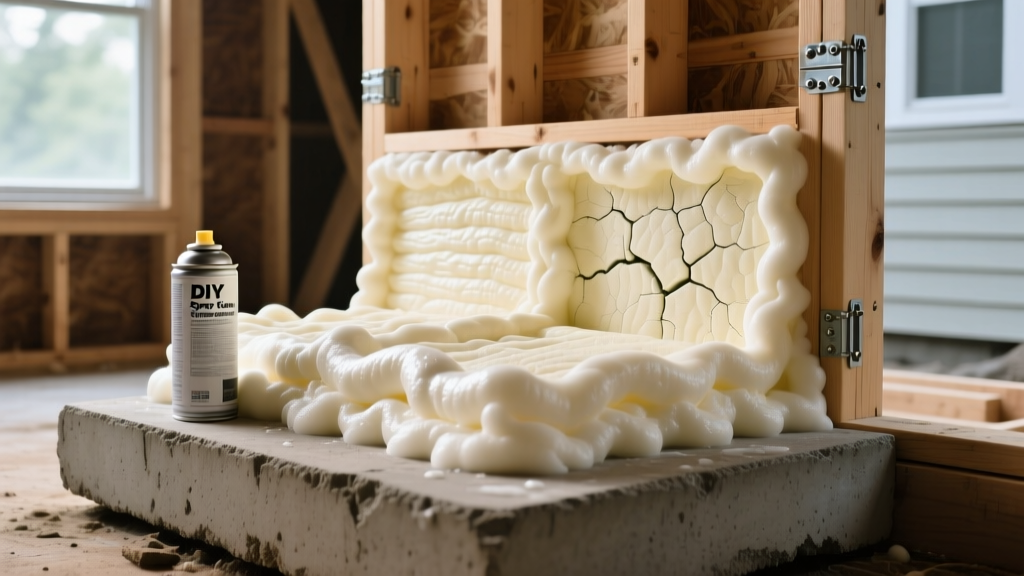
The Reality of DIY Spray Foam Longevity
When evaluating building envelope upgrades, contractors and homeowners frequently ask how long pressurized spray foam insulation kits last compared to professional high-pressure rig applications. Under optimal conditions, properly applied closed-cell spray foam from consumer and prosumer kits (such as Tiger Foam or Touch 'n Foam Pro) maintains its structural and thermal integrity for 20 to 30 years. However, this lifespan is not guaranteed. Unlike professional two-component high-pressure systems that precisely meter chemicals at the gun, DIY and prosumer kits rely on pressurized propellants to push the A-side (isocyanate) and B-side (polyol resin) through a static mixing nozzle.
As of 2026, the regulatory landscape has shifted significantly. Following the phasedown of hydrofluorocarbons (HFCs) under the AIM Act, modern spray foam kits now exclusively utilize hydrofluoroolefin (HFO) blowing agents. While HFOs offer a drastically lower global warming potential, they also alter the foam's cellular structure and long-term thermal drift characteristics. Understanding the chemical and mechanical limitations of these pressurized kits is critical for predicting their true lifespan in the field.
Chemical Composition and Inherent Lifespan Limits
The longevity of kit-applied foam is fundamentally tethered to the chemical reaction between the isocyanate and polyol resin. In a professional rig, heated hoses and high-pressure impingement mixing ensure a perfect 1:1 volumetric ratio. In a pressurized kit, the ratio is dictated by the internal tank pressure and the flow restrictors built into the nozzle.
If tank pressures are unequal—often caused by storing the kit in a cold garage or failing to shake the tanks—the chemical mix becomes "off-ratio." Off-ratio foam may appear normal upon initial application but will suffer from severe long-term friability (crumbling) and shrinkage, reducing its effective lifespan from decades to just a few years before it detaches from the substrate.
According to building science guidelines from the Pacific Northwest National Laboratory (PNNL), spray foam must maintain continuous adhesion to the substrate to function as an air and vapor barrier. Kit foam that is applied off-ratio will undergo post-curing shrinkage exceeding 2%, breaking the adhesive bond and creating micro-gaps that compromise the building envelope.
Primary Failure Modes in Kit-Applied Foam
To accurately assess durability, we must examine the specific failure modes that disproportionately affect pressurized kits compared to professional applications.
1. Thermal Cycling and Micro-Fracturing
Closed-cell kit foam boasts a rigid, dense structure (typically 1.75 to 2.0 lbs per cubic foot). While this provides excellent structural rigidity and an R-value of roughly 6.5 to 7.0 per inch, it lacks the flexibility of open-cell foam. In climates with extreme temperature swings, the framing lumber expands and contracts at a different rate than the rigid foam. Over 10 to 15 years of severe thermal cycling, kit-applied closed-cell foam can develop micro-fractures along the stud-to-foam interface, particularly if applied in overly thick, single passes that generate excessive exothermic heat during curing.
2. UV Degradation and Surface Chalking
Polyurethane foam is highly susceptible to ultraviolet radiation. If kit foam is applied in an attic or crawl space and left exposed to sunlight through an unsealed window or vent, the surface will begin to oxidize and chalk within 48 hours. While this surface degradation does not immediately destroy the insulation's R-value, it compromises the foam's fire-retardant intumescent coating and creates a friable dust layer that degrades indoor air quality. The Environmental Protection Agency (EPA) mandates that all spray foam must be covered by an approved thermal or ignition barrier within specific timeframes to prevent this degradation and mitigate fire risks.
3. Moisture Intrusion and Hydrolysis
While closed-cell foam is virtually impermeable to liquid water (acting as a Class II vapor retarder at 1.5 inches thick), the *interface* between the foam and the substrate is vulnerable. If a roof leak or plumbing condensation introduces bulk water behind the foam, the trapped moisture cannot dry inward. Over time, this trapped moisture causes the wood substrate to rot, destroying the mechanical adhesion of the foam and leading to catastrophic delamination.
Lifespan and Performance Comparison Matrix
The following matrix contrasts the long-term performance metrics of modern HFO-based pressurized kits against professional high-pressure closed-cell applications.
| Metric | Pressurized Kits (HFO) | Professional High-Pressure Rig |
|---|---|---|
| Expected Lifespan | 20 - 30 Years | 50+ Years (Life of Structure) |
| Long-Term R-Value (Aged) | R-6.2 to R-6.5 per inch | R-6.5 to R-7.0 per inch |
| Shrinkage Risk | Moderate (Highly temp-dependent) | Negligible (< 1%) |
| Adhesion Strength | 15 - 20 psi | 25 - 35+ psi |
| Cost per Board Foot (1" thick) | $1.10 - $1.60 | $1.50 - $2.80 |
Thermal Drift and Blowing Agent Diffusion
A critical, often overlooked factor in spray foam durability is thermal drift. When kit foam is first applied, the HFO blowing agents trapped within the closed cells provide an initial R-value that can exceed 7.0 per inch. However, over the first 5 to 10 years, these heavy blowing agent gases slowly diffuse out of the cellular structure and are replaced by ambient air. According to the U.S. Department of Energy, this diffusion process stabilizes after roughly a decade, resulting in the "aged R-value" listed by manufacturers.
The transition to HFO blowing agents in modern kits has actually improved long-term thermal drift profiles compared to the older HFC-245fa formulations. HFO molecules are larger and diffuse through the polyurethane cell walls at a slower rate, meaning 2026-era kits retain their peak insulating properties longer than kits manufactured prior to the regulatory phase-down.
Actionable Protocols to Extend Kit Foam Lifespan
To ensure a pressurized kit reaches its maximum 30-year lifespan, installers must strictly adhere to environmental and mechanical protocols during application.
- Temperature Conditioning: Store the kit tanks in a conditioned space (70°F to 80°F) for at least 48 hours prior to use. Cold tanks result in sluggish B-side resin flow, causing severe off-ratio mixing and permanent friability.
- Vigorous Agitation: Shake both the A and B tanks for a minimum of 60 seconds each, inverting them completely. This ensures the blowing agents and resins are uniformly suspended, preventing density variations that lead to localized shrinkage.
- Substrate Preparation: Vacuum and wipe down all framing and sheathing. Polyurethane will not adhere to sawdust, frost, or oily residues. A mechanical bond to clean wood or concrete is mandatory for long-term durability.
- Pass Thickness Limits: Do not apply closed-cell kit foam in passes thicker than 2 to 3 inches. Excessive thickness traps exothermic heat, which can scorch the core of the foam, degrading the polymer matrix and creating internal voids.
- Nozzle Management: Change the static mixing nozzle immediately if you pause for more than 30 seconds. A partially cured nozzle will restrict flow unevenly, instantly ruining the chemical ratio of the subsequent spray.
Decision Framework: When to Use Kits vs. Professional Rigs
Understanding the durability limits of kits allows for intelligent project scoping. Use the following framework to determine the appropriate application method:
✅ Ideal Scenarios for Spray Foam Kits
- Rim Joist Sealing: High-impact air sealing in small, complex geometries where a professional rig's minimum setup fee is cost-prohibitive.
- Crawl Space Band Joists: Targeted moisture and thermal control in confined spaces.
- Draft Stopping & Penetrations: Sealing around plumbing stacks, electrical chases, and top plates in retrofit scenarios.
- Van/RV Conversions: Small-volume applications where the rigid structural support of closed-cell kit foam adds to the vehicle's torsional rigidity.
❌ Scenarios Requiring Professional High-Pressure Rigs
- Whole-Attic Roof Decks: Creating unvented cathedral ceilings requires continuous, thick applications that are nearly impossible to achieve uniformly with kits without risking off-ratio shrinkage and massive cost overruns.
- New Construction Full-Wall Cavities: The volume of kits required for a whole home is cost-inefficient, and the risk of cumulative application errors compromises the entire building envelope's durability.
- Metal Building Insulation: Adhesion to curved or corrugated metal requires the high-velocity impingement mixing of a professional gun to ensure long-term bond integrity against thermal expansion.
Ultimately, the lifespan of spray foam insulation kits is highly contingent on the installer's discipline. When environmental variables are strictly controlled and application limits are respected, modern HFO-based kits provide a highly durable, decades-long thermal and air barrier for targeted building envelope upgrades.