Top Car Sound Insulation Material for EV Range and Noise Control
Discover the best car sound insulation material for EVs. Learn how lightweight acoustic treatments reduce cabin noise while maximizing battery range.
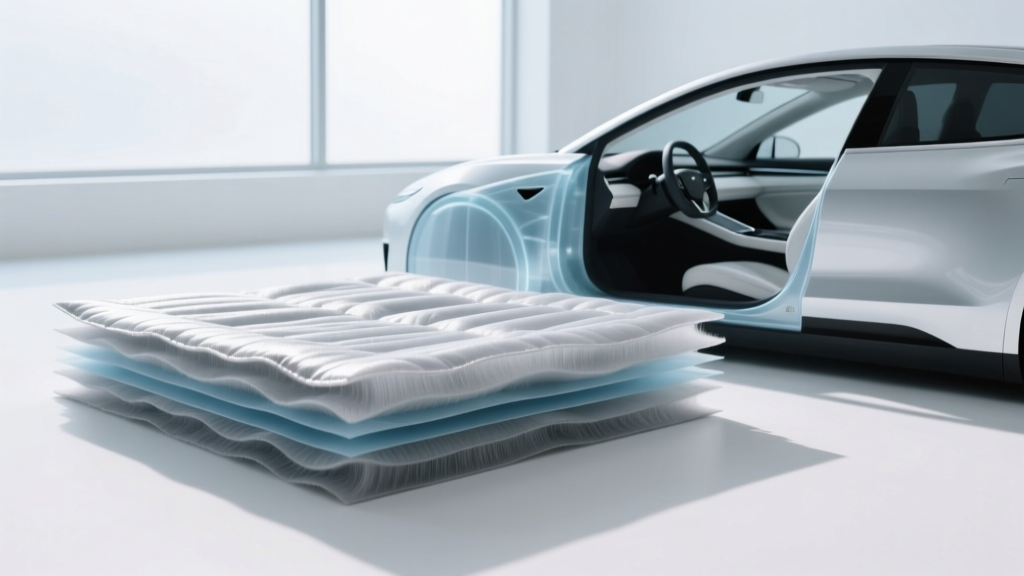
The EV Dilemma: Balancing NVH Reduction with Energy Efficiency
As automotive engineering shifts toward electric vehicles (EVs), the paradigm of cabin acoustics has fundamentally changed. Without the masking noise of an internal combustion engine (ICE), road roar, tire cavity resonance, and wind noise become glaringly apparent. However, traditional soundproofing methods often rely on mass, which directly penalizes EV efficiency. According to the U.S. Department of Energy, reducing vehicle weight is one of the most effective ways to improve electric range and overall energy consumption. Every 100 pounds of added weight can reduce an EV's range by 1% to 2%.
Selecting the right car sound insulation material is no longer just about blocking decibels; it is a critical exercise in weight management and thermal efficiency. Modern acoustic treatments must mitigate Noise, Vibration, and Harshness (NVH) while simultaneously providing thermal resistance to reduce HVAC compressor loads—a major drain on traction batteries.
How Car Sound Insulation Material Impacts Thermal and Electrical Loads
To understand material selection, we must separate acoustic damping from acoustic decoupling and thermal blocking.
- Resonance Damping: Stops large sheet metal panels (doors, roof, floor) from vibrating and amplifying low-frequency road noise.
- Decoupling: Prevents high-frequency airborne noise from transmitting through the chassis into the cabin.
- Thermal Blocking: Reflects radiant heat and slows conductive heat transfer, reducing the energy required to heat or cool the cabin.
Hauling 80 pounds of Mass Loaded Vinyl (MLV) to block airborne noise is an outdated ICE-era strategy. The Vehicle Technologies Office emphasizes lightweighting as a core pillar of next-generation mobility. Therefore, the optimal car sound insulation material for 2026 EV platforms utilizes a multi-layer, low-mass approach.
Material Matrix: Weight-to-Performance Ratios for EV Platforms
The table below compares the most common automotive acoustic materials, highlighting their specific gravity, primary function, and impact on vehicle efficiency.
| Material Type | Example Product | Thickness / Weight | Primary Role | EV Efficiency Impact |
|---|---|---|---|---|
| Butyl CLD (Constrained Layer Damper) | Dynamat Xtreme / Noico 80 mil | 67-80 mil / 0.35-0.40 lbs/sq ft | Stops structural panel resonance | High (Minimal weight penalty) |
| Closed-Cell Polyethylene Foam (CCF) | Thermo-Tec / Generic PE Foam | 1/4 to 1/2 inch / 0.05 lbs/sq ft | Decoupling & high-frequency absorption | Excellent (Near-zero weight) |
| Aerogel-Infused Blanket | Aspen Aerogels Spaceloft | 10 mm / 0.02 lbs/sq ft | Extreme thermal & acoustic blocking | Superior (Saves HVAC energy) |
| Mass Loaded Vinyl (MLV) | Soundsulate 1 lb MLV | 1/8 inch / 1.00+ lbs/sq ft | Airborne noise blocking via mass | Poor (Severe range penalty) |
Top Tier Car Sound Insulation Material Profiles
1. Butyl-Based Constrained Layer Dampers (CLD)
CLD mats consist of a viscoelastic butyl rubber layer bonded to a rigid aluminum constraining layer. When the car's sheet metal vibrates, the butyl layer shears, converting kinetic vibrational energy into trace amounts of heat. Dynamat Xtreme (67 mil) and Noico 80 mil are industry benchmarks. Unlike older asphalt-based mats, premium butyl remains stable from -40°F to 240°F, ensuring it will not melt, sag, or off-gas toxic fumes during summer months. For EV efficiency, butyl CLD offers the highest decibel-reduction-per-pound ratio available.
2. Closed-Cell Polyethylene Foam (CCF)
CCF is a lightweight, waterproof foam that acts as a decoupler. When placed between the vehicle's metal chassis and the interior plastic trim or carpet, it prevents high-frequency vibrations from transferring into the cabin. Because it is closed-cell, it also provides an excellent moisture barrier and a modest thermal R-value. Applying a 1/4-inch layer of CCF over CLD treatments creates a highly effective, ultra-lightweight acoustic sandwich.
3. Aerogel-Infused Acoustic Blankets
For the ultimate energy efficiency upgrade, silica aerogel blankets (such as those utilizing Aspen Aerogels Spaceloft technology) represent the cutting edge of automotive insulation. Aerogel is up to 95% air by volume, making it incredibly light while boasting a thermal conductivity as low as 14 mW/m-K. Placing aerogel blankets beneath the EV cabin floor dramatically reduces thermal transfer from the battery pack, keeping the cabin cooler in summer and warmer in winter without taxing the HVAC compressor.
Strategic Application: The 25% Coverage Rule
The most common mistake DIYers and custom shops make is attempting 100% surface coverage with CLD mats. This is a waste of money and adds unnecessary weight. Acoustic engineering principles dictate that treating just 25% to 30% of a flat panel's surface area is sufficient to alter its resonant frequency and eliminate low-frequency drumming.
Applying butyl CLD in strategic strips or grid patterns across the center of door skins, the roof, and the rear quarter panels yields 95% of the acoustic benefit of full coverage, while saving up to 15 pounds of dead weight per vehicle.
Step-by-Step Installation for Maximum Cabin Efficiency
- Strip and Clean: Remove seats, carpet, and trim. Clean the bare metal with isopropyl alcohol or a dedicated automotive prep solvent to remove factory grease and anti-corrosion oils.
- Map the Resonance: Use a rubber mallet to tap the bare metal panels. Identify areas that produce a low, ringing 'gong' sound. These are your primary target zones for CLD application.
- Apply Butyl CLD: Cut the butyl mats into manageable strips. Apply them to the target zones, covering roughly 25% of the surface area. Use a hard plastic or wooden roller to apply immense pressure, ensuring the butyl fully bonds to the metal's microscopic pores.
- Layer the CCF Decoupler: Apply Closed-Cell Foam over the entire floor pan and firewall using high-temperature spray adhesive. This creates the decoupling layer and adds thermal resistance.
- Seal the Gaps: Use acoustic caulk or butyl tape to seal any pass-through holes in the firewall and floor where wiring harnesses enter the cabin. Airborne noise travels through air leaks; sealing them costs ounces, not pounds.

Common Failure Modes and Weight Penalties
Many budget-friendly car sound insulation material options on the market use asphalt instead of butyl rubber. Asphalt is heavily reliant on mass rather than viscoelastic damping. It becomes brittle in freezing temperatures (cracking and losing effectiveness) and turns into a sticky, foul-smelling mess when cabin temperatures exceed 130°F. Furthermore, asphalt mats weigh nearly twice as much as butyl equivalents, inflicting a severe and unnecessary penalty on your EV's energy efficiency.
Another critical failure mode is trapping moisture. If you apply non-breathable insulation materials directly over factory felt or jute padding without removing it first, condensation will become trapped against the bare metal. Over time, this accelerates galvanic corrosion and rust from the inside out. Always strip the vehicle to bare, painted metal before applying any acoustic or thermal treatments.
By prioritizing advanced, lightweight materials like butyl CLD, CCF, and aerogel over antiquated mass-heavy solutions, you can achieve a whisper-quiet cabin while actively protecting your EV's battery range and thermal efficiency. The data from the EPA regarding EV benefits underscores that maximizing efficiency isn't just about battery chemistry; it's about holistic vehicle design, including the intelligent application of modern insulation materials.
Written by
James ThorntonJames Thornton is a construction industry veteran with 25 years of hands-on experience in wood framing, lumber grading, and residential building codes. He started as a framing carpenter in rural Oregon, earned his ICC Residential Building Inspector certification, and eventually became a senior plan reviewer for the City of Portland Bureau of Development Services. James holds a B.S. in Wood Science & Technology from Oregon State University and is a certified lumber grader through the West Coast Lumber Inspection Bureau (WCLIB). He has inspected over 3,000 residential construction sites and authored the city's internal guide on advanced framing techniques (2x6 at 24" O.C.). James lives in Bend, OR, where he builds custom timber-frame cabins and competes in lumberjack sports.
More from James Thornton
View all
Insulation
Best Home Insulation Materials: Complete 2026 Guide
Compare top home insulation materials for 2026. Find R-values, installed costs per square foot, and best uses for fiberglass, spray foam, and mineral wool.
Aug 4, 2026

Sustainable Building
Certify Your Green Building Material for LEED and WELL
Step-by-step guide to certifying a green building material for LEED v5 and WELL v2. Master EPDs, HPDs, and VOC limits for 2026 project specifications.
Aug 4, 2026

Stone & Masonry
Veneer Stacked Stone Panels: Interior Design & Style Showcase
Discover how veneer stacked stone panels transform interiors. Explore modern design profiles, material pairings, and technical installation specs.
Aug 4, 2026