Evaluating Electrical Insulation Material Suppliers for R-Value
Learn how to evaluate electrical insulation material suppliers based on dual-performance metrics: thermal R-value and dielectric strength for MEP.

The Dual Mandate: Dielectric Strength Meets Thermal R-Value
In commercial and industrial MEP (Mechanical, Electrical, and Plumbing) design, electrical vaults, transformer substations, and high-voltage switchgear enclosures present a unique engineering paradox. These environments generate massive thermal loads while requiring strict dielectric isolation to prevent arc flashes and short circuits. Consequently, facility managers and electrical contractors cannot rely on standard building insulation. Sourcing the right electrical insulation material suppliers requires evaluating products against two often-competing metrics: thermal resistance (R-value) and dielectric breakdown strength (measured in kV/mm).
Standard high R-value building materials, such as open-cell spray foam or unfaced fiberglass batts, are highly porous. In an electrical room, these pores can trap ambient moisture or conductive dust, catastrophically lowering their dielectric resistance and creating a severe fire hazard. Conversely, materials with exceptional dielectric properties, like solid epoxy resins or dense mica composites, typically possess high thermal conductivity, offering almost zero thermal resistance. Bridging this gap requires specialized dual-purpose materials and suppliers who understand both thermodynamics and electrotechnical safety standards.
Core Materials Supplied for High-Voltage Thermal Management
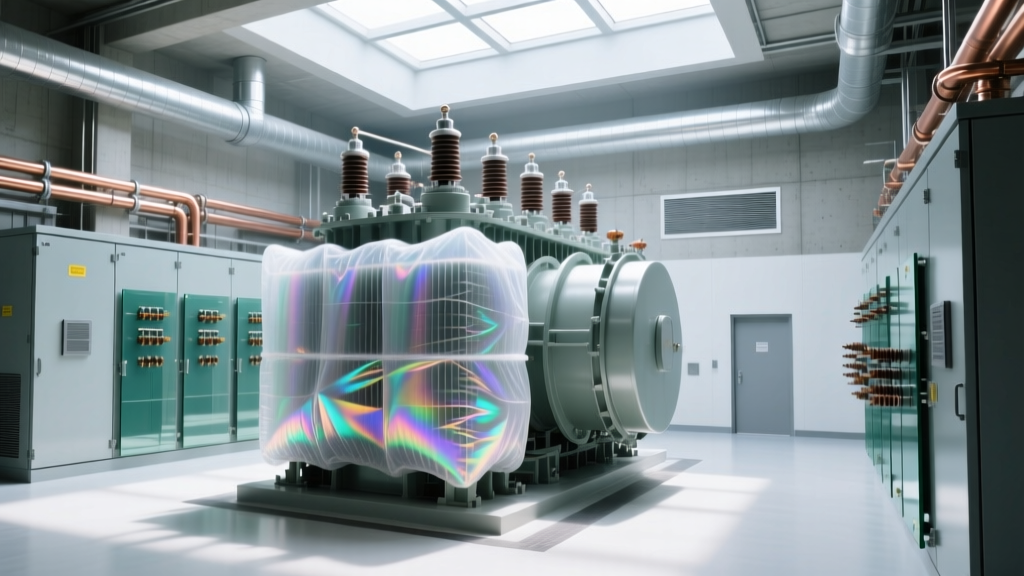
Top-tier electrical insulation material suppliers do not sell generic building products; they manufacture engineered composites designed to withstand high heat flux while maintaining electrical isolation. Below are the primary material categories used in modern electrical enclosures.
Ceramic-Fiber Dielectric Boards
Products like Cotronics 902 or equivalent high-purity alumina-silica boards are staples in high-voltage busway enclosures.
- Thermal Performance: R-2.4 per inch (Thermal conductivity $k \approx 0.06 \, W/m\cdot K$).
- Dielectric Strength: Non-conductive up to 2500°F (1370°C), maintaining structural integrity during arc-flash events.
- Application: Lining the interior of transformer vault doors and bus duct partitions to protect adjacent building spaces from extreme radiant heat.
Mica-Glass Laminates
Suppliers specializing in electrotechnical components (e.g., Von Roll, Isovolta) provide mica-glass composites bonded with high-temperature silicone resins.
- Thermal Performance: Low R-value (approx. R-0.4 per inch), but utilized in thin 1/16" to 1/4" sheets where space is constrained.
- Dielectric Strength: Exceptional, typically exceeding 15 kV/mm per ASTM D149.
- Application: Direct wrapping of high-voltage busbars, coil insulation, and terminal board separators where localized heat dissipation must be managed without risking phase-to-phase faults.
Aerogel-Infused Dielectric Blankets
For maximum thermal resistance in cramped electrical rooms, specialized silica aerogel blankets (such as Pyrogel XT-E variants) are used. While standard aerogel is not inherently rated for direct high-voltage contact, premium electrical insulation material suppliers encapsulate these blankets in dielectric silicone-fiberglass jackets.
- Thermal Performance: Industry-leading R-10.2 per inch.
- Dielectric Strength: Dependent on the outer jacket; typically rated for 600V to 5kV isolation depending on the specific silicone-fiberglass weave.
- Application: Wrapping high-voltage conduit runs passing through unconditioned spaces to prevent thermal loss and condensation-induced tracking.
Supplier Evaluation Matrix: Beyond the Spec Sheet
When vetting electrical insulation material suppliers, MEP engineers must look past basic marketing brochures. The following matrix outlines the critical differentiators between commodity distributors and specialized electrotechnical manufacturers.
| Evaluation Criteria | Commodity Distributor | Specialized Electrotechnical Supplier |
|---|---|---|
| Certification Standards | Basic UL 94 flammability ratings. | Full UL 1446 (Systems of Insulating Materials) and IEC 60674 compliance. |
| Thermal Data Transparency | Provides only maximum operating temperature. | Provides full thermal conductivity ($k$) curves across varying temperatures per ASTM C518. |
| Custom Fabrication | Sells only in standard 4x8 sheets or bulk rolls. | Offers CNC routing for custom busbar cutouts and precise dielectric clearances. |
| Moisture Tracking Data | Not available. | Provides volume resistivity data post-humidity conditioning (ASTM D257). |
Red Flags When Sourcing Electrical Insulation Material Suppliers
The National Electrical Manufacturers Association (NEMA) maintains strict guidelines for electrical insulation. If a prospective supplier exhibits any of the following red flags, they are likely supplying repurposed building materials rather than true electrotechnical insulation:
- Lack of Tracking Index Data: High-voltage environments require materials with a high Comparative Tracking Index (CTI). If a supplier cannot provide the CTI rating (tested per IEC 60112), their material may fail prematurely due to surface carbonization from micro-arcs.
- Conflating R-Value with Fire Rating: Some suppliers will market a material's 1-hour ASTM E119 fire rating as proof of thermal insulation performance. Fire resistance indicates how long a material maintains structural integrity in a blaze; it does not equate to the R-value required to keep adjacent spaces below ambient temperature limits during normal transformer operation.
- Ignoring Thermal Expansion Coefficients: Busbars expand and contract significantly under load. Rigid insulation materials with mismatched coefficients of thermal expansion (CTE) will crack over time, compromising both the R-value and the dielectric barrier. Premium suppliers provide CTE data to ensure compatibility with copper and aluminum conductors.
Cost Benchmarks for Dual-Purpose Electrical Insulation
Budgeting for specialized electrical insulation requires understanding the premium placed on dual-certified materials. Based on 2026 commercial pricing structures, here is what MEP contractors should expect when sourcing from qualified electrical insulation material suppliers:
2026 Pricing Realities
- Ceramic-Fiber Boards (1/2" thick): $8.50 to $14.00 per square foot. Often sold in custom-cut kits for specific switchgear models.
- Mica-Glass Laminates (1/8" thick): $18.00 to $28.00 per square foot. High material cost is offset by the extremely thin profile required, saving valuable vault footprint space.
- Dielectric-Encapsulated Aerogel Blankets (10mm): $35.00 to $45.00 per linear foot. The most expensive option, reserved for critical high-voltage conduit runs where maximizing R-value in a tight spatial envelope is mandatory.
Frequently Asked Questions (FAQ)
Can standard fiberglass insulation be used in electrical rooms if it has a fire rating?
No. While faced fiberglass may carry a Class A fire rating per ASTM E84, the glass fibers and binder resins are not tested or certified for dielectric strength. Furthermore, if the vapor barrier is punctured, the exposed fiberglass can absorb moisture and conductive dust, creating a severe tracking and arc-flash hazard. Always refer to the Whole Building Design Guide (WBDG) for proper MEP material separation protocols.
How do I calculate the required R-value for a transformer vault wall?
The required R-value depends on the transformer's heat dissipation (watts), the vault's surface area, and the maximum allowable temperature of the adjacent occupied space. Electrical engineers typically use finite element analysis (FEA) software to model the thermal load. Once the required thermal resistance is calculated, you must select an electrical insulation material supplier whose products meet that R-value while simultaneously satisfying the NEC (National Electrical Code) working space and dielectric clearance requirements.
Do aerogel blankets outperform mica boards in electrical applications?
They serve entirely different purposes. Aerogel blankets provide superior thermal resistance (high R-value) and are used to insulate the environment around electrical equipment. Mica boards provide superior dielectric strength and arc resistance, and are used to insulate the electrical components themselves. A comprehensive vault design often utilizes both materials in tandem.
Written by
Priya KapoorPriya Kapoor is a real estate market analyst and construction economics researcher with expertise in housing affordability, development feasibility, and infrastructure investment. She holds a Master of Regional Planning from Cornell University and previously worked as a senior analyst at CBRE's Investment Properties group, where she modeled returns for $4B in mixed-use development pipelines. Priya now runs an independent research practice advising developers, municipalities, and REITs on construction cost forecasting and market timing. She publishes the quarterly "BuildMat Market Pulse" report tracking material price indices across 12 commodity categories. Based in Austin, TX, Priya serves on the board of Habitat for Humanity Austin and is a marathon runner.
More from Priya Kapoor
View all
Construction Cost
Cost to Build a 1600 Sq Ft Home in 2026: Full Breakdown
Accurate 2026 cost to build a 1600 sq ft home—material, labor, and regional pricing breakdowns included. Plan your budget with real-time estimates.
Aug 11, 2026

Wood & Lumber
Name the Types of Wood for Pressure Treatment and Preservation
Learn how to name the types of wood best suited for pressure treatment. Compare species treatability, chemical retention levels, and 2026 preservation costs.
Aug 4, 2026

Stone & Masonry
Stone Veneer Suppliers Lindenhurst: 2026 Cost Analysis
Analyze 2026 stone veneer costs in Lindenhurst, NY. Compare local supplier pricing, delivery fees, and Suffolk County installation labor rates.
Aug 4, 2026