Selecting the Best Home Insulation Material for Sound Control
Compare top home insulation material options for sound control. Discover STC ratings, costs, and installation tips for acoustic mineral wool and fiberglass.

The Physics of Noise: Why Standard Insulation Fails
When designing a quiet residential space, builders and homeowners frequently make a critical error: assuming that thermal insulation automatically provides acoustic insulation. While any cavity fill will slightly dampen high-frequency airborne noise, true sound control requires a deliberate approach to mass, damping, decoupling, and absorption. Selecting the right home insulation material for acoustic performance requires understanding how sound waves interact with building assemblies.
Airborne noise (voices, television) and impact noise (footsteps, structural vibration) travel through wall cavities by vibrating the drywall, passing through the air gap, and vibrating the opposite drywall. Standard lightweight thermal batts lack the density to absorb low-frequency sound waves, allowing bass and mechanical hums to pass directly through. To achieve genuine privacy and comfort, you must specify materials engineered for high Noise Reduction Coefficients (NRC) and integrate them into assemblies that maximize the Sound Transmission Class (STC).
Decoding Acoustic Metrics: STC vs. NRC
Before evaluating specific products, it is vital to distinguish between the two primary acoustic metrics used in residential construction:
- Sound Transmission Class (STC): Measures a complete wall or floor assembly's ability to block airborne sound from passing from one room to another. An STC of 35 allows loud speech to be clearly understood. An STC of 50 means loud speech is inaudible. The National Research Council of Canada provides extensive, highly reliable STC testing data for various residential assemblies.
- Noise Reduction Coefficient (NRC): Measures a specific material's ability to absorb sound within a room, reducing echo and reverberation. An NRC of 1.0 indicates 100% absorption of mid-to-high frequency sound. NRC applies to the insulation material itself, while STC applies to the finished wall.
Material Comparison Matrix: Top Home Insulation Material Options
The table below compares the most common cavity insulation types used for interior sound control, reflecting 2026 material pricing and acoustic performance baselines.
| Material Type | Density (lbs/ft³) | NRC Rating | Cost per Sq Ft (2026) | Best Application |
|---|---|---|---|---|
| Acoustic Mineral Wool | 2.5 - 3.0 | 1.05 | $1.15 - $1.45 | Media rooms, bedrooms, plumbing chases |
| Acoustic Fiberglass | 0.8 - 1.2 | 0.90 - 0.95 | $0.65 - $0.85 | Standard interior partitions |
| Dense-Pack Cellulose | 3.0 - 3.5 | 0.85 - 0.90 | $0.90 - $1.20 | Retrofit soundproofing, enclosed walls |
| Open-Cell Spray Foam | 0.4 - 0.5 | 0.70 - 0.80 | $1.30 - $1.60 | Sealing irregular gaps (not primary sound block) |
Deep Dive: Evaluating the Best Home Insulation Material Choices
1. Mineral Wool (The Acoustic Gold Standard)
Mineral wool, specifically products like Rockwool Safe'n'Sound, remains the undisputed leader for residential cavity soundproofing. Its superiority lies in its density and internal fiber structure. At 2.5 lbs/ft³, it is nearly three times denser than standard thermal fiberglass. The randomized, dense stone fibers create immense internal friction, converting acoustic energy into microscopic amounts of heat energy (damping).
Furthermore, mineral wool is inherently non-combustible and hydrophobic. When installing it in interior walls separating a living space from a garage or utility room, you gain simultaneous acoustic, thermal, and fire-blocking benefits. According to the U.S. Department of Energy, mineral wool's rigid nature also allows it to be friction-fit tightly against studs, eliminating the small edge gaps that often compromise acoustic performance in softer batts.
2. Acoustic Fiberglass (The Budget Alternative)
Products like Owens Corning QuietZone are specifically manufactured for sound control. Unlike standard pink fiberglass, acoustic fiberglass is unfaced (lacking a kraft paper or foil vapor barrier) and features a slightly higher density and a more resilient, spring-like fiber matrix. This resilience helps it absorb mid-to-high frequency sounds effectively.
While it cannot match the low-frequency damping of mineral wool due to its lower mass, acoustic fiberglass is highly cost-effective for standard bedroom-to-bedroom partitions where the primary goal is to muffle normal conversation rather than block heavy bass from a home theater.
3. Spray Foam (The Decoupling Myth)
A persistent myth in residential construction is that filling a wall cavity with closed-cell spray foam will soundproof it. In reality, closed-cell foam cures into a rigid, structural plastic. While it adds mass and seals air leaks perfectly, its rigidity can actually create a mechanical bridge between the two sides of the drywall, transmitting low-frequency structural vibrations (flanking noise). Open-cell spray foam is softer and absorbs some sound, but its low density (0.5 lbs/ft³) makes it inferior to mineral wool for dedicated sound control. Use spray foam for sealing rim joists and exterior thermal envelopes, not for interior acoustic partitions.
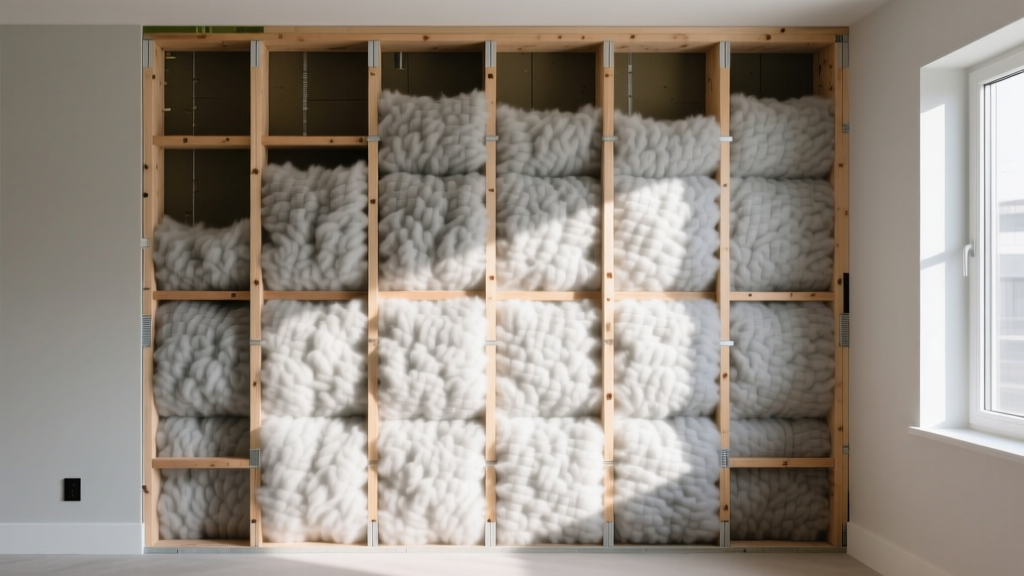
Real-World Wall Assembly Frameworks
The insulation material is only one component of the acoustic system. The Whole Building Design Guide emphasizes that the assembly design dictates the final STC. Here are two proven frameworks for 2026 residential builds:
Scenario A: The Standard 2x4 Interior Partition (Target STC 45-50)
- Framing: Standard 2x4 wood studs at 16 inches on center.
- Cavity Fill: 3-inch Rockwool Safe'n'Sound mineral wool batts. Do not compress them; they must fill the 3.5-inch cavity loosely to maintain their acoustic absorption properties.
- Drywall: 5/8-inch Type X gypsum board on both sides.
- Sealing: Apply a continuous bead of acoustical sealant (e.g., Tremco Acoustical Sealant or OSI SC-175) along the bottom and top plates before drywall installation.
Scenario B: High-Privacy Decoupled Wall (Target STC 55+)
For home theaters, recording studios, or bedrooms adjacent to noisy living areas, mass and absorption are not enough; you must decouple the structure.
- Framing: Staggered-stud design on a single 2x6 plate, or two separate 2x4 walls with a 1-inch air gap.
- Cavity Fill: Mineral wool batts filling the entire depth of the stud cavities.
- Decoupling Hardware: Install RC-1 resilient channels horizontally across the studs at 24 inches on center on one or both sides.
- Drywall: Two layers of 5/8-inch drywall on the resilient channels, sandwiching a layer of Green Glue damping compound. The Green Glue converts sound vibration into heat, drastically reducing low-frequency transmission.
Contractors frequently attempt to force a 3.5-inch thick mineral wool batt into a wall cavity that has plumbing or electrical wires running through it, compressing the material. Compressing acoustic insulation increases its density but decreases its total thickness and air volume, severely degrading its NRC rating and ruining its ability to absorb sound. Always cut the batts to fit precisely around obstructions rather than stuffing them.
Critical Installation Failures and Flanking Paths
Even the most expensive home insulation material will fail if the installation ignores flanking paths—the routes sound takes to bypass the insulated cavity. To protect your investment, mandate the following site protocols:
- Electrical Box Backing: When electrical outlets are installed on opposite sides of the same stud bay, sound travels directly through the drywall and into the boxes. Always separate outlet boxes by at least 24 inches horizontally. Wrap the back of the boxes in mass-loaded vinyl (MLV) or use specialized acoustic putty pads to seal the drywall cutouts.
- Perimeter Acoustical Caulking: Drywall mud and paint do not stop sound. The 1/4-inch gap left between the drywall edge and the floor or ceiling plate acts as an acoustic highway. This gap must be filled with a non-hardening, pliable acoustical sealant before baseboards are installed. Standard latex caulk dries hard and cracks, breaking the acoustic seal over time.
- HVAC Ducting: If a forced-air system uses interior wall cavities as return-air plenums, the sound will travel through the ducts. Ensure all interior partition cavities used for sound control are completely isolated from the HVAC airflow, and line metal ductwork with internal acoustic fiberglass duct liner near registers.
By understanding the physical properties of these materials and pairing the correct home insulation material with proper decoupling and sealing techniques, builders can deliver residential spaces that meet the highest standards of acoustic privacy and comfort.
Written by
Priya KapoorPriya Kapoor is a real estate market analyst and construction economics researcher with expertise in housing affordability, development feasibility, and infrastructure investment. She holds a Master of Regional Planning from Cornell University and previously worked as a senior analyst at CBRE's Investment Properties group, where she modeled returns for $4B in mixed-use development pipelines. Priya now runs an independent research practice advising developers, municipalities, and REITs on construction cost forecasting and market timing. She publishes the quarterly "BuildMat Market Pulse" report tracking material price indices across 12 commodity categories. Based in Austin, TX, Priya serves on the board of Habitat for Humanity Austin and is a marathon runner.
More from Priya Kapoor
View all
Construction Cost
Cost to Build a 1600 Sq Ft Home in 2026: Full Breakdown
Accurate 2026 cost to build a 1600 sq ft home—material, labor, and regional pricing breakdowns included. Plan your budget with real-time estimates.
Aug 11, 2026

Wood & Lumber
Name the Types of Wood for Pressure Treatment and Preservation
Learn how to name the types of wood best suited for pressure treatment. Compare species treatability, chemical retention levels, and 2026 preservation costs.
Aug 4, 2026

Stone & Masonry
Stone Veneer Suppliers Lindenhurst: 2026 Cost Analysis
Analyze 2026 stone veneer costs in Lindenhurst, NY. Compare local supplier pricing, delivery fees, and Suffolk County installation labor rates.
Aug 4, 2026