Best Steam Insulation Material for Pipe Energy Efficiency
Compare the best steam insulation material options for pipe energy efficiency, including calcium silicate, mineral wool, and aerogel blankets.

The Thermodynamics of Steam Line Heat Loss
Steam distribution systems operate under extreme thermal deltas, with pipe surface temperatures frequently ranging from 250°F to over 800°F. When selecting a steam insulation material, the primary objective is minimizing sensible heat loss to maintain steam quality (dryness fraction) at the point of use. An uninsulated 4-inch carbon steel steam pipe operating at 350°F in a 70°F ambient environment will lose approximately 1,500 BTU/hr per linear foot. At 2026 industrial natural gas rates averaging $9 to $12 per MMBtu, a single 100-foot run of uninsulated pipe wastes over $2,500 annually in boiler fuel.
Standard commercial building insulation, such as faced fiberglass batts or basic elastomeric foams, will rapidly degrade, off-gas, or melt under these conditions. Industrial steam lines require rigid or semi-rigid high-temperature materials paired with robust vapor-retarding jacketing to prevent moisture intrusion and subsequent Corrosion Under Insulation (CUI).
Primary Steam Insulation Material Categories
The selection of the optimal steam insulation material hinges on operating temperature, physical abuse tolerance, spatial constraints, and moisture exposure. Below is a comparative matrix of the three dominant materials used in modern mechanical insulation specifications.
| Material Type | ASTM Standard | Max Temp Limit | K-Value @ 400°F | Compressive Strength | Est. Cost (per lin. ft.) |
|---|---|---|---|---|---|
| Calcium Silicate | C533 Type I | 1200°F (649°C) | 0.41 BTU·in/hr·ft²·°F | 150 psi | $4.50 - $7.00 |
| High-Temp Mineral Wool | C547 Type I | 1200°F (649°C) | 0.44 BTU·in/hr·ft²·°F | 75 psi | $2.50 - $4.00 |
| Silica Aerogel Blanket | C1728 Type I | 1200°F (649°C) | 0.25 BTU·in/hr·ft²·°F | 15 psi (Flexible) | $25.00 - $45.00 |
Calcium Silicate: The Heavy-Duty Standard
Calcium silicate (commonly specified under brands like Thermo-12® Gold) remains the benchmark steam insulation material for high-abuse environments. Its defining characteristic is exceptional structural integrity. With a compressive strength exceeding 150 psi, it can withstand foot traffic, ladder leaning, and impact from maintenance equipment without crushing. It is a hydrophilic material, meaning it will absorb water if the outer jacket is breached. However, modern formulations include integral hydrophobic additives that allow the material to dry out and retain its thermal properties once the leak is repaired, provided it hasn't been subjected to physical crushing while wet.
High-Temperature Mineral Wool: The Cost-Effective Workhorse
Mineral wool pipe insulation offers the best balance of thermal performance and upfront cost. Unlike calcium silicate, it is semi-rigid and can accommodate minor pipe vibrations and thermal expansion cycles more gracefully. Mineral wool is inherently hydrophobic; it repels liquid water, making it highly resistant to CUI in environments where jacketing integrity is a concern. The trade-off is lower compressive strength. If maintenance personnel step on mineral wool-insulated pipes, the material will compress, creating a thin spot that drastically reduces local R-value and creates a severe burn hazard on the outer jacket.
Silica Aerogel Blankets: The Space-Saving Premium Option
As manufacturing scales have improved through 2025 and 2026, silica aerogel blankets (such as Aspen Aerogels Pyrogel® HPS) have transitioned from niche aerospace applications to viable industrial retrofits. Aerogel provides up to five times the thermal resistance of traditional materials at a fraction of the thickness. A 40mm layer of aerogel can match the performance of 100mm of calcium silicate. This makes it the mandatory choice for congested pipe racks, tight wall penetrations, and shipboard steam lines where spatial volume is heavily constrained. While the material cost is high, the reduction in scaffolding, labor hours, and aluminum jacketing surface area often equalizes the total installed cost on complex retrofits.
Corrosion Under Insulation (CUI) is the leading cause of catastrophic steam line failure. According to the U.S. Department of Energy Steam Systems Optimization guidelines, water ingress combined with operating temperatures between 212°F and 350°F creates an ideal electrolytic cell for rapid carbon steel oxidation. Never rely on the insulation material itself as a water barrier; the outer jacketing system is your primary defense.
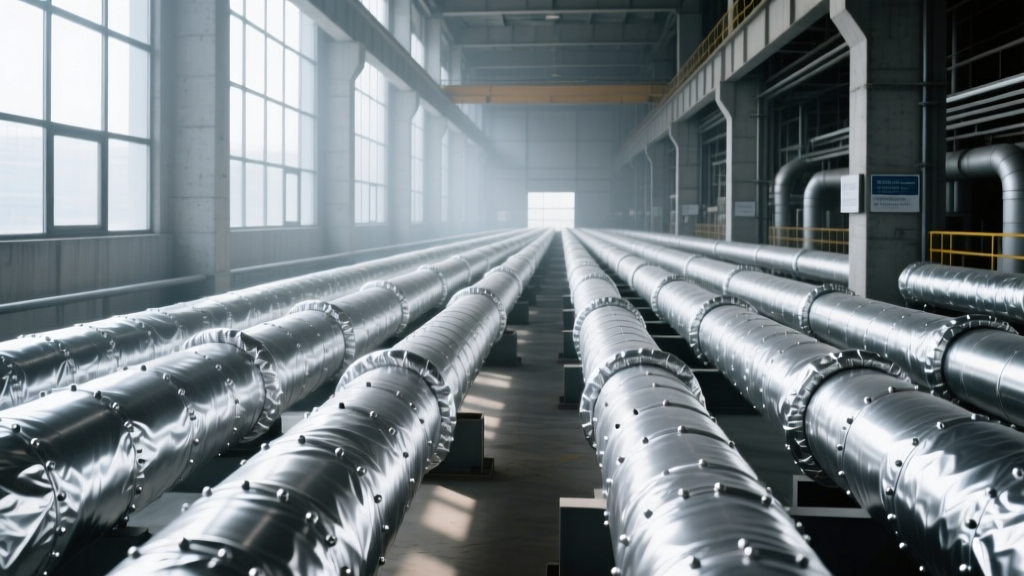
Jacketing Systems: The Unsung Heroes of Energy Retention
The most advanced steam insulation material will fail catastrophically if the outer jacketing is improperly specified. The jacket serves three functions: mechanical protection, UV resistance, and vapor retardation.
- Aluminum (0.024-inch minimum): The industry standard for outdoor and indoor applications. It must be installed with a 2-inch overlap and sealed with UV-stable silicone or specialized mastic. For coastal or high-salt environments, specify 316 stainless steel bands for securing the aluminum to prevent galvanic corrosion.
- Stainless Steel (304 or 316): Required in chemical processing plants, offshore rigs, or areas subject to severe mechanical abuse. It is highly resistant to chloride-induced stress corrosion cracking when paired with the correct insulation.
- PVC / Vinyl (Indoor Only): Acceptable only for low-pressure, low-temperature condensate return lines where surface temperatures will never exceed 150°F. Never use PVC on live steam lines; it will melt and emit toxic fumes in the event of a steam leak.
Calculating Economic Thickness of Insulation (ETI)
Determining the correct thickness of your steam insulation material requires moving beyond basic code minimums. The Economic Thickness of Insulation (ETI) is the thickness that minimizes the sum of heat loss costs and annualized insulation capital costs over the system's lifespan.
On vertical steam risers, install vapor dams (mastic-sealed barriers) every 15 feet to prevent water from migrating down the pipe within the insulation layer. On horizontal runs, punch 1/8-inch weep holes in the bottom of the aluminum jacketing every 10 feet to allow trapped condensation to escape, as recommended by the Insulation Institute.
To calculate ETI for a 2026 facility upgrade, gather the following data points:
- Operational Hours: Continuous (8,760 hrs/yr) vs. intermittent batch processing.
- Energy Cost: Current marginal cost of steam generation ($/MMBtu).
- Material Cost: Installed cost per linear foot at various thickness increments (1.5", 2", 3", 4").
- Discount Rate: Corporate hurdle rate for capital expenditures (typically 8-12%).
For a 6-inch steam main operating at 400°F continuously, ETI calculations almost always dictate a minimum of 3.5 inches of calcium silicate or 2 inches of aerogel, significantly thicker than basic OSHA personnel protection minimums.
Common Installation Failures and Edge Cases
Even the best steam insulation material will underperform if installation ignores thermal dynamics. Watch for these specific edge cases:
Compression at Pipe Hangers
When insulated pipes rest on standard steel hangers, the weight of the pipe and fluid crushes the bottom layer of the insulation, destroying its R-value and creating a thermal bridge that condenses ambient moisture. Solution: Specify high-density insulation inserts (often made of rigid polyurethane or high-density calcium silicate) specifically engineered for the hanger contact points, or use external insulation saddles that transfer the load to the outer jacket.
Thermal Expansion Gaps
Steam pipes expand significantly when heated. A 100-foot run of carbon steel pipe heated from 70°F to 400°F will expand by nearly 2.5 inches. If the rigid insulation is installed tightly butted without accommodating the pipe's movement, the insulation will crack and separate at the joints when the system goes live. Solution: Install expansion joints in the insulation layer coincident with the pipe's engineered expansion loops, filling the gaps with flexible high-temperature ceramic fiber rope.
Summary Decision Framework
Use this rapid decision matrix to specify the correct steam insulation material for your next project:
- IF the pipe is in a high-traffic maintenance corridor and subject to physical abuse THEN specify Calcium Silicate (ASTM C533) with 0.032" aluminum jacketing.
- IF the project is a budget-conscious new build in a dry, indoor environment THEN specify High-Temp Mineral Wool (ASTM C547) with PVC or thin aluminum jacketing.
- IF the pipe rack is severely congested, or penetrates a tight fire-rated wall THEN specify Silica Aerogel Blanket (ASTM C1728) to minimize spatial footprint.
- IF the environment is highly corrosive (marine, chemical washdown) THEN pair any hydrophobic insulation with 316 Stainless Steel jacketing and sealed seams.
Optimizing steam pipe insulation is not merely a matter of wrapping pipes; it is a precise engineering exercise in thermodynamics and material science. By matching the specific physical and thermal properties of the steam insulation material to the exact environmental conditions of the facility, plant managers can eliminate hidden energy waste, extend asset lifespans, and ensure safe surface temperatures for personnel.
Written by
Marcus ChenMarcus Chen is a licensed structural engineer (PE) and building materials analyst with over 12 years of experience across residential, commercial, and industrial construction. He holds a Master of Science in Civil Engineering from UC Berkeley and spent six years at Thornton Tomasetti before transitioning to independent consulting and technical writing. Marcus specializes in material selection for seismic-prone regions, concrete reinforcement strategies, and lifecycle cost analysis. His work has been cited by the American Concrete Institute (ACI) and the Structural Engineers Association of California (SEAOC). When he is not on a job site or at his desk, you will find him hiking the Sierra Nevada or restoring a 1920s craftsman bungalow in Oakland, CA.
More from Marcus Chen
View all
Construction Cost
How Much Did the Eiffel Tower Cost to Build?
How much did the Eiffel Tower cost to build in 1889? We adjust for inflation and compare its budget to modern skyscraper construction.
Aug 4, 2026

Fire Resistance
What Is a Fire Resistant Material? Testing & Certification Guide
Discover what is a fire resistant material through ASTM and UL testing. Learn how fire ratings, certifications, and assemblies work in construction.
Aug 4, 2026

Construction Cost
How Much Did the Burj Khalifa Cost to Build?
How much did the Burj Khalifa cost to build? We break down the $1.5B project and extract 5 money-saving strategies for your next build.
Jul 30, 2026