EPS Insulation Performance Ratings: R-Value, Density & Specs
Explore EPS insulation performance ratings, including R-value per inch, density types, compressive strength, and ASTM specifications for modern builds.
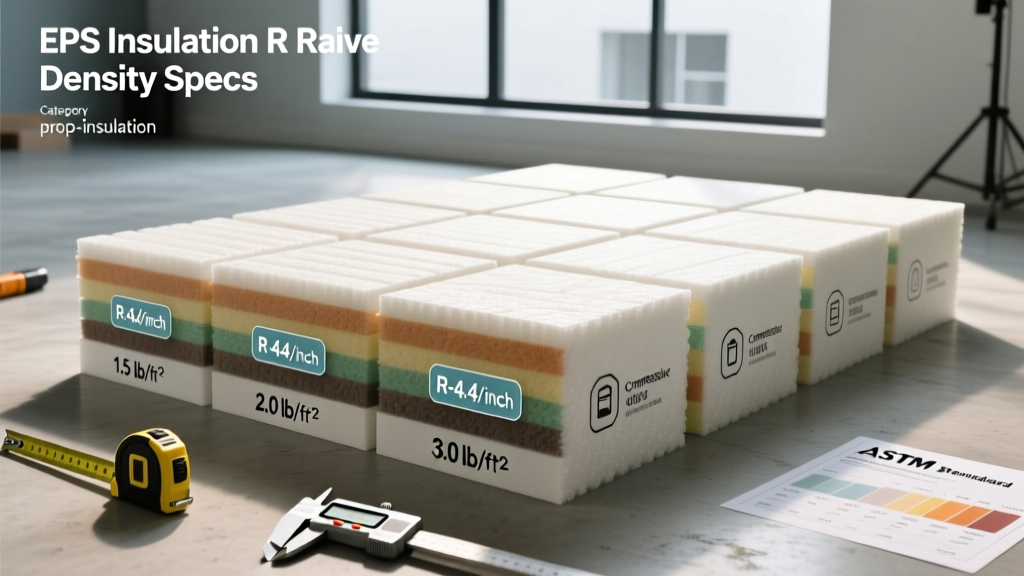
Core Thermal Performance: R-Value and Temperature Dependence
Expanded Polystyrene (EPS) is a closed-cell, rigid foam board manufactured by expanding polystyrene beads using pentane as a blowing agent. Unlike extruded polystyrene (XPS) or polyisocyanurate (polyiso), which rely on high-global-warming-potential blowing agents that diffuse out over time, EPS uses ambient air to replace the pentane shortly after manufacturing. This results in a highly stable, permanent thermal resistance.
The baseline thermal performance of EPS insulation ranges from R-3.6 to R-4.2 per inch at a mean temperature of 75°F (24°C), depending on the specific density and bead fusion quality. However, the most critical specification for architects and builders is its temperature-dependent performance curve.
Temperature Coefficient Advantage
While polyiso insulation experiences a significant drop in R-value at freezing temperatures (due to the condensation of its blowing agents), EPS actually increases in thermal resistance as temperatures drop. At 25°F (-4°C), EPS performs at approximately R-4.0 to R-4.4 per inch. This makes EPS the superior rigid foam choice for cold-climate exterior continuous insulation and below-grade foundation applications where winter thermal bridging is a primary concern.
According to the U.S. Department of Energy, maintaining continuous exterior insulation is critical for minimizing thermal bridging through wood or steel framing. EPS provides a cost-effective method to achieve high whole-wall R-values without the thermal degradation seen in other foam plastics during peak winter loads.
Density Classifications and Compressive Strength (ASTM C578)
Specifying EPS requires strict adherence to ASTM C578 (Standard Specification for Rigid, Cellular Polystyrene Thermal Insulation). The standard categorizes EPS into distinct types based on minimum density and compressive resistance at 10% deflection. Selecting the correct type prevents slab settlement, foundation cracking, and subgrade failure.
| ASTM C578 Type | Min. Density (pcf) | Compressive Strength (psi) | Primary Application |
|---|---|---|---|
| Type I | 0.90 | 10 psi | Non-load bearing wall sheathing, roof insulation |
| Type II | 1.35 | 15 psi | Standard residential slab-on-grade, exterior foundation |
| Type VIII | 1.80 | 30 psi | Commercial flooring, light traffic plaza decks |
| Type IX | 2.20 | 40 psi | Heavy-load industrial slabs, driveways, geofoam |
| Type X | 3.00 | 60 psi | Highway embankments, structural void fill, heavy rail |
Geofoam Load Calculation Warning
When using EPS as geofoam (Types VIII, IX, X) for structural void fill or landscaping, you must calculate the total dead and live load. A standard Type II (15 psi) board will permanently deform if subjected to sustained loads exceeding 3.0 psi (roughly 430 lbs per square foot). Always specify Type IX (40 psi) or higher for any application beneath vehicular traffic or heavy structural point loads.
Moisture Dynamics: Vapor Permeability vs. Water Absorption
Moisture management is where EPS specifications frequently cause confusion on job sites. EPS is not a vapor barrier. Depending on the density, EPS has a water vapor permeance rating between 3.0 and 5.0 perms per inch. This semi-permeable nature allows wall assemblies to dry to the exterior, a critical feature for preventing trapped moisture in wood-framed structures.
However, liquid water absorption is governed by ASTM C272. When subjected to total submersion for 24 hours, Type II EPS absorbs a maximum of 4.0% water by volume, while higher density Types (VIII and IX) absorb 2.0% or less.
Below-Grade Specification Protocol
For below-grade foundation walls, the EPS Industry Alliance recommends specific detailing to manage hydrostatic pressure. While XPS is often defaulted for below-grade use due to its lower initial absorption, long-term studies show that XPS can actually absorb more water than EPS after years of continuous soil exposure due to micro-fractures in the extrusion skin. When specifying EPS below grade:
- Mandate Type II or higher to ensure adequate compressive strength against soil backfill.
- Apply a fluid-applied or peel-and-stick waterproofing membrane directly to the concrete, not the EPS.
- Install a dimpled drainage mat over the exterior face of the EPS to relieve hydrostatic pressure before water can contact the foam.
Fire Ratings and Code Compliance (ASTM E84)
As a thermoplastic, unfaced EPS will melt and drip when exposed to direct flame. Therefore, fire performance specifications are strictly regulated by building codes. EPS is tested using ASTM E84 (Standard Test Method for Surface Burning Characteristics of Building Materials).
- Flame Spread Index (FSI): Must be ≤ 75 for unfaced, or ≤ 25 when faced with specific thermal barriers.
- Smoke Developed Index (SDI): Must be ≤ 450.
Under the International Building Code (IBC) Section 2603, all foam plastic insulation, including EPS, must be separated from the interior of a building by an approved 15-minute thermal barrier. In residential and commercial construction, a standard 1/2-inch (12.7mm) gypsum wallboard satisfies this requirement. For exposed applications, such as commercial roof decks or interior metal building panels, you must specify EPS that is factory-laminated with a fire-rated facer (such as fiberglass or foil) or coated with an intumescent paint to achieve a Class A fire rating.
Edge Profiles and Dimensional Tolerances
The physical geometry of the EPS board dictates its installation efficiency and thermal continuity. ASTM C578 allows a dimensional tolerance of ±1/16 inch per 4 feet of length. When specifying boards for continuous exterior insulation, edge profiling is critical to prevent thermal bridging at the joints.
| Edge Profile | Specification Use Case | Thermal Bridging Risk |
|---|---|---|
| Square Edge | Multi-layer applications where joints are staggered; roof insulation. | High if used in a single layer. |
| Shiplap (Rabbeted) | Single-layer exterior wall sheathing; below-grade foundation. | Low; creates a labyrinth seal against air infiltration. |
| Tongue-and-Groove | Precise architectural panels; insulated concrete forms (ICFs). | Very Low; provides structural interlocking and wind resistance. |
Procurement, Pricing, and 2026 Market Specifications
Pricing for EPS insulation fluctuates based on petroleum-derived polystyrene resin costs and regional manufacturing density. As of early 2026, bulk procurement rates for standard 4x8-foot boards are as follows:
- 1-inch Type I (Square Edge): $0.35 – $0.45 per square foot.
- 2-inch Type II (Shiplap): $0.75 – $0.95 per square foot.
- 4-inch Type IX (Geofoam/Structural): $1.80 – $2.20 per square foot.
When drafting procurement specifications, always mandate that the EPS is CFC-free, HCFC-free, and HFC-free. While EPS inherently uses pentane (which has an Ozone Depletion Potential of zero and a very low Global Warming Potential), verifying the absence of secondary chemical treatments is required for LEED v4.1 and Living Building Challenge certifications.
Specification Decision Matrix
Quick Spec Guide for Architects
Wood-Framed Exterior Continuous Insulation: Specify Type I or II, 1.5 to 2 inches thick, shiplap edges, unfaced (allows drying).
Slab-on-Grade (Residential): Specify Type II, 2 to 3 inches thick, square edges, placed over a 6-mil poly vapor retarder.
Below-Grade Foundation: Specify Type II or VIII, 2 to 4 inches thick, shiplap edges, protected by a dimpled drainage mat.
Commercial Plaza Deck: Specify Type VIII or IX, 4+ inches thick, square edges, installed in multiple staggered layers above the waterproofing membrane.
By aligning your specifications strictly with ASTM C578 density types and understanding the unique thermal and moisture characteristics of expanded polystyrene, you can optimize both the energy performance and structural longevity of the building envelope. For comprehensive code adoption updates regarding foam plastics, refer to the International Code Council resources on thermal barrier requirements.