Top Insulated Vinyl Siding Brands & Lines for 2026
Compare top insulated vinyl siding brands for 2026. Deep-dive into Alside Prodigy, CertainTeed CedarBoards, R-values, installation, and real costs.
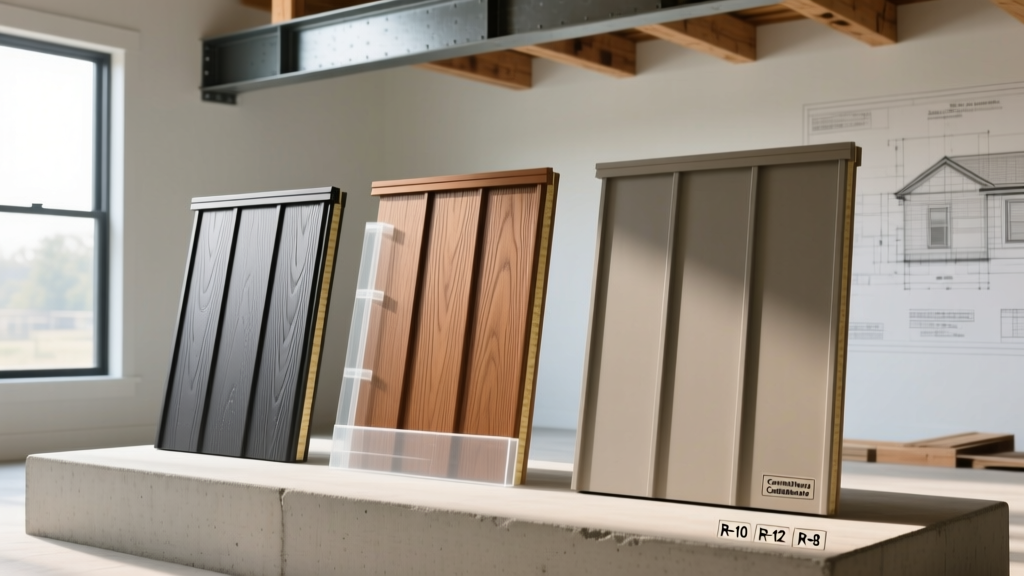
The Physics of Insulated Vinyl Siding: Solving Thermal Bridging
Standard cavity insulation (like R-13 fiberglass batts) is severely compromised by thermal bridging. Wood framing accounts for roughly 20% to 25% of a typical wall's surface area. Because wood conducts heat much faster than insulation, the effective R-value of an R-13 framed wall drops to approximately R-9 or R-10 in real-world conditions. Insulated vinyl siding addresses this by providing a continuous layer of exterior expanded polystyrene (EPS) foam, effectively wrapping the thermal bridging points.
According to research published by the Building Science Corporation, continuous exterior insulation is critical for moving the dew point outward, preventing condensation inside the wall cavity. While insulated siding typically only adds R-2.0 to R-5.0, its primary value lies in breaking the thermal bridge at the studs and flattening the wall assembly, which reduces air infiltration and improves the overall thermal performance of the building envelope.
Never evaluate insulated vinyl siding as a replacement for cavity insulation. The EPS foam backing is 1 to 1.5 inches thick, yielding a maximum R-value of roughly R-3.0 to R-5.0. It is designed to supplement, not replace, primary wall insulation. Marketing materials that highlight 'up to R-5.0' are technically accurate for the siding itself, but this does not mean your wall assembly is R-5.
Brand Deep-Dive: Leading Insulated Product Lines
The insulated vinyl siding market is dominated by a few key manufacturers who have refined the lamination and form-fit processes over the last decade. Here is a technical breakdown of the top product lines available in 2026.
1. Alside Prodigy NextGen
Alside’s Prodigy line is widely considered the benchmark for insulated siding. The defining feature of the NextGen series is its use of Neopor graphite-infused EPS foam. By integrating microscopic graphite particles into the EPS, Alside increases the foam's thermal resistance by up to 20% compared to standard white EPS without increasing the thickness.
- Foam Integration: Form-fit (the foam is molded directly to the back of the vinyl profile, eliminating air gaps).
- Max R-Value: Up to R-3.0 (measured via ASTM C518).
- Profile Options: Single 6, Single 7, Double 4, and Dutchlap profiles.
- Wind Load Rating: Tested to withstand 180 mph wind loads (ASTM D3679), largely due to the reinforced double-nailing hem and the rigidifying effect of the 1.5-inch foam backing.
2. CertainTeed CedarBoards Insulated
CertainTeed approaches the market with a focus on aesthetic authenticity and acoustic dampening. CedarBoards Insulated utilizes a laminated EPS foam backing rather than a form-fit mold. While lamination can theoretically introduce micro-gaps if the adhesive fails, CertainTeed’s proprietary bonding process has proven highly durable in field applications.
- Foam Integration: Factory-laminated EPS.
- Max R-Value: Up to R-3.0.
- Profile Options: D4D (Double 4-inch Dutchlap) and D5 (Double 5-inch clapboard).
- Acoustic Benefit: The dense foam backing increases the Sound Transmission Class (STC) rating of the exterior wall assembly by 2 to 4 points, noticeably dampening exterior street noise and rain impact.
3. Norandex Polar Wall
Norandex (a division of ABC Supply) offers the Polar Wall line, which prioritizes impact resistance and extreme weather durability. The 1.5-inch EPS backing acts as a shock absorber, making the vinyl highly resistant to hail and debris impact—a critical factor for builds in the Midwest and Southeast.
- Foam Integration: Contour-fit EPS backing.
- Max R-Value: R-3.3.
- Impact Resistance: Exceeds ASTM D3679 requirements for impact resistance at sub-freezing temperatures, where standard vinyl becomes brittle.
Product Line Comparison Matrix
| Brand / Line | Foam Type | Max R-Value | Thickness | Est. Material Cost (2026) |
|---|---|---|---|---|
| Alside Prodigy NextGen | Neopor Graphite EPS | R-3.0 | 1.5' | $6.50 - $8.50 / sq ft |
| CertainTeed CedarBoards | Laminated EPS | R-3.0 | 1.25' | $5.50 - $7.50 / sq ft |
| Norandex Polar Wall | Contour-fit EPS | R-3.3 | 1.5' | $5.00 - $7.00 / sq ft |
Installation Gotchas: Where Contractors Fail
Insulated vinyl siding is not installed like standard hollow-back vinyl. The EPS foam fundamentally changes the physical behavior of the panel. According to the Vinyl Siding Institute (VSI), failure to adapt installation techniques to the foam backing is the leading cause of warranty-voiding buckling and seam failure.
- The J-Channel Mismatch: Standard vinyl siding requires 1/2-inch or 5/8-inch J-channels around windows and doors. Insulated siding, with its 1.25 to 1.5-inch foam backing, requires specialized 3/4-inch or 1-inch J-channels. If a contractor attempts to use standard J-channel, they will be forced to crush or carve out the foam backing at the edges. This destroys the continuous thermal seal and creates voids where water can infiltrate and pool against the window flanges.
- Nailing Hem Fulcrum Effect: The foam backing acts as a lever arm. If nails are driven tight against the nailing hem, the foam pushes against the wall, and the nail acts as a fulcrum. When the vinyl expands in summer heat, it cannot slide laterally; instead, it bows outward. Nails must be driven perfectly straight (not angled) and left with exactly 1/32-inch of clearance between the nail head and the hem to allow for lateral thermal expansion.
- Cutting and Scoring: The traditional 'score-and-snap' method used for hollow vinyl does not work for insulated siding. The 1.5-inch EPS core prevents a clean snap. Installers must use a fine-tooth circular saw or a specialized guillotine shear designed for foam-backed profiles to ensure clean, square cuts that fit tightly into the receiving channels.
- House Wrap Compatibility: Because the foam backing sits flush against the weather-resistive barrier (WRB), it can trap moisture if a low-permeability house wrap is used. Always pair insulated siding with a high-perm, breathable WRB (minimum 10 US perms) to allow outward drying of the wall assembly.
Cost Breakdown and ROI Analysis
Upgrading from standard hollow-back vinyl to insulated vinyl siding represents a significant premium. For a standard 2,500-square-foot exterior, the cost differential is substantial.
- Standard Vinyl Siding (Material + Labor): $6.00 to $9.00 per sq. ft.
- Insulated Vinyl Siding (Material + Labor): $9.50 to $14.50 per sq. ft.
The material cost accounts for roughly 60% of this premium, while labor accounts for the remaining 40%. Labor is higher because the panels are heavier, bulkier to transport around the site, and require more precision during the cutting and fitting phases.
However, the ROI extends beyond thermal savings. The U.S. Department of Energy notes that continuous exterior insulation reduces the load on HVAC systems, but the immediate financial benefit for homeowners often comes from impact resistance and acoustic dampening. In hail-prone regions, the EPS backing prevents the cracking and shattering common with standard vinyl, potentially lowering home insurance premiums and eliminating the need for frequent panel replacements.
Final Verdict: Which Line Should You Specify?
Choose Alside Prodigy NextGen if: You are building in a high-wind coastal zone or require the highest possible R-value per inch due to strict local energy codes. The Neopor foam and reinforced hem provide superior structural rigidity.
Choose CertainTeed CedarBoards if: Aesthetic authenticity and acoustic performance are your primary drivers. The D4D Dutchlap profile offers deep shadow lines that mimic real wood, and the laminated foam provides excellent sound dampening for homes near busy roadways.
Choose Norandex Polar Wall if: You are building in the Midwest or Southeast where severe hail and extreme temperature swings are common. The contour-fit EPS offers the best impact absorption and thermal shock resistance.