Selecting the Right Car Thermal Insulation Material for Mobile Builds
Learn how to adapt car thermal insulation material for van conversions and tiny homes. Compare R-values, radiant barriers, and closed-cell foams.

Mobile architecture—ranging from van conversions and skoolies to shipping container homes and modular tiny houses—shares a fundamental DNA with automotive design. These structures feature thin, highly conductive metal skins, severe spatial constraints, and complex curved geometries. Because traditional residential insulation like fiberglass batts or rigid XPS boards often fail in these dynamic, vibration-heavy environments, builders increasingly turn to automotive-grade solutions. However, selecting the right car thermal insulation material requires a deep understanding of building science, as the marketing claims in the automotive sector frequently clash with the laws of thermodynamics.
The Thermal Reality of Metal-Clad Architecture
Steel and aluminum are exceptional thermal conductors. A standard steel van frame or shipping container wall creates massive thermal bridging, conducting exterior temperatures into the interior up to 400 times faster than traditional wood framing. Furthermore, metal structures are highly susceptible to radiant heat gain from direct sunlight and catastrophic condensation when interior moisture meets cold metal panels. To achieve genuine energy efficiency in a mobile build, the insulation envelope must simultaneously address conductive heat transfer, radiant heat gain, acoustic resonance, and vapor management.
Decoding Car Thermal Insulation Material: Myths vs. Physics
The most pervasive myth in the mobile building community is the conflation of acoustic damping with thermal resistance. Many builders apply thick layers of asphalt or butyl-based sound deadeners to their metal walls, assuming they are also insulating the space.
Butyl rubber and asphalt-based sound deadeners (often sold in 80-mil or 100-mil sheets) possess an R-value of approximately 0.05 per inch. They add mass to the metal to stop low-frequency acoustic resonance, but they provide virtually zero thermal resistance. Relying on them as your primary car thermal insulation material will result in severe heat loss and unchecked condensation.
True thermal efficiency requires a multi-material approach. While automotive sound deadeners are a necessary first step for acoustics and anti-fluttering, they must be paired with materials specifically engineered to trap air (conductive insulation) or reflect infrared energy (radiant barriers).
Material Matrix: Performance, Cost, and Application
When sourcing car thermal insulation material for architectural applications, you will encounter four primary categories. Below is a 2026 market breakdown of their physical properties and average costs.
| Material Type | Composition | R-Value / Performance | Primary Function | Avg Cost (per sq ft) |
|---|---|---|---|---|
| Butyl Rubber Dampener | Butyl rubber + aluminum facing | R-0.05 | Acoustic damping, anti-flutter | $1.50 - $2.50 |
| Closed-Cell Polyethylene (CCF) | Cross-linked polyethylene foam | R-3.5 per inch | Conductive insulation, vapor barrier | $1.20 - $2.00 |
| Elastomeric Foam (e.g., Armaflex) | Closed-cell nitrile rubber | R-4.2 per inch | Thermal resistance, condensation control | $2.50 - $3.80 |
| Radiant Barrier (Double-Bubble) | Polyethylene bubbles + aluminum foil | Blocks 97% radiant heat | Radiant heat reflection | $0.60 - $1.10 |
| Mass Loaded Vinyl (MLV) | Vinyl + barium sulfate/calcium silicate | R-0.10 (STC 27) | Airborne sound blocking | $2.00 - $3.50 |
The 3-Layer Energy Efficient Envelope Strategy
To maximize energy efficiency in a metal-walled mobile structure, you must engineer a composite envelope. According to the U.S. Department of Energy, radiant barriers are most effective when installed adjacent to an open air space. Therefore, a layered approach is mandatory.
Layer 1: Acoustic Damping and Condensation Control
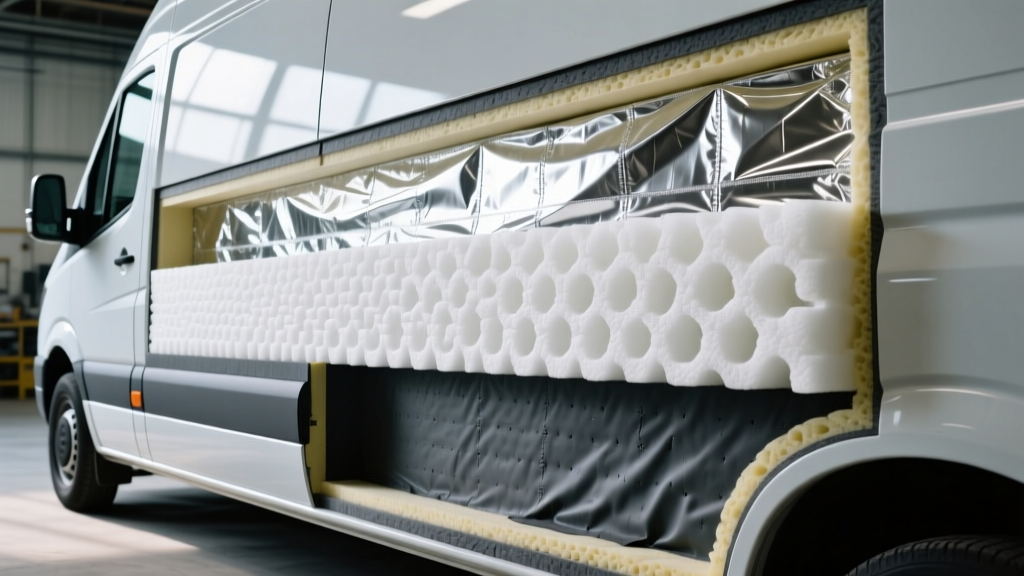
Apply a high-quality, butyl-based sound deadener (such as Kilmat 80-mil or Dynamat Xtreme) to the bare metal. Do not cover 100% of the surface. Apply in 25% to 40% coverage patches on large, flat sheet metal areas to stop acoustic resonance. Next, cover the entire metal surface with a 1/2-inch layer of closed-cell elastomeric foam (like Armaflex 520). This layer acts as your primary thermal break and prevents warm, moist interior air from contacting the cold metal, thereby eliminating condensation.
Layer 2: Radiant Heat Rejection
Over the elastomeric foam, install a double-bubble reflective foil barrier (such as Reflectix). Crucial Installation Detail: Radiant barriers require a minimum 3/4-inch air gap on at least one side to function. If you press the foil directly against your interior wall panels, it becomes a conductive material and loses its reflective properties. Use furring strips or structural battens to create this vital air gap.
Layer 3: Thermal Mass and Cavity Fill
The deep cavities created by the structural framing (wood or metal studs) should be filled with a high R-value, vibration-resistant material. While residential fiberglass sags over time in moving vehicles, 3M Thinsulate (SM550) or dense-packed sheep’s wool (like Havelock Wool) maintains its loft and provides an R-3.8 to R-4.0 per inch thermal resistance while managing ambient humidity.
Real-World Failure Modes and Edge Cases
Even with premium car thermal insulation material, mobile builds frequently suffer from preventable envelope failures.
- Asphalt Meltdown: Cheap, asphalt-based sound deadeners (often recognizable by their strong tar odor) have a low melting point. In a metal van parked in direct summer sun, panel temperatures can exceed 160°F (71°C). Asphalt will liquefy, slide down the walls, and pool at the base, leaving the upper panels unprotected and creating a toxic off-gassing hazard. Always specify butyl rubber formulations rated for high-heat environments.
- The Vapor Trap: Using multiple layers of impermeable materials (like CCF foam, MLV, and foil barriers) without calculating the dew point can trap moisture inside the wall cavity. If moisture breaches the interior vapor barrier via electrical outlets or seams, it will condense inside the wall and cause hidden mold. Always seal interior seams with specialized HVAC aluminum tape, not standard duct tape.
- Thermal Bridging at Fasteners: Driving self-tapping screws directly through your insulation layers into the metal frame creates micro-thermal bridges. Use structural adhesives (like 3M VHB tape or Sikaflex 221) to bond insulation and furring strips to the metal wherever possible, minimizing mechanical penetrations.
Health, Safety, and Off-Gassing in Confined Spaces
Automotive materials are engineered for environments with active HVAC systems and frequent window ventilation. In a tightly sealed tiny home or van, Volatile Organic Compounds (VOCs) can accumulate to dangerous levels. The Environmental Protection Agency (EPA) notes that indoor VOC concentrations can be up to ten times higher than outdoors, exacerbated by heat.
When sourcing car thermal insulation material for human habitation, demand products with low-VOC certifications. Avoid recycled cotton batting treated with unverified borate fire retardants, and ensure any spray adhesives used during installation are fully cured and off-gassed before sealing the wall cavity. Elastomeric foams like Armaflex are generally superior in this regard, as they are manufactured without CFCs, HFCs, or formaldehyde, making them safe for confined, high-heat architectural applications.
Summary Checklist for Mobile Insulation
- ✅ Never use butyl rubber as your primary thermal insulation (R-value is negligible).
- ✅ Use elastomeric or CCF foam directly against metal to stop condensation and thermal bridging.
- ✅ Leave an air gap adjacent to radiant foil barriers to reflect infrared heat.
- ✅ Specify butyl, not asphalt, for sound deadeners to prevent melting and toxic off-gassing.
- ✅ Seal all interior seams with HVAC-grade aluminum tape to maintain a continuous vapor barrier.
Written by
James ThorntonJames Thornton is a construction industry veteran with 25 years of hands-on experience in wood framing, lumber grading, and residential building codes. He started as a framing carpenter in rural Oregon, earned his ICC Residential Building Inspector certification, and eventually became a senior plan reviewer for the City of Portland Bureau of Development Services. James holds a B.S. in Wood Science & Technology from Oregon State University and is a certified lumber grader through the West Coast Lumber Inspection Bureau (WCLIB). He has inspected over 3,000 residential construction sites and authored the city's internal guide on advanced framing techniques (2x6 at 24" O.C.). James lives in Bend, OR, where he builds custom timber-frame cabins and competes in lumberjack sports.
More from James Thornton
View all
Insulation
Best Home Insulation Materials: Complete 2026 Guide
Compare top home insulation materials for 2026. Find R-values, installed costs per square foot, and best uses for fiberglass, spray foam, and mineral wool.
Aug 4, 2026

Sustainable Building
Certify Your Green Building Material for LEED and WELL
Step-by-step guide to certifying a green building material for LEED v5 and WELL v2. Master EPDs, HPDs, and VOC limits for 2026 project specifications.
Aug 4, 2026

Stone & Masonry
Veneer Stacked Stone Panels: Interior Design & Style Showcase
Discover how veneer stacked stone panels transform interiors. Explore modern design profiles, material pairings, and technical installation specs.
Aug 4, 2026