Complete Thermal Insulation Materials List & R-Value Guide
Explore our complete thermal insulation materials list, comparing R-values, costs, and applications for fiberglass, spray foam, and rigid boards.

Decoding the Core Thermal Insulation Materials List
Selecting the correct insulation requires moving beyond basic R-value labels to understand material chemistry, vapor permeability, and long-term thermal drift. As building codes tighten—mandating higher continuous insulation (ci) requirements under the latest IECC standards—architects and builders must match specific material properties to exact climate zones and assembly types. This comprehensive thermal insulation materials list breaks down the four dominant categories used in modern commercial and residential construction, providing actionable data on costs, performance limits, and installation edge cases.
1. Fiberglass Batts and Rolls
Fiberglass remains the most widely installed cavity insulation in North America, manufactured by spinning molten glass into fibers and binding them with acrylic or bio-based resins. While standard batts are common, high-density formulations are critical for modern framing.
- R-Value: R-3.1 to R-4.3 per inch.
- Installed Cost: $0.40 to $1.20 per square foot.
- Vapor Permeability: High (Class III vapor retarder unless faced with kraft paper or foil).
- Specific Products: Owens Corning EcoTouch (standard), Knauf JetStream (blown-in).
Expert Insight: Never compress fiberglass to fit a cavity. Stuffing an R-19 batt (designed for a 2x6 cavity) into a 2x4 wall reduces its thickness and traps air out of the matrix, dropping the effective R-value to roughly R-14. Always use high-density R-15 batts specifically manufactured for 2x4 framing.
2. Closed-Cell Spray Polyurethane Foam (ccSPF)
ccSPF is a two-component liquid that expands and cures into a rigid, high-density cellular plastic. It provides structural racking strength and acts as a standalone air and vapor barrier. Crucially, the industry has largely transitioned to HFO (Hydrofluoroolefin) blowing agents, dropping the Global Warming Potential (GWP) from over 1,000 to less than 10.
- R-Value: R-6.0 to R-7.0 per inch.
- Installed Cost: $1.50 to $3.00 per board foot.
- Vapor Permeability: Very Low (Class II vapor retarder at 1.5 inches; Class I at 3+ inches).
- Specific Products: BASF Enertite, Demilec Heatlok HFO.
Expert Insight: ccSPF is highly sensitive to substrate temperature and mix ratios. If applied to cold sheathing (below 60°F) without pre-heating, the foam can shrink, pull away from studs, and create massive thermal bridges. Always verify the installer uses calibrated proportioning equipment.
3. Mineral Wool (Rock and Slag Wool)
Mineral wool is spun from basalt rock and steel slag. It is inherently non-combustible, resisting temperatures up to 2,150°F, making it the premier choice for fire-stopping and exterior continuous insulation in commercial assemblies.
- R-Value: R-4.2 to R-5.0 per inch.
- Installed Cost: $1.00 to $2.20 per square foot.
- Vapor Permeability: High (Vapor open, allowing assemblies to dry to the exterior).
- Specific Products: ROCKWOOL Comfortbatt, Thermafiber RainBarrier.
Expert Insight: While mineral wool is hydrophobic (it repels liquid water), it is highly vapor-permeable. In cold climates, if placed on the exterior of a wall assembly without a proper exterior air barrier, warm interior moisture can condense within the cold outer layers of the wool. Pair it with a smart vapor retarder on the interior.
4. Polyisocyanurate (Polyiso) Rigid Boards
Polyiso is a closed-cell thermoset foam plastic, almost always faced with aluminum foil or coated glass mats. It offers the highest initial R-value per inch of any commercially available board stock, but it suffers from a unique thermal anomaly.
- R-Value: R-6.0 to R-6.5 per inch (at 75°F mean temperature).
- Installed Cost: $0.60 to $1.10 per square foot.
- Vapor Permeability: Foil-faced is Class I (impermeable); Glass-mat faced is Class II/III.
- Specific Products: Dow Thermax, Carlisle SecurShield.
Expert Insight: Polyiso experiences "thermal drift." The blowing gases trapped in its cells condense at temperatures below 50°F, causing the R-value to drop significantly in extreme cold. When designing exterior continuous insulation in Climate Zones 5 and higher, calculate your assembly using the aged, cold-temperature R-value (often closer to R-5.0 per inch), not the labeled 75°F value.
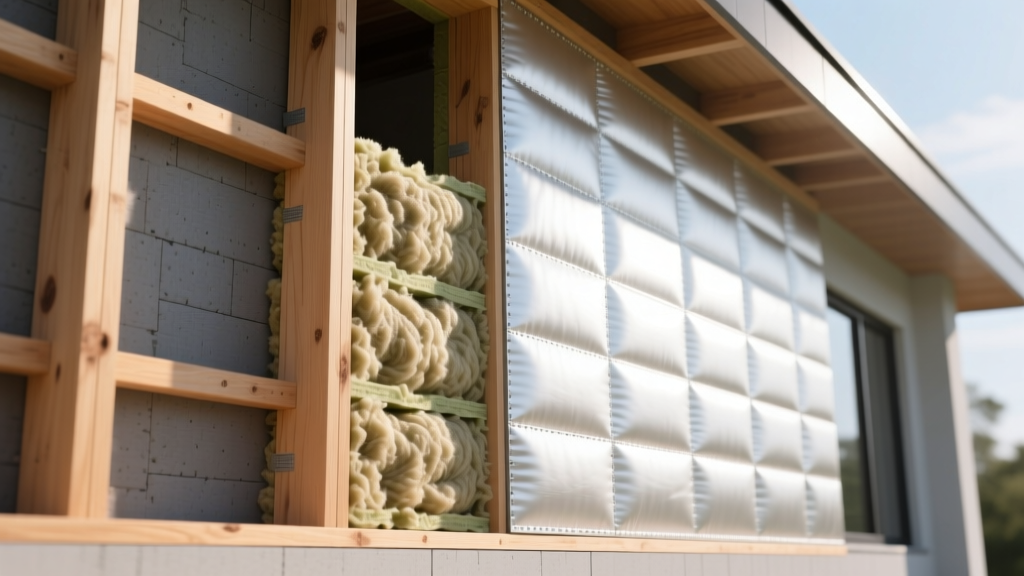
Comparative Data Matrix
The following table synthesizes the core metrics for quick specification. According to the U.S. Department of Energy, matching these material properties to your specific climate zone is the primary driver of long-term energy efficiency.
| Material Type | R-Value / Inch | Cost (Installed) | Vapor Retarder Class | Best Application |
|---|---|---|---|---|
| Fiberglass (High-Density) | R-3.8 - R-4.3 | $0.80 - $1.20 / sq ft | Class III (Unfaced) | Interior wood-framed cavities |
| ccSPF (Closed-Cell) | R-6.0 - R-7.0 | $1.50 - $3.00 / bd ft | Class I / II | Unvented roofs, rim joists, flood zones |
| Mineral Wool Batt | R-4.2 - R-5.0 | $1.20 - $2.20 / sq ft | Class III | Fire-rated walls, acoustic partitions |
| Polyiso (Foil-Faced) | R-6.0 - R-6.5 | $0.60 - $1.10 / sq ft | Class I | Exterior continuous insulation (ci), roofing |
Application-Specific Decision Framework
Use the following frameworks to select the correct material from the thermal insulation materials list based on your specific building envelope challenge.
Scenario A: Unvented Cathedral Ceiling
Recommendation: Closed-Cell Spray Foam (ccSPF).
Why: Unvented roofs require the insulation to be in direct contact with the roof sheathing to prevent condensation. ccSPF provides the necessary R-value in limited rafter depths (e.g., R-38 in a 2x8 rafter) while acting as an air-impermeable barrier, satisfying IRC Section R806.5 requirements without needing a separate ventilation channel.
Scenario B: Interior Basement Wall Retrofit
Recommendation: Foil-Faced Polyiso or XPS Rigid Board.
Why: Concrete is highly porous and wicks ground moisture. Fiberglass or mineral wool placed directly against a basement wall will trap moisture, leading to mold. Rigid foam blocks vapor diffusion. Building envelope experts at Building Science Corporation strongly advise against using vapor-permeable cavity insulation on below-grade concrete without a dedicated dimpled drainage mat and exterior waterproofing.
Scenario C: Exterior Commercial Wood-Frame Wall
Recommendation: Mineral Wool Continuous Insulation (ci).
Why: Mineral wool provides excellent R-value per inch, is completely non-combustible (meeting NFPA 285 assembly requirements for multi-story buildings), and allows the wall assembly to dry outward. It also resists UV degradation during construction delays better than exposed rigid foams.
Common Installation Failure Modes & Edge Cases
Even the highest-performing materials on this thermal insulation materials list will fail if installed incorrectly. Watch for these specific edge cases:
- The Polyiso Thermal Bridge: When installing exterior polyiso, installers often use standard metal screws or Z-furring strips that penetrate the foam, creating massive thermal bridges. Use thermally broken fasteners or structural insulated clips to maintain the continuous R-value.
- Fiberglass Air Washing: Fiberglass is an air filter, not an air barrier. If wind washes through a poorly sealed soffit and blows across the top of attic fiberglass batts, it strips away the trapped heat (convective looping). You must install a dedicated air barrier (like drywall or spray foam) at the eaves to stop air washing.
- Mineral Wool Dusting: Cutting mineral wool with a standard wood saw creates excessive dust that can coat the surrounding studs, interfering with drywall adhesion and indoor air quality. Always use a specialized serrated insulation knife or a guillotine cutter.
Frequently Asked Questions
Does doubling the insulation double the R-value?
Mathematically, yes (two layers of R-10 equal R-20). However, in practice, thermal bridging through the framing studs can reduce the "whole-wall" R-value by 15% to 25%. This is why modern codes require continuous exterior insulation to cover the studs and break the thermal bridge.
How is the R-value on packaging regulated?
The FTC's R-Value Rule strictly mandates that manufacturers test and label insulation using standardized ASTM C518 testing procedures. The labeled R-value must represent the aged, long-term thermal resistance (LTTR), not just the day-one manufacturing value, protecting consumers from deceptive marketing.
Which material is best for soundproofing?
While thermal resistance and acoustic attenuation are different metrics, mineral wool is the undisputed leader for dual-purpose applications. Its dense, fibrous, interlocking structure absorbs mid-to-high frequency sound waves far better than the lighter, more porous structure of fiberglass or the rigid cellular structure of spray foam.
Written by
Sarah WhitfieldSarah Whitfield is a chartered quantity surveyor (MRICS) and construction cost analyst with 15 years of experience in material pricing, procurement strategy, and project budgeting. She earned her degree in Construction Management from the University of Reading (UK) and has worked on projects ranging from $2M custom homes to $180M mixed-use developments across North America and Europe. Sarah currently leads cost estimating for BuildMat Insight, maintaining a proprietary database of 4,000+ material price points updated quarterly. She is a frequent contributor to RSMeans cost data panels and has presented at the International Cost Engineering Council (ICEC) congress. Based in Denver, CO, Sarah is an avid trail runner and volunteer mentor for Women in Construction.
More from Sarah Whitfield
View all
Wood & Lumber
What Are the Different Types of Wood? A Builder's Guide
Compare structural softwoods, finish hardwoods, and engineered lumber. Analyze Janka ratings, MOE values, and 2026 pricing for construction.
Aug 4, 2026

Walls & Panels
Steel Framing vs Wood Framing: Corrosion and Moisture Defense
Compare steel framing vs wood framing for moisture resistance. Learn about galvanized coatings, condensation risks, and corrosion protection strategies.
Jul 21, 2026

Stone & Masonry
How to Cut Stone Veneer: Wet Saw vs Grinder Comparison
Compare the best tools for cutting stone veneer. We review wet saws, angle grinders, and chop saws to help you achieve clean, chip-free cuts.
Jul 21, 2026