Best House Insulation Material for Soundproofing: STC Ratings & Costs
Compare the best house insulation material for soundproofing. Analyze STC ratings, mineral wool vs. fiberglass costs, and acoustic wall assemblies.

The Physics of Sound Transmission in Residential Framing
Selecting the correct house insulation material for acoustic control requires understanding how sound energy moves through structural assemblies. Sound travels in two primary forms in residential construction: airborne noise (voices, television, music) and impact noise (footsteps, dropped objects, vibrating machinery). The Department of Energy notes that mitigating these distinct frequencies requires different material properties and assembly techniques.
Acoustic performance is measured using the Sound Transmission Class (STC) for airborne noise and the Impact Insulation Class (IIC) for impact noise. A standard bare 2x4 wood-framed wall with 1/2-inch drywall on both sides yields an STC of roughly 34—meaning normal speech is easily understood through the partition. To achieve true acoustic privacy (STC 50+), the house insulation material must possess high density to absorb sound waves, while the overall wall assembly must incorporate decoupling and mass to block vibration transfer.
Top House Insulation Material Options for Acoustic Control
Not all insulation is created equal. Thermal resistance (R-value) does not correlate directly with acoustic absorption. Here is a technical breakdown of the primary materials used for soundproofing in 2026.
Mineral Wool (Stone Wool)
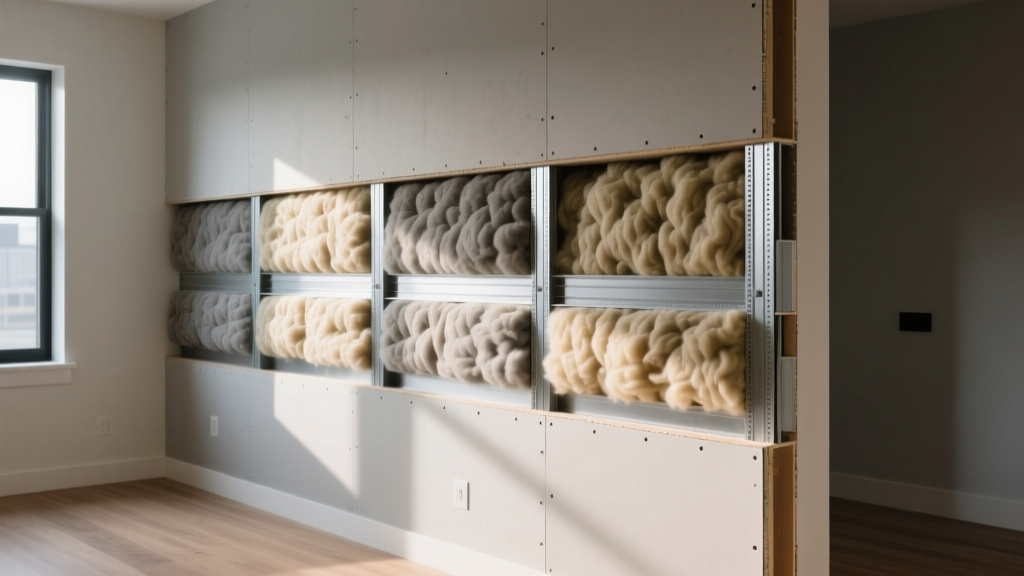
Mineral wool, specifically acoustic-grade products like Rockwool Safe'n'Sound, is the industry standard for high-performance soundproofing. Manufactured from basalt rock and slag, it achieves a density of approximately 2.5 pounds per cubic foot (pcf). This high mass creates a tortuous path for sound waves, effectively dampening low-frequency airborne noise (like bass from a subwoofer) that easily bypasses lighter materials. Mineral wool is also non-combustible, providing a secondary fire-blocking benefit without the need for chemical treatments.
High-Density Fiberglass Batts
Acoustic fiberglass batts, such as Owens Corning QuietZone, are engineered with a tighter fiber matrix than standard thermal pink fiberglass. With a density around 1.5 pcf, they excel at absorbing mid-to-high-frequency sounds (human speech, television dialogue). While they are lighter and easier to cut than mineral wool, they lack the mass required to effectively dampen low-frequency structural vibrations on their own. They are best utilized in multi-layered assemblies or interior partitions where extreme low-frequency blocking is not the primary concern.
The Spray Foam Misconception
A persistent myth in residential construction is that spray foam insulation provides superior soundproofing. In reality, closed-cell spray foam (2.0 pcf) cures into a rigid, structural plastic that actually creates a mechanical bridge for vibration, potentially worsening impact noise transmission. Open-cell spray foam (0.5 pcf) offers better acoustic absorption than closed-cell due to its spongy matrix, but its STC contribution per dollar spent is vastly inferior to mineral wool batts. Spray foam should be reserved for air-sealing and thermal envelopes, not dedicated acoustic partitions.
No house insulation material can achieve an STC above 45 in a standard rigid wall assembly. Sound will simply vibrate through the wooden studs (structural flanking). To reach STC 50+, you must mechanically decouple the drywall from the framing using resilient channels (RC-1) or staggered-stud framing, allowing the insulation to absorb the trapped sound energy without it transferring to the adjacent room.
Comparative STC Matrix: Wall Assembly Performance
The following matrix demonstrates how the house insulation material interacts with the broader wall assembly to dictate final acoustic performance. Data reflects standard 16-inch on-center 2x4 wood framing.
| Wall Assembly Configuration | Insulation Material | Estimated STC | Acoustic Result |
|---|---|---|---|
| Standard 2x4, 1/2" drywall both sides | None (Hollow) | 34 | Normal speech clearly audible and understood. |
| Standard 2x4, 1/2" drywall both sides | R-13 Standard Fiberglass | 37 | Loud speech audible, normal speech muffled. |
| Standard 2x4, 5/8" Type X drywall both sides | Acoustic Fiberglass (1.5 pcf) | 42 | Loud speech heard as murmur; TV volume restricted. |
| Standard 2x4, 5/8" Type X drywall both sides | Mineral Wool (2.5 pcf) | 46 | Loud speech barely audible; good privacy. |
| 2x4 + Resilient Channel, 5/8" Type X drywall | Mineral Wool (2.5 pcf) | 56 | Excellent privacy; loud music heavily muffled. |
Cost Breakdown and Material Yield (2026 Pricing)
Budgeting for acoustic insulation requires calculating both the raw material cost and the labor implications. Mineral wool is denser and requires more effort to friction-fit and cut, slightly increasing labor time compared to fiberglass.
- Rockwool Safe'n'Sound (3-inch thick, 15.25" wide): $1.05 - $1.20 per square foot. Excellent ROI for media rooms and bedroom partitions.
- Owens Corning QuietZone (3.5-inch thick): $0.70 - $0.85 per square foot. Cost-effective for general noise reduction in standard interior walls.
- Resilient Channel (RC-1, 25-gauge steel): $1.15 - $1.40 per linear foot. Mandatory for achieving STC 50+; installed horizontally at 24 inches on center.
- Green Glue Noiseproofing Compound: ~$24.00 per 28 oz tube (covers ~24 sq ft). Used between two layers of drywall to convert sound vibration into microscopic heat. Highly recommended for basement home theaters.
Installation Failure Modes That Destroy Acoustic Performance
Even the most expensive house insulation material will fail if the installation violates basic acoustic principles. The Environmental Protection Agency highlights that environmental noise intrusion often stems from poor building envelope sealing. In interior partitions, the following errors are the most common culprits of acoustic failure:
1. Batt Compression
Acoustic insulation relies on its specific thickness and density to trap sound waves. Forcing a 3.5-inch batt into a 2.5-inch cavity (such as near plumbing lines or electrical wires) compresses the material, increasing its density but drastically reducing its overall sound-absorbing volume. Always cut the batt to fit precisely around obstructions rather than stuffing it.
2. Back-to-Back Electrical Boxes
Installing electrical outlet boxes on opposite sides of the same wall stud creates a direct, unsealed acoustic tunnel. Sound will bypass the insulation entirely. To fix this, stagger electrical boxes by at least one stud bay, and wrap the back and sides of the boxes with acoustic putty pads or heavy mass-loaded vinyl (MLV).
3. Flanking Paths via HVAC
If a supply duct serves two adjacent rooms without an internal acoustic baffle or flex-duct loop, sound will travel directly through the metal ductwork, rendering the wall insulation useless. Use insulated flex-duct with a minimum 6-foot drop loop before the register to break the line-of-sight sound path.
4. Unsealed Perimeter Gaps
Sound behaves like water; it will exploit the path of least resistance. A 1/4-inch gap at the bottom of the drywall where it meets the subfloor can reduce a wall's STC rating by up to 5 points. Always apply a continuous bead of acoustical sealant (which remains flexible and does not crack over time) at all perimeter joints, ceiling tracks, and floor plates before installing baseboards.
Decision Framework: Matching the Material to the Noise Source
To finalize your material selection, identify the primary noise profile of the space:
- Home Theater / Music Room (Low-Frequency Heavy): Use 2.5 pcf Mineral Wool batts. Decouple the drywall using resilient channels or staggered studs. Apply a layer of Green Glue between two layers of 5/8-inch Type X drywall. Target STC: 55-60.
- Bedroom / Bathroom Partitions (Mid/High-Frequency Speech): Use Acoustic Fiberglass batts. Standard 2x4 framing with 5/8-inch drywall on both sides is sufficient. Seal all electrical boxes and perimeter gaps. Target STC: 45-50.
- Home Office / Confidential Meeting Room: Prioritize mineral wool for broad-spectrum absorption. Pay strict attention to HVAC flanking paths and install solid-core doors with automatic door bottom sweeps, as a hollow-core door will bottleneck the wall's acoustic performance.
By aligning the density of the house insulation material with the specific frequency of the target noise, and ensuring the structural assembly prevents vibration transfer, you can achieve commercial-grade acoustic privacy in residential construction.
Written by
James ThorntonJames Thornton is a construction industry veteran with 25 years of hands-on experience in wood framing, lumber grading, and residential building codes. He started as a framing carpenter in rural Oregon, earned his ICC Residential Building Inspector certification, and eventually became a senior plan reviewer for the City of Portland Bureau of Development Services. James holds a B.S. in Wood Science & Technology from Oregon State University and is a certified lumber grader through the West Coast Lumber Inspection Bureau (WCLIB). He has inspected over 3,000 residential construction sites and authored the city's internal guide on advanced framing techniques (2x6 at 24" O.C.). James lives in Bend, OR, where he builds custom timber-frame cabins and competes in lumberjack sports.
More from James Thornton
View all
Insulation
Best Home Insulation Materials: Complete 2026 Guide
Compare top home insulation materials for 2026. Find R-values, installed costs per square foot, and best uses for fiberglass, spray foam, and mineral wool.
Aug 4, 2026

Sustainable Building
Certify Your Green Building Material for LEED and WELL
Step-by-step guide to certifying a green building material for LEED v5 and WELL v2. Master EPDs, HPDs, and VOC limits for 2026 project specifications.
Aug 4, 2026

Stone & Masonry
Veneer Stacked Stone Panels: Interior Design & Style Showcase
Discover how veneer stacked stone panels transform interiors. Explore modern design profiles, material pairings, and technical installation specs.
Aug 4, 2026