Building Materials Insulation for Sound Control: The 2026 Guide
Master acoustic comfort with our 2026 guide to building materials insulation. Compare STC ratings, costs, and assembly techniques for soundproofing.

Achieving true acoustic isolation in residential and commercial construction requires moving beyond basic thermal batts. When evaluating building materials insulation for sound control, architects and builders must address both airborne noise (voices, media) and structure-borne impact noise (footsteps, machinery). Standard fiberglass insulation designed primarily for thermal resistance (R-value) often falls short in acoustic applications due to its low density and lack of damping properties.
This guide details the specific material properties, assembly techniques, and 2026 cost metrics required to engineer high-performance acoustic barriers, targeting Sound Transmission Class (STC) ratings of 55 to 65+ for critical partitions.
The Physics of Soundproofing: Mass, Decoupling, and Damping
Effective acoustic design relies on three fundamental physical principles. Understanding these is critical before selecting any specific building materials insulation.
- Mass: Heavier materials block high-frequency airborne sound more effectively. Adding a second layer of 5/8-inch gypsum board increases the surface mass, shifting the mass-air-mass resonance frequency lower, out of the range of typical human speech (125 Hz to 4000 Hz).
- Decoupling: Mechanical isolation prevents sound vibrations from traveling through rigid structural connections. This is achieved using resilient channels, staggered stud framing, or double-stud walls.
- Damping: Viscoelastic compounds dissipate vibrational energy as trace amounts of heat. Damping is crucial for eliminating the 'coincidence dip'—a frequency at which thin, rigid panels like drywall become transparent to sound.
According to Building Science Corporation's BSI-055, failing to address flanking paths (continuous structural elements that bypass the insulated cavity) will render even the most expensive cavity insulation useless. Sound behaves like water; it will exploit the path of least resistance.
Comparing Top Building Materials Insulation for Acoustics
Not all insulation is created equal. The Noise Reduction Coefficient (NRC) and density are the primary metrics for evaluating cavity fill. Below is a comparison of the most effective acoustic cavity insulations available in 2026.
| Material Type | Specific Product Example | Density (lb/cu ft) | NRC (3.5 in.) | Best Application | Approx. Material Cost |
|---|---|---|---|---|---|
| Mineral Wool | ROCKWOOL Safe'n'Sound | 2.5 | 1.05 | Interior partition walls, floor joists | $1.15 / sq ft |
| Dense Fiberglass | Owens Corning 703 | 3.0 | 0.85 | Acoustic wall panels, theater builds | $2.40 / sq ft |
| Standard Fiberglass | Kraft-faced R-13 Batts | 0.7 | 0.90 | Thermal exterior walls (poor acoustic) | $0.45 / sq ft |
| Cellulose (Damp-Spray) | Applegate Stabilized | 3.5 | 0.95 | Retrofit existing enclosed walls | $1.30 / sq ft |
| Recycled Denim | Bonded Logic UltraTouch | 1.5 | 1.00 | Eco-friendly residential interiors | $1.60 / sq ft |
For standard interior partitions targeting STC 55+, mineral wool remains the industry standard. As detailed in ROCKWOOL Acoustic Solutions technical literature, the non-directional fiber matrix of stone wool absorbs acoustic energy more efficiently across a broader frequency spectrum than standard spun fiberglass.
Step-by-Step Wall Assembly for STC 60+
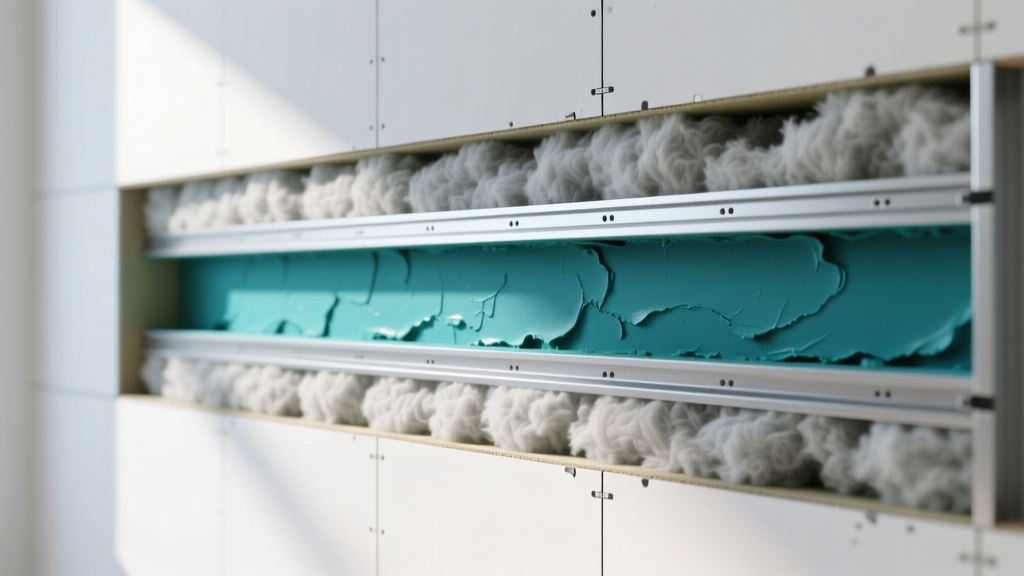
To achieve an STC rating of 60 (where loud music is inaudible in the adjacent room), you must combine high-density cavity insulation with decoupled, damped mass. Follow this precise assembly sequence:
- Frame and Seal: Frame a standard 2x4 or 2x6 wood stud wall at 16 inches on center. Apply a continuous bead of acoustic sealant (e.g., OSI SC-175) along the bottom and top plates before securing them to the subfloor and ceiling joists to eliminate edge flanking.
- Install Cavity Fill: Friction-fit 3-inch ROCKWOOL Safe'n'Sound into the stud bays. Ensure there are no gaps around electrical boxes. Use putty pads (STC-rated) over all recessed electrical boxes to maintain the acoustic seal.
- First Drywall Layer: Screw the first layer of 5/8-inch Type X gypsum board directly to the studs. Do not use adhesive; mechanical fasteners only.
- Decoupling: Install 25-gauge furring hat channels or proprietary resilient sound clips (like Kinetics IsoMax) horizontally across the studs, spaced 24 inches on center. Ensure channels do not touch the floor or ceiling plates.
- Damping Compound: Apply Green Glue Noiseproofing Compound to the back of the second layer of 5/8-inch drywall. Use two standard tubes per 4x8 sheet for optimal low-frequency damping.
- Second Drywall Layer: Screw the second drywall layer to the resilient channels. Stagger all seams by at least 12 inches from the first layer. Finish all perimeter gaps with acoustic sealant, never standard joint compound.
Floor and Ceiling Impact Noise Solutions
While STC (tested per ASTM E90) measures airborne sound, Impact Insulation Class (IIC, tested per ASTM E492) measures structure-borne impact noise, such as footsteps or dropped objects. Insulating floor/ceiling assemblies requires a different approach to building materials insulation.
For wood-frame floors, filling the joist cavities with dense mineral wool improves airborne STC but does virtually nothing to improve IIC. To resolve impact noise, you must introduce a resilient break at the walking surface.
- Floating Floors: Install a 5mm to 10mm acoustic underlayment (such as cork or recycled rubber) beneath the finished floor. For premium builds, use a poured gypsum underlayment over a 1/2-inch acoustic mat.
- Suspended Ceilings: Suspend the ceiling drywall using wire-hung resilient channels isolated from the joists above. Fill the joist cavity with 5.5-inch mineral wool to absorb cavity resonance.
A common failure mode in multi-family construction is rigid HVAC ducting connecting two acoustically isolated rooms. Sound travels through the ductwork, bypassing the insulated wall entirely. Always install canvas flexible duct connectors and acoustically lined duct boots when crossing partition walls.
2026 Cost Breakdown for Acoustic Insulation Projects
Upgrading from a standard thermal wall (STC 33) to a premium acoustic wall (STC 60+) significantly impacts the budget. Below is a realistic 2026 cost breakdown for a 100-square-foot partition wall, including materials and specialized labor.
| Component | Standard Wall (STC 33) | Premium Acoustic Wall (STC 60+) |
|---|---|---|
| Cavity Insulation | $45 (Fiberglass) | $115 (Mineral Wool) |
| Drywall Materials | $60 (1 layer 1/2 in.) | $210 (2 layers 5/8 in. Type X) |
| Damping & Sealants | $0 | $160 (Green Glue + Acoustic Sealant) |
| Decoupling Hardware | $0 | $85 (Resilient Channels/Clips) |
| Labor (Installation) | $150 | $450 (Specialized detailing) |
| Total Estimated Cost | $255 ($2.55/sq ft) | $1,020 ($10.20/sq ft) |
While the premium assembly costs roughly four times more per square foot, the return on investment in multi-family residential, home theaters, and recording studios is realized through code compliance, increased property valuation, and elimination of post-construction remediation costs.
Frequently Asked Questions
Can I just add more standard fiberglass insulation to improve soundproofing?
No. Adding a second layer of standard low-density fiberglass to a wall cavity yields diminishing acoustic returns. Once the cavity is about 50% full, additional low-density material does not significantly increase sound absorption. High-density mineral wool or cellulose is required to alter the acoustic impedance of the cavity.
Is spray foam good for sound control?
Closed-cell spray foam is actually detrimental to soundproofing. Because it cures into a rigid, dense plastic that structurally bonds the drywall to the studs, it creates a direct mechanical bridge for vibrations, effectively ruining any decoupling efforts. Open-cell spray foam performs slightly better acoustically than closed-cell but still falls short of mineral wool in both NRC and fire-resistance metrics. For a comprehensive look at drywall and foam integrations, refer to the USG Sound Control Systems guidelines.
Do acoustic panels on the wall surface block sound from entering the room?
No. Fabric-wrapped acoustic panels (typically made of Owens Corning 703 or 705) are designed for sound absorption (reducing reverberation and echo inside the room), not sound isolation (blocking sound from passing through the wall). To block sound transmission, mass and decoupling must be integrated into the structural assembly itself.
Written by
Priya KapoorPriya Kapoor is a real estate market analyst and construction economics researcher with expertise in housing affordability, development feasibility, and infrastructure investment. She holds a Master of Regional Planning from Cornell University and previously worked as a senior analyst at CBRE's Investment Properties group, where she modeled returns for $4B in mixed-use development pipelines. Priya now runs an independent research practice advising developers, municipalities, and REITs on construction cost forecasting and market timing. She publishes the quarterly "BuildMat Market Pulse" report tracking material price indices across 12 commodity categories. Based in Austin, TX, Priya serves on the board of Habitat for Humanity Austin and is a marathon runner.
More from Priya Kapoor
View all
Construction Cost
Cost to Build a 1600 Sq Ft Home in 2026: Full Breakdown
Accurate 2026 cost to build a 1600 sq ft home—material, labor, and regional pricing breakdowns included. Plan your budget with real-time estimates.
Aug 11, 2026

Wood & Lumber
Name the Types of Wood for Pressure Treatment and Preservation
Learn how to name the types of wood best suited for pressure treatment. Compare species treatability, chemical retention levels, and 2026 preservation costs.
Aug 4, 2026

Stone & Masonry
Stone Veneer Suppliers Lindenhurst: 2026 Cost Analysis
Analyze 2026 stone veneer costs in Lindenhurst, NY. Compare local supplier pricing, delivery fees, and Suffolk County installation labor rates.
Aug 4, 2026