Selecting Good Insulating Materials for Residential Sound Control
Discover which good insulating materials deliver the best acoustic performance. Compare STC ratings, costs, and assembly strategies for soundproofing.

The Physics of Sound: Why Standard Thermal Batts Fall Short
When evaluating good insulating materials for acoustic performance, it is critical to understand that thermal resistance (R-value) does not equate to sound attenuation. Standard lightweight fiberglass batts designed to trap air for thermal insulation lack the mass and density required to disrupt sound waves. Acoustic control requires addressing two distinct types of noise: airborne sound (voices, television, music) and structure-borne impact noise (footsteps, dropped objects, HVAC vibrations).
According to the Whole Building Design Guide (WBDG), effective acoustic design relies on four principles: absorption, damping, decoupling, and mass. Selecting the right materials means combining high-density absorptive insulation with decoupling mechanisms and heavy, damped boundary layers. Below, we break down the specific materials that deliver measurable Sound Transmission Class (STC) and Impact Insulation Class (IIC) improvements in modern residential construction.
- STC (Sound Transmission Class): Measures a partition's ability to block airborne sound. A standard interior wall with drywall on both sides and no insulation is STC 33. A good target for privacy is STC 50+.
- IIC (Impact Insulation Class): Measures a floor/ceiling assembly's ability to block impact noise. Building codes typically mandate a minimum IIC 50, but STC/IIC 55+ is recommended for luxury or multi-family builds.
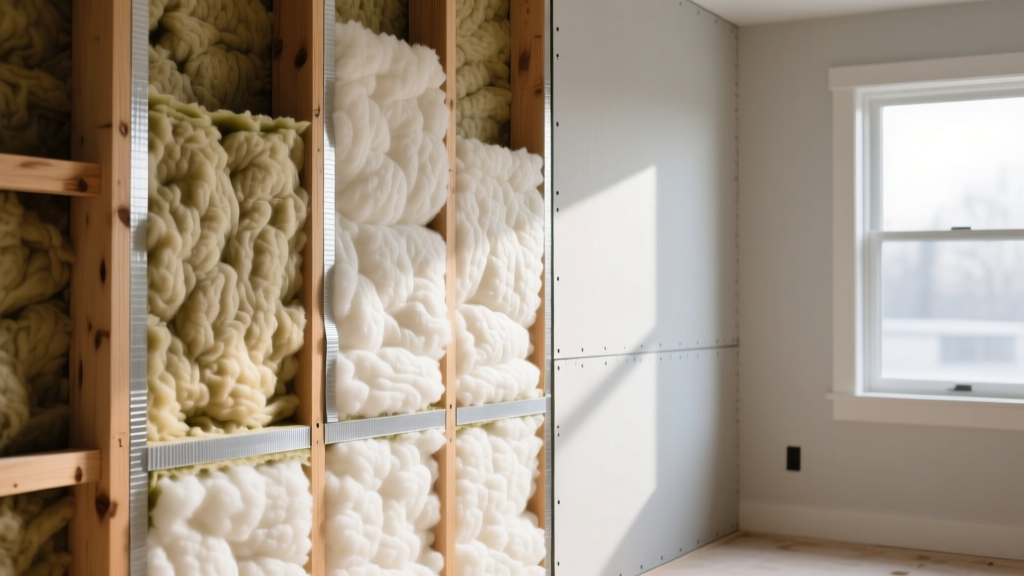
Top Good Insulating Materials for Airborne Noise (STC)
To absorb airborne sound within a wall or floor cavity, the insulation must be dense enough to create friction against the sound waves, converting acoustic energy into trace amounts of heat. Here are the top-performing cavity insulations for 2026 construction standards.
1. Mineral Wool (Stone Wool) Batts
Mineral wool is widely considered one of the best good insulating materials for soundproofing due to its high density and non-directional fiber matrix. Products like ROCKWOOL Safe'n'Sound are engineered specifically for acoustic applications, boasting a density of approximately 2.5 lbs per cubic foot (compared to standard thermal fiberglass at 0.5 to 0.8 lbs/ft³).
- Acoustic Gain: Adds an STC improvement of 4 to 6 points over an empty stud cavity.
- NRC (Noise Reduction Coefficient): 1.05, meaning it absorbs over 100% of sound energy at specific frequencies due to edge effects.
- Cost (2026): $1.20 to $1.50 per square foot.
- Best Application: Interior partition walls, home theaters, and mechanical room enclosures.
2. Acoustic Fiberglass Batts
While standard pink fiberglass is sub-optimal for sound, specialized acoustic fiberglass (such as Owens Corning QuietZone) is manufactured with a slightly higher density and a unique fiber orientation to improve sound absorption. While it does not match the mass of mineral wool, it provides excellent high-frequency absorption at a lower price point.
- Acoustic Gain: Adds an STC improvement of 2 to 4 points over an empty cavity.
- Cost (2026): $0.65 to $0.85 per square foot.
- Best Application: Standard bedroom-to-bedroom partition walls where budget constraints preclude mineral wool.
3. Dense-Pack Cellulose
For retrofitting existing walls without tearing down drywall, dense-pack cellulose is unmatched. Blown into closed cavities at a density of 3.0 to 3.5 lbs/ft³, it completely eliminates the air gaps and drum-like resonances found in empty stud bays. Its irregular, shredded-paper texture scatters sound waves highly effectively.
- Acoustic Gain: Can improve existing wall STC by 5 to 8 points depending on the existing assembly.
- Cost (2026): $1.80 to $2.20 per square foot (installed via professional blowing equipment).
- Best Application: Historic renovations, existing party walls, and floor joist cavities.
The Decoupling and Damping Matrix
Cavity insulation alone cannot stop low-frequency bass or structure-borne impact noise. To achieve an STC above 55, you must pair good insulating materials with mechanical decoupling and viscoelastic damping. The table below outlines the structural components required to complete a high-performance acoustic assembly.
| Component | Function | STC / IIC Impact | Approx. Cost (2026) |
|---|---|---|---|
| Resilient Channels (RC-1) | Decouples drywall from studs, preventing vibration transfer. | +5 to +8 STC | $1.10 / linear ft |
| Acoustic Clips & Hat Channel | Superior decoupling via rubber isolators; prevents short-circuiting. | +10 to +15 STC | $4.50 / sq ft (system) |
| Viscoelastic Damping Compound (e.g., Green Glue) | Converts shear force between two drywall layers into heat. | +8 to +10 STC | $18.00 / tube (covers 16 sq ft) |
| Mass Loaded Vinyl (1 lb/sq ft) | Adds limp mass to block low-frequency sound transmission. | +3 to +5 STC | $1.75 / sq ft |
| Acoustic Underlayment (Cork/Rubber) | Decouples finished flooring from subfloor to stop impact noise. | +15 to +22 IIC | $1.50 - $3.00 / sq ft |
Real-World Assembly Blueprints
Theoretical material data is useless without proper assembly. Below are two field-tested blueprints utilizing the materials discussed above, verified against ASTM E90 laboratory testing standards for airborne sound transmission loss.
Scenario A: The Dedicated Home Theater (Interior Partition)
Target: STC 60+ to prevent low-frequency bass bleed into adjacent living spaces.
Assembly (Outside to Inside):
- 5/8-inch Type X Gypsum Board (Mass layer 1)
- Viscoelastic Damping Compound (Green Glue - 2 tubes per 4x8 sheet)
- 5/8-inch Type X Gypsum Board (Mass layer 2)
- 1-5/8-inch Acoustic Clips and Hat Channel system (Decoupling)
- 2x4 Wood Stud Framing (16 inches on center)
- 3-inch ROCKWOOL Safe'n'Sound Mineral Wool Batts (Absorption)
- 5/8-inch Type X Gypsum Board on the adjacent room side.
Scenario B: Bedroom Over an Unconditioned Garage (Floor/Ceiling)
Target: IIC 55+ and STC 55 to block tire noise, engine rumble, and footfalls.
Assembly (Top to Bottom):
- Engineered Hardwood or Luxury Vinyl Plank Flooring
- 1/4-inch Acoustic Cork Underlayment (Impact decoupling)
- 3/4-inch OSB or Plywood Subfloor
- 10-inch Engineered Wood I-Joists (19.2 inches on center)
- 10-inch Dense-Pack Cellulose or Mineral Wool Batts (Cavity absorption)
- Resilient Channels (RC-1) attached perpendicular to joists at 16 inches OC
- 5/8-inch Type X Gypsum Board (Ceiling mass)
Critical Installation Failures That Ruin Acoustic Performance
You can spend thousands on the best good insulating materials, but a single installation error can render the entire assembly useless. Sound behaves like water; it will exploit the smallest microscopic gap. Avoid these three fatal field errors:
- Flanking Paths via Electrical Boxes: Never install electrical outlets back-to-back on opposite sides of a soundproofed partition wall. The drywall is broken on both sides, creating a direct acoustic tunnel. Fix: Stagger outlets by at least 24 inches horizontally, and wrap each electrical box in acoustic putty pads or enclose them in mass-loaded vinyl hoods.
- Skipping the Acoustic Sealant: Standard latex caulk hardens and cracks over time as the house settles, opening hairline gaps at the perimeter of the drywall. Fix: Use a non-hardening, viscoelastic acoustic sealant (such as Tremco Acoustical Sealant) at all top and bottom plate joints, and where drywall meets adjacent walls. Budget roughly one 28-oz tube per 100 linear feet of joint.
- Insulation Compression: Forcing a 3.5-inch mineral wool batt into a 2.5-inch wall cavity does not increase mass; it destroys the fiber matrix and reduces the material's NRC rating. Always match the insulation thickness precisely to the cavity depth.
Frequently Asked Questions
Is spray foam a good insulating material for soundproofing?
Generally, no. While closed-cell spray foam is excellent for thermal insulation and air sealing, its rigid, high-density structure actually couples the drywall to the studs, facilitating the transfer of structure-borne vibration. Open-cell spray foam offers marginal acoustic absorption but lacks the mass of mineral wool or dense-pack cellulose. For dedicated sound control, stick to fibrous or cellulose-based absorbers paired with mechanical decoupling.
Does adding more layers of drywall replace the need for cavity insulation?
Adding mass (extra drywall) improves low-frequency blocking, but without cavity insulation, the empty air space between the drywall layers will act as a drum, amplifying specific mid-range frequencies (a phenomenon known as the mass-air-mass resonance). You must combine mass on the boundaries with absorptive good insulating materials inside the cavity to achieve a flat, broadband STC rating.
Written by
Marcus ChenMarcus Chen is a licensed structural engineer (PE) and building materials analyst with over 12 years of experience across residential, commercial, and industrial construction. He holds a Master of Science in Civil Engineering from UC Berkeley and spent six years at Thornton Tomasetti before transitioning to independent consulting and technical writing. Marcus specializes in material selection for seismic-prone regions, concrete reinforcement strategies, and lifecycle cost analysis. His work has been cited by the American Concrete Institute (ACI) and the Structural Engineers Association of California (SEAOC). When he is not on a job site or at his desk, you will find him hiking the Sierra Nevada or restoring a 1920s craftsman bungalow in Oakland, CA.
More from Marcus Chen
View all
Construction Cost
How Much Did the Eiffel Tower Cost to Build?
How much did the Eiffel Tower cost to build in 1889? We adjust for inflation and compare its budget to modern skyscraper construction.
Aug 4, 2026

Fire Resistance
What Is a Fire Resistant Material? Testing & Certification Guide
Discover what is a fire resistant material through ASTM and UL testing. Learn how fire ratings, certifications, and assemblies work in construction.
Aug 4, 2026

Construction Cost
How Much Did the Burj Khalifa Cost to Build?
How much did the Burj Khalifa cost to build? We break down the $1.5B project and extract 5 money-saving strategies for your next build.
Jul 30, 2026