Best Wall Insulation Material Choices for Maximum Energy Efficiency
Compare the best wall insulation material options for energy efficiency. Analyze R-values, thermal bridging, costs, and climate-specific code requirements.

The Hidden Cost of Thermal Bridging in Modern Wall Assemblies
When evaluating a wall insulation material for energy efficiency, looking solely at the manufacturer's stated R-value is a critical mistake. The Oak Ridge National Laboratory (ORNL) demonstrates that standard 2x6 wood framing with R-19 fiberglass batts actually performs at a whole-wall R-value of just R-13.7. This 27% loss in thermal resistance is caused by thermal bridging—heat transferring directly through the solid wood studs, plates, and headers.
To meet the stringent energy codes of the 2024 and upcoming 2026 IECC cycles, builders and retrofit specialists must move beyond cavity-only insulation. The most energy-efficient wall assemblies combine a high-density cavity fill with a continuous exterior insulation (ci) layer to break the thermal bridge. Below is a technical breakdown of the highest-performing wall insulation materials available, analyzed by real-world thermal dynamics, installation tolerances, and lifecycle costs.
Climate-Specific Wall Insulation Material Selection Matrix
Selecting the correct material requires matching the insulation's vapor permeability and R-value to your specific IECC Climate Zone. The U.S. Department of Energy recommends the following baseline configurations for optimal energy retention:
| IECC Climate Zone | Cavity Insulation Material | Continuous Insulation (ci) | Target Whole-Wall R-Value |
|---|---|---|---|
| Zones 1-3 (Hot/Humid) | Open-Cell Spray Foam (R-3.7/in) | None or Vapor-Permeable Mineral Wool | R-13 to R-15 |
| Zones 4-5 (Mixed) | Closed-Cell Spray Foam or Dense Pack Cellulose | 1" Polyiso or XPS (R-5 to R-6) | R-20 to R-23 |
| Zones 6-8 (Cold/Very Cold) | High-Density Mineral Wool (R-4.2/in) | 2" to 3" Polyiso or EPS (R-12 to R-18) | R-27 to R-35+ |
Material Deep-Dive: Performance, Pricing, and Edge Cases
1. Closed-Cell Spray Polyurethane Foam (ccSPF)
Closed-cell spray foam (such as Demilec Heatlok H2 High Rise or Carlisle SPF) remains the premium cavity wall insulation material for maximizing R-value in constrained spaces. It delivers R-6.5 to R-7.2 per inch and acts as a Class II vapor retarder at just 1.5 inches of thickness, eliminating the need for separate poly sheeting in mixed climates.
- Energy Efficiency Edge: Expands to fill irregular cavities, sealing bypasses around electrical boxes and plumbing penetrations that account for up to 30% of a home's infiltration load.
- Failure Mode: Temperature sensitivity during application. If the substrate is below 60°F or the chemical drums are not properly heated, the foam can shrink, pull away from studs, and off-gas unreacted isocyanates.
- Cost: $1.80 to $2.80 per board foot (installed). For a standard 2x6 wall, expect to pay $10.50 to $16.00 per square foot of wall area.
2. High-Density Mineral Wool Batts
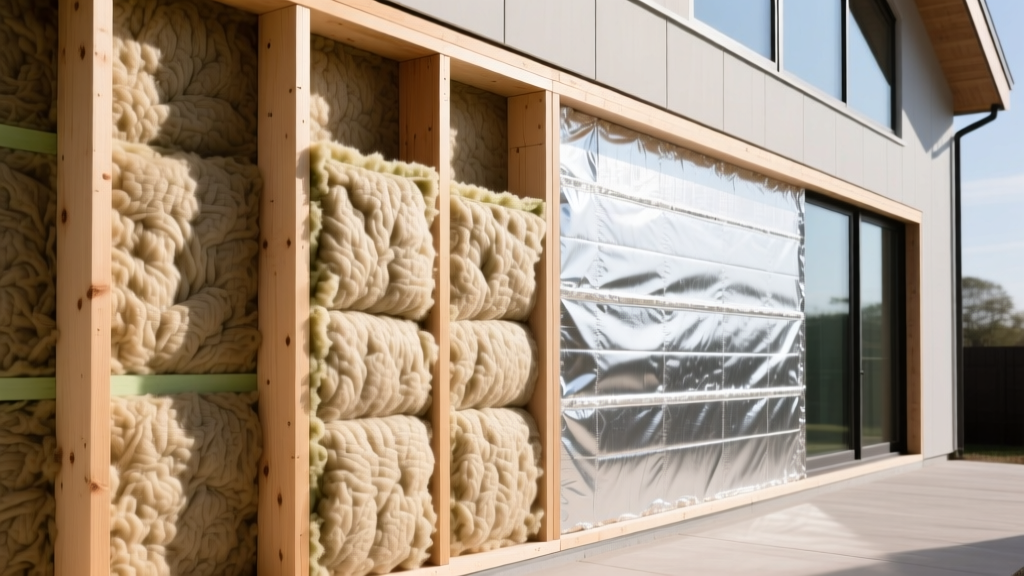
Mineral wool (specifically stone wool like ROCKWOOL Comfortbatt) has become the go-to wall insulation material for builders prioritizing fire resistance, acoustic dampening, and vapor openness. It provides R-4.2 per inch and is hydrophobic, meaning it will not wick moisture or lose its R-value if it gets wet during construction.
- Energy Efficiency Edge: Maintains its dimensional stability across extreme temperature swings, ensuring it doesn't slump or settle over decades, which is a common failure point with fiberglass.
- Failure Mode: Improper friction fitting. Mineral wool is designed to be compressed by 1/2 inch to hold itself in the cavity. If cut too small, gaps form at the edges; if cut too large, the material bunches, creating voids that degrade thermal performance.
- Cost: $1.10 to $1.60 per square foot (material only) for 3.5-inch and 5.5-inch batts.
3. Polyisocyanurate Continuous Insulation (ci)
To address thermal bridging, rigid polyisocyanurate boards (like Hunter Panels Polyiso or Owens Corning FOAMULAR NGX for XPS alternatives) are installed over the wall sheathing. Polyiso offers the highest R-value per inch of any rigid board at R-6.0 to R-6.5.
- Energy Efficiency Edge: Foil-faced polyiso acts as a radiant barrier and a Class I vapor retarder, drastically reducing thermal bridging through wood framing.
- Failure Mode (Thermal Drift): Polyiso experiences a phenomenon called "thermal drift." At 75°F, it performs at R-6.0/inch. However, as temperatures drop below 40°F, the blowing agents inside the foam cells begin to condense, dropping the effective R-value to R-5.0 or lower. In Climate Zones 6+, polyiso must be thick enough to keep the interior sheathing above the dew point, or it must be paired with a vapor-permeable exterior layer like mineral wool.
- Cost: $0.85 to $1.30 per square foot for 1-inch thick boards (R-6).
A leading cause of mold and structural rot in modern energy-efficient homes is the accidental creation of a "moisture sandwich." If you install an interior Class I vapor retarder (like polyethylene sheeting) alongside an exterior foil-faced polyiso board, any moisture that enters the wall cavity during construction or via interior humidity spikes is trapped. Always consult the Building Science Corporation's guidelines on continuous insulation to ensure your wall assembly can dry to at least one direction (usually the exterior in cooling-dominated climates, and the interior in heating-dominated climates).
10-Year Energy Payback: Upfront Cost vs. HVAC Savings
Choosing a wall insulation material is a capital expenditure that pays dividends through reduced HVAC loads. The following analysis models a 2,500 sq. ft. single-story home in IECC Climate Zone 5 (e.g., Chicago, IL), comparing a baseline code-minimum wall against high-performance assemblies.
| Wall Assembly Configuration | Upfront Insulation Cost | Estimated Annual HVAC Savings | 10-Year Net Benefit |
|---|---|---|---|
| Code Min: 2x4 w/ Fiberglass (R-13) | $1,800 | Baseline ($0) | $0 |
| Upgrade: 2x6 w/ Mineral Wool + 1" Polyiso | $5,400 | $650 / year | +$2,900 |
| Premium: 2x6 w/ ccSPF + 2" Mineral Wool ci | $9,800 | $920 / year | +$3,000 (plus HVAC downsizing savings) |
Note: The premium assembly often allows for downsizing the HVAC equipment by 15-20%, which can offset $2,000 to $4,000 of the initial insulation cost, making the payback period nearly immediate.
Technical FAQ: Code Compliance and Installation Gotchas
Can I use structural insulated sheathing instead of standard ci?
Yes. Products like Huber ZIP System R-Sheathing combine the structural OSB, water-resistive barrier (WRB), and continuous polyiso insulation into a single panel. This reduces labor costs and eliminates the need to tape and flash a separate layer of rigid foam. However, you must use the manufacturer's specific structural screws to attach the panels to the framing, as the foam layer alters the sheer transfer dynamics of the wall.
How do I handle electrical boxes in thick continuous insulation walls?
When adding 2 to 4 inches of exterior continuous insulation, standard electrical boxes will not reach the exterior siding. You must use specialized extension rings or deep-mount boxes designed for thick-wall assemblies. Furthermore, air-seal the back of every electrical box with canned spray foam or specialized gaskets (like Lessco air-tight boxes) before the cavity insulation is installed to prevent convective heat loss.
Is blown-in fiberglass a viable alternative to mineral wool for retrofits?
Blown-in fiberglass (like Owens Corning InsulSafe) is excellent for attic floors but performs poorly in enclosed vertical wall cavities compared to dense-pack cellulose or mineral wool. In vertical applications, blown-in fiberglass is prone to settling over time, leaving the top 10-15% of the wall cavity completely uninsulated. If using a blown material for wall retrofits, dense-pack cellulose (installed at 3.5 lbs per cubic foot) is the superior choice for energy efficiency and air sealing.
Written by
Marcus ChenMarcus Chen is a licensed structural engineer (PE) and building materials analyst with over 12 years of experience across residential, commercial, and industrial construction. He holds a Master of Science in Civil Engineering from UC Berkeley and spent six years at Thornton Tomasetti before transitioning to independent consulting and technical writing. Marcus specializes in material selection for seismic-prone regions, concrete reinforcement strategies, and lifecycle cost analysis. His work has been cited by the American Concrete Institute (ACI) and the Structural Engineers Association of California (SEAOC). When he is not on a job site or at his desk, you will find him hiking the Sierra Nevada or restoring a 1920s craftsman bungalow in Oakland, CA.
More from Marcus Chen
View all
Construction Cost
How Much Did the Eiffel Tower Cost to Build?
How much did the Eiffel Tower cost to build in 1889? We adjust for inflation and compare its budget to modern skyscraper construction.
Aug 4, 2026

Fire Resistance
What Is a Fire Resistant Material? Testing & Certification Guide
Discover what is a fire resistant material through ASTM and UL testing. Learn how fire ratings, certifications, and assemblies work in construction.
Aug 4, 2026

Construction Cost
How Much Did the Burj Khalifa Cost to Build?
How much did the Burj Khalifa cost to build? We break down the $1.5B project and extract 5 money-saving strategies for your next build.
Jul 30, 2026