Top Closed-Cell Spray Foam Brands Compared for 2026
Compare top closed-cell spray foam brands for 2026. Deep dive into Carlisle, Icynene, and Huntsman specs, HFO blowing agents, and installed costs.
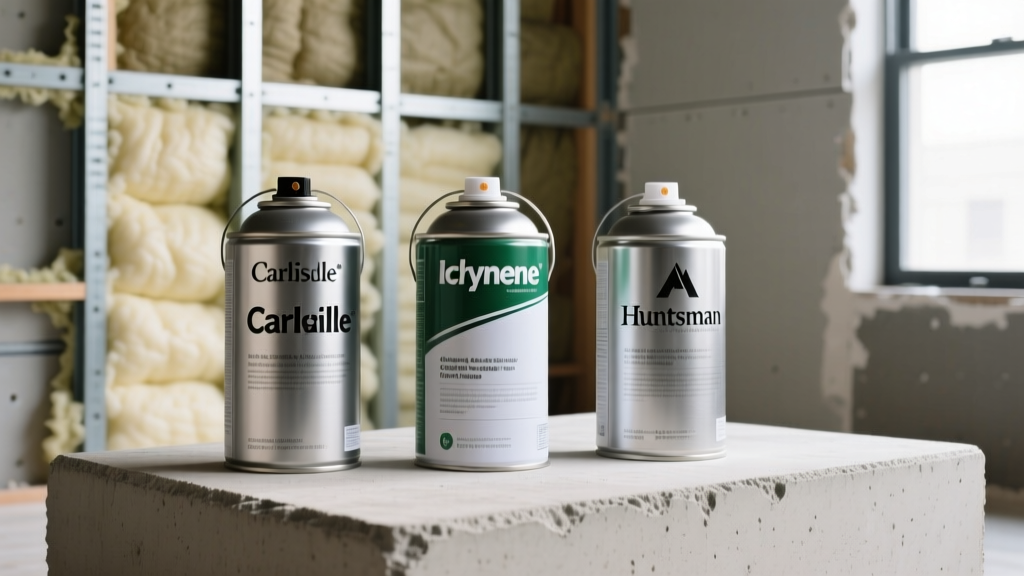
The 2026 Landscape: HFO Blowing Agents and the AIM Act
The closed-cell spray foam market has undergone a massive chemical transition over the last few years, driven by the American Innovation and Manufacturing (AIM) Act. As of 2026, the phase-down of high-GWP (Global Warming Potential) HFC blowing agents like HFC-245fa is nearly complete. Top manufacturers have reformulated their flagship 2 lb/ft³ closed-cell products to utilize next-generation HFO (Hydrofluoroolefin) blowing agents, which boast a GWP of less than 10 compared to the 1030 GWP of legacy HFCs. According to the EPA's HFC Reduction guidelines, this transition not only reduces environmental impact but also yields a slight bump in aged R-values due to the superior thermal resistance of HFO gases trapped within the foam matrix.
For architects, builders, and high-performance home consultants, choosing a closed-cell spray foam brand is no longer just about R-value per inch. It requires evaluating the proportioner settings required for the specific resin, the vapor permeance profile at standard 2-inch thicknesses, and the long-term adhesion to modern engineered wood substrates like Zip System sheathing or rigid mineral wool exterior continuous insulation.
Carlisle Spray Foam Insulation: Heatlok XT High Rise
Carlisle (which fully integrated the legacy Demilec product lines) remains a dominant force in the North American market. Their premier closed-cell offering for commercial and high-end residential applications is Heatlok XT High Rise.
Technical Profile and Application Specs
Heatlok XT High Rise is a 2.0 lb/ft³ density, HFO-blown closed-cell foam. It delivers an impressive aged R-value of R-7.4 per inch. The "High Rise" designation refers to its unique reaction profile: it allows contractors to pull the trigger and achieve a 3-inch to 4-inch pass thickness in a single lift without the risk of thermal degradation or core scorching, which is a common failure mode in standard 2-lb foams when applied too thickly.
- Density: 2.0 lb/ft³ (Nominal)
- Compressive Strength: 42 psi (ASTM D1621)
- Water Vapor Permeance: 0.8 perms at 2.5 inches (Class II Vapor Retarder)
- Proportioner Temp: 130°F - 140°F (A and B sides)
Icynene-Lapolla: Icynene ProSeal Eco
Icynene-Lapolla approaches the closed-cell market with a heavy emphasis on indoor air quality and renewable content. Icynene ProSeal Eco incorporates castor oil and recycled plastics into its polyol resin blend, making it a favorite for LEED-certified and Living Building Challenge projects.
Performance and Substrate Adhesion
ProSeal Eco yields an R-value of R-6.7 per inch. While slightly lower than Carlisle's HFO offering, it compensates with exceptional low-temperature adhesion. Building science experts at Building Science Corporation frequently note that closed-cell foam's structural racking strength is only as good as its substrate adhesion. ProSeal Eco maintains a tensile adhesion strength of over 25 psi even when applied to substrates as cold as 35°F, provided the material itself is heated correctly at the spray gun.
- Density: 1.8 lb/ft³ (Nominal)
- Compressive Strength: 38 psi (ASTM D1621)
- Blowing Agent: HFO / Water-blown hybrid
- Max Pass Thickness: 2.5 inches per lift
Huntsman Building Solutions: FOAM-LOK 2000
Huntsman's FOAM-LOK 2000 is engineered specifically for extreme wind uplift resistance and structural rigidity, making it the go-to specification for coastal hurricane zones and commercial roofing tie-ins. It is a slightly denser formulation, hovering around 2.1 lb/ft³.
Structural Racking and Flood Resistance
Because of its higher density and cross-linking polymer structure, FOAM-LOK 2000 provides a higher compressive strength (48 psi) and adds significant shear strength to wall assemblies. Furthermore, it meets the FEMA classification for flood-resistant materials. As outlined by the Spray Polyurethane Foam Alliance (SPFA), closed-cell foams with a density of 2.0 lb/ft³ or greater are generally considered acceptable for below-grade applications and areas subject to direct water contact, as they will not absorb water or harbor mold when submerged.
Technical Specification Matrix: 2026 Flagship Models
| Brand & Product | Nominal Density | Aged R-Value / Inch | Compressive Strength | Blowing Agent Tech | Max Single Lift |
|---|---|---|---|---|---|
| Carlisle Heatlok XT High Rise | 2.0 lb/ft³ | R-7.4 | 42 psi | 100% HFO | 4.0 inches |
| Icynene ProSeal Eco | 1.8 lb/ft³ | R-6.7 | 38 psi | HFO Hybrid | 2.5 inches |
| Huntsman FOAM-LOK 2000 | 2.1 lb/ft³ | R-7.0 | 48 psi | HFO | 3.5 inches |
Real-World Application Failures and Edge Cases
Even the most advanced HFO closed-cell foams will fail catastrophically if the application parameters are ignored. The following edge cases account for 90% of closed-cell spray foam callbacks in the field:
1. The "Off-Ratio" Shrinkage Delamination
If the Graco proportioner's A-side (Iso) and B-side (Resin) pumps experience a pressure drop, the chemical mix deviates from the strict 1:1 volumetric ratio. This results in foam that initially expands but shrinks away from the studs within 48 hours, creating massive air gaps. The Fix: Contractors must perform a daily "cup test" and verify that the impingement pressure at the spray gun remains above 1000 psi. If pressure drops below 900 psi, the spray must halt immediately to clean the AP spray gun chamber.
2. Fish-Eyes on Silicone-Contaminated Substrates
Closed-cell foam requires mechanical and chemical bonding to the substrate. If a previous tradesperson used silicone-based caulk, WD-40, or certain types of form-release oils on the concrete or wood, the foam will pull back into circular "fish-eyes," leaving bare spots. The Fix: Substrates must be wiped with an isopropyl alcohol solution prior to spraying. Silicone contamination requires mechanical abrasion (grinding/sanding) before foam application.
3. Core Scorching in Deep Cavities
Applying 6 inches of standard closed-cell foam in a single pass generates exothermic heat exceeding 350°F inside the core of the foam. This causes the center of the foam to char, turning brown or black, and destroying its cellular structure and R-value. The Fix: Never exceed the manufacturer's maximum single-pass thickness (usually 2.5 to 4 inches). For a 6-inch wall cavity, the contractor must spray a 3-inch lift, allow 15 minutes for thermal dissipation, and then apply the second 3-inch lift.
2026 Installed Cost Breakdown by Application
Pricing for closed-cell spray foam is calculated by the board foot (1 square foot at 1 inch thick). In 2026, material costs have stabilized following the HFO transition, but regional labor variances remain significant.
- Standard 2-Inch Wall Application (R-14 to R-15): $1.25 to $1.55 per board foot installed. (Total: $2.50 - $3.10 per sq ft of wall area).
- Standard 5-Inch Roofline Application (R-35 to R-37): $1.15 to $1.40 per board foot installed. (Total: $5.75 - $7.00 per sq ft of roof deck). Note: Thicker applications yield a lower per-board-foot cost due to reduced mobilization and setup amortization.
- Below-Grade / Crawl Space Application: $1.60 to $1.90 per board foot. Requires specialized ventilation, fire-retardant intumescent paint coatings (like DC315), and tighter safety protocols, driving up labor costs.
Final Specification Guidance
When writing your project specifications, do not simply call out "2 lb closed-cell spray foam." Specify the exact product line (e.g., Carlisle Heatlok XT High Rise), mandate the use of HFO blowing agents to ensure compliance with current environmental codes, and explicitly require the contractor to provide daily proportioner temperature and pressure logs. By controlling the chemical inputs and application parameters, you ensure the foam delivers the structural rigidity, air sealing, and high R-value that justifies its premium cost over traditional fiberglass or mineral wool alternatives.