Insulation Sound Dampening Ratings: STC, NRC & OITC Explained
Master insulation sound dampening specs. Compare STC, NRC, and OITC ratings, material densities, and assembly designs for optimal acoustic control.
Decoding the Core Acoustic Performance Metrics
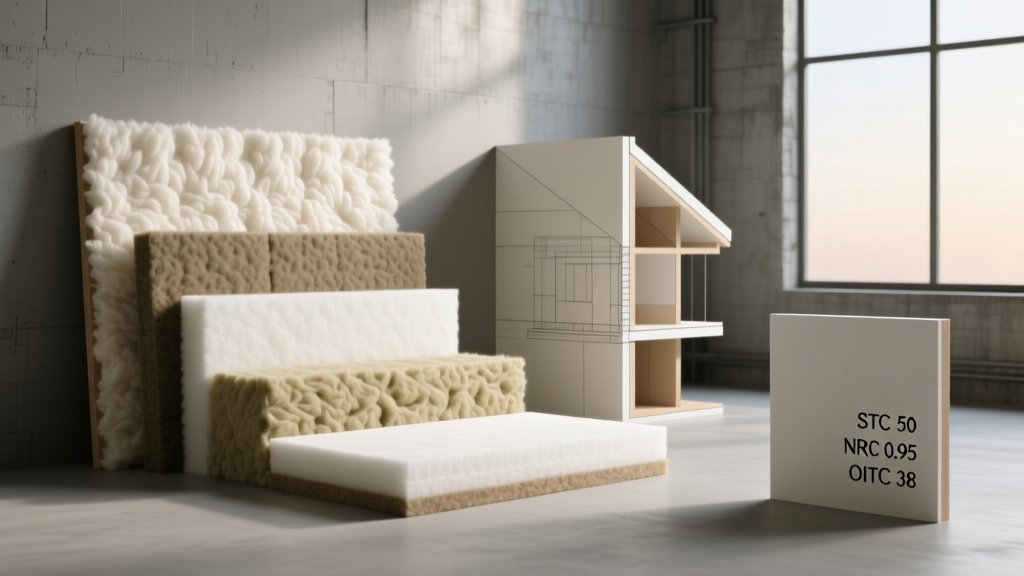
Specifying insulation for sound control requires abandoning the colloquial term "soundproofing" in favor of precise acoustic metrics. When evaluating insulation sound dampening capabilities, architects and builders must differentiate between sound absorption (reducing echo within a room) and sound transmission (blocking noise from passing through a barrier). The industry relies on four primary standardized ratings to quantify these behaviors, each governed by specific ASTM testing protocols.
| Metric | Full Name | What It Measures | Scale & Target | Governing Standard |
|---|---|---|---|---|
| STC | Sound Transmission Class | Airborne sound blocking (speech, TV) | 25 (poor) to 70+ (studio). Target: 50+ for multi-family. | ASTM E90 / E413 |
| NRC | Noise Reduction Coefficient | Sound absorption (reducing reverberation) | 0.00 (reflective) to 1.00+ (absorptive). Target: 0.85+. | ASTM C423 |
| OITC | Outdoor-Indoor Transmission Class | Low-frequency airborne noise (traffic, HVAC) | 20 to 50+. Target: 35+ for exterior walls. | ASTM E1332 |
| IIC | Impact Insulation Class | Structure-borne impact noise (footsteps) | 25 (poor) to 70+ (excellent). Target: 50+. | ASTM E492 / E989 |
According to the Whole Building Design Guide (WBDG), relying solely on STC for exterior walls or mechanical room partitions is a critical error. STC testing heavily penalizes low-frequency noise, meaning a wall can achieve a high STC rating while still allowing the deep rumble of an HVAC unit or highway traffic to penetrate. For these scenarios, OITC is the mandatory specification.
Material Specifications: Density, Thickness, and NRC
Insulation materials dampen sound primarily through friction—converting acoustic energy into trace amounts of heat as sound waves navigate the material's fibrous or cellular matrix. Density and flow resistivity are the primary drivers of acoustic performance.
Mineral Wool (Stone Wool)
Mineral wool is the industry standard for high-performance acoustic cavities. Products like ROCKWOOL Safe'n'Sound are engineered specifically for acoustics rather than thermal resistance. With a density of approximately 2.5 lb/ft³ and high flow resistivity, a standard 3-inch batt achieves an NRC of 1.05. Its non-directional fiber structure excels at trapping mid-to-high frequency airborne noise (1000 Hz to 4000 Hz), making it ideal for interior party walls and home theaters.
Fiberglass Batts
Acoustic fiberglass, such as Owens Corning QuietZone, offers a lighter, more cost-effective alternative. At a density of 1.2 to 1.5 lb/ft³, it provides an NRC between 0.90 and 1.00 at 3.5 inches. While excellent for general residential speech privacy, fiberglass lacks the mass and rigidity of mineral wool, resulting in slightly lower performance in the critical 500 Hz range where human conversation peaks.
Spray Polyurethane Foam (SPF)
Spray foam is frequently misunderstood in acoustic applications. Closed-cell foam (2.0 lb/ft³) is highly rigid and structurally couples the drywall to the framing, which can actually increase the transmission of low-frequency, structure-borne noise. Open-cell foam (0.5 lb/ft³) acts as a decent mid-frequency absorber (NRC ~0.80) but lacks the mass to block sound. Neither should be specified as a primary acoustic dampening solution in high-STC assemblies.
Dense-Packed Cellulose
For retrofit scenarios where drywall cannot be removed, dense-packed cellulose (blown at 3.0 to 3.5 lb/ft³) provides exceptional cavity damping. The high mass and interlocking fibers effectively deaden cavity resonance, often outperforming standard fiberglass in existing 2x4 walls.
The Assembly Fallacy: Why Insulation Alone Has No STC
To understand how insulation sound dampening integrates into a broader system, consider the evolution of a standard interior partition, tested per ASTM E90 laboratory standards:
- Baseline Assembly: Standard 2x4 wood studs (16" o.c.), R-13 thermal fiberglass, single layer 1/2" drywall both sides. STC: 33-36. (Normal speech is clearly understood).
- Upgraded Cavity: Standard 2x4 studs, ROCKWOOL Safe'n'Sound, single layer 5/8" Type X drywall both sides. STC: 43-46. (Loud speech heard as murmur).
- High-Performance Assembly: Staggered 2x4 studs on a 2x6 plate, Safe'n'Sound, resilient channels on one side, two layers of 5/8" drywall with Green Glue damping compound. STC: 60-65. (Loud music barely audible).
The insulation provides the baseline cavity absorption, but the 20+ point jump in the final assembly is achieved through decoupling (staggered studs/resilient channels) and mass/damping (double drywall + viscoelastic compound). For comprehensive assembly designs, the USG Acoustical Design Guide remains the definitive reference for tested UL and ULC configurations.
Frequency Matters: Targeting the Right Noise Profile
Selecting the correct insulation requires identifying the primary noise pollutant. Different materials and assembly techniques target different frequency bands.
Airborne Mid/High Frequencies (500 Hz - 4000 Hz)
Sources: Human speech, television, barking dogs.
Solution: Standard mineral wool or acoustic fiberglass batts. The porous fiber matrix creates high flow resistivity, effectively absorbing these shorter wavelengths. Ensure the batt completely fills the cavity without compression.
Low-Frequency Airborne Noise (63 Hz - 250 Hz)
Sources: Highway traffic, aircraft, HVAC duct rumble, subwoofers.
Solution: Mass and decoupling. Insulation alone is virtually transparent to low-frequency waves. You must specify high-mass barriers (Mass Loaded Vinyl, concrete, multiple layers of 5/8" gypsum) and isolate the structure using resilient channels or staggered studs. OITC is the governing metric here.
Structure-Borne Impact Noise
Sources: Footsteps, dropped objects, vibrating machinery.
Solution: Cavity insulation does not stop impact noise. You must isolate the impact at the source using acoustic underlayments (e.g., 5mm rubber-cork composites) or float the floor on neoprene isolators. The IIC rating measures this assembly's performance.
Installation Tolerances That Destroy Acoustic Ratings
A specified STC 55 assembly will perform at STC 40 in the field if installation tolerances are ignored. Acoustic energy behaves like water; it will find the path of least resistance. Protect your insulation sound dampening investment by enforcing the following site protocols:
- The 1% Flanking Rule: A gap or unsealed penetration comprising just 1% of the wall surface area can reduce the assembly's STC by 5 to 10 points. All perimeter joints, top/bottom plates, and penetrations must be sealed with a non-hardening acoustical sealant (e.g., Tremco Acoustical Sealant). Do not use standard acrylic latex caulk, which shrinks and cracks over time.
- Electrical Box Placement: Never install electrical outlets back-to-back on a party wall. This creates a direct acoustic short-circuit. Boxes must be staggered by at least 24 inches horizontally and wrapped in acoustic putty pads (e.g., Trade-Master) to maintain the mass of the drywall barrier.
- Batt Compression: Forcing a 3.5-inch acoustic batt into a 2.5-inch cavity does not increase its sound-blocking properties. Compression alters the material's flow resistivity, potentially creating resonant frequencies that worsen low-frequency transmission. Cut the insulation to fit snugly without force.
- Rigid Penetrations: HVAC ducts, plumbing stacks, and recessed lighting cans that touch the drywall or framing will bypass the insulation entirely. Use flexible duct connectors, isolate pipes with rubber hangers, and specify IC-rated, acoustic-hooded recessed lights.
Mastering insulation sound dampening requires moving beyond product brochures and focusing on assembly physics. By matching the correct material density to the specific noise frequency, and rigorously sealing flanking paths, builders can reliably achieve the acoustic privacy demanded by modern building codes and high-end residential clients.