Best Heat Insulator Materials for Energy Efficiency in 2026
Discover the best heat insulator materials for 2026. Compare R-values, costs, and applications of spray foam, aerogel, and rigid boards for top efficiency.

The Physics of Heat Transfer and the 2026 Blowing Agent Shift
Selecting the best heat insulator materials requires moving beyond basic R-value charts and understanding the thermodynamics of building envelopes. In 2026, the insulation market has been fundamentally reshaped by the Environmental Protection Agency’s (EPA) enforcement of the AIM Act, which mandated the phase-down of high-GWP (Global Warming Potential) hydrofluorocarbon (HFC) blowing agents. Today’s top-tier thermal insulators now utilize next-generation hydrofluoroolefin (HFO) blowing agents or inert gases, altering both the environmental footprint and the long-term thermal drift characteristics of rigid foams and spray polyurethane.
According to the U.S. Department of Energy, effective thermal resistance depends not just on the material's inherent conductivity, but on its installation quality, air-sealing capabilities, and moisture management. Below is a technical breakdown of the highest-performing heat insulator materials available for residential and commercial construction in 2026.
Top Tier: The Best Heat Insulator Materials Ranked by Thermal Resistance
1. Silica Aerogel Insulation (The Extreme Performer)
Aerogel is a synthetic porous ultralight material derived from a gel, in which the liquid component has been replaced with a gas. The result is a solid that is up to 95% air by volume. Products like Aspen Aerogels Spaceloft offer an astonishing R-10.3 per inch, making it the undisputed leader in thermal resistance per unit of thickness.
- Cost: $3.50 to $5.00 per square foot (for 10mm blankets).
- Best Application: Historic masonry retrofits where interior space cannot be sacrificed, basement rim joists with severe spatial constraints, and thermal bridging mitigation over steel framing.
- Limitations: High material cost and low compressive strength; it cannot be used in structural load-bearing cavities or under slabs.
2. Closed-Cell Spray Polyurethane Foam (ccSPF)
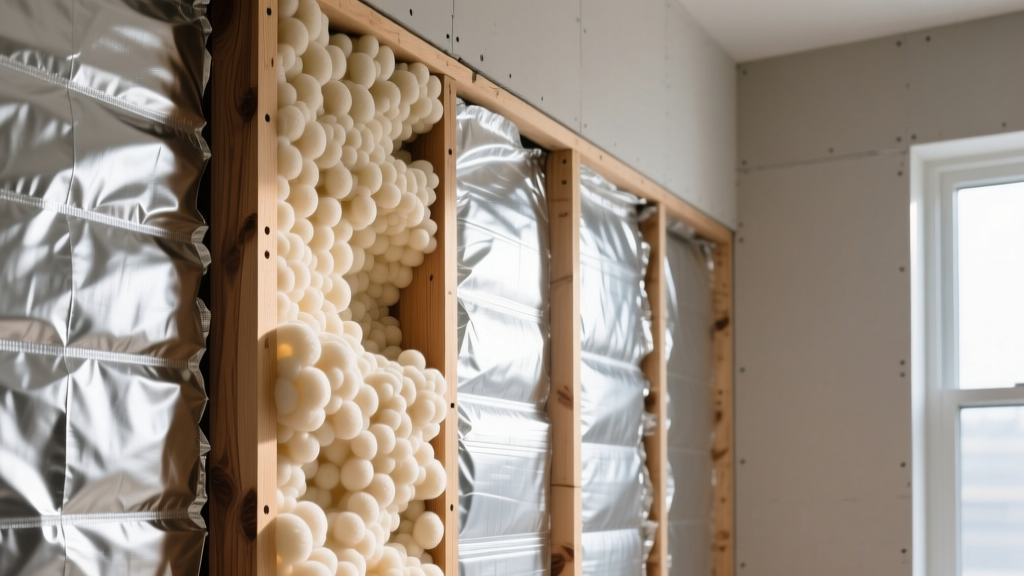
Modern 2-pound density ccSPF, such as Demilec Heatlok HTX or Icynene ProSeal Eco, utilizes HFO blowing agents to deliver R-6.5 to R-7.0 per inch. Beyond its high thermal resistance, ccSPF acts as a Class II vapor retarder and an exceptional air barrier, effectively eliminating convective heat loss (which can account for up to 40% of a building's energy leakage).
- Cost: $1.60 to $2.80 per board foot (installed).
- Best Application: Unvented cathedral ceilings, complex roof geometries, and below-grade foundation walls where hydrostatic pressure and moisture are present.
- Limitations: Requires certified professional installation; highly sensitive to substrate temperature and moisture during application. Improper mixing ratios can result in off-gassing and shrinkage.
3. Polyisocyanurate (Polyiso) Rigid Foam
Foil-faced polyiso boards, like Johns Manville ENRGY 3 or Carlisle RMAX Thermasheath, are the workhorses of continuous exterior insulation (ci). At a mean temperature of 75°F, polyiso delivers an impressive R-6.0 to R-6.5 per inch. However, building scientists have long documented the phenomenon of "thermal drift" in polyiso.
Unlike other insulators, polyiso's R-value decreases in extreme cold. As the ambient temperature drops below 40°F, the blowing gases trapped within the closed cells begin to condense, reducing the effective R-value to approximately R-4.5 per inch. When designing exterior continuous insulation in Climate Zones 5 and above, you must calculate your wall assembly's total R-value based on the winter design temperature, not the 75°F laboratory rating. For a deep dive into this thermodynamic quirk, refer to the Building Science Corporation's research on thermal drift.
4. Mineral Wool (Rockwool) Batts and Boards
Manufactured by spinning molten basalt rock and steel slag into dense fibers, mineral wool (e.g., Rockwool Comfortboard 80) offers R-4.2 to R-5.0 per inch. While its raw R-value is lower than foams, its value in high-performance assemblies lies in its secondary properties: it is completely vapor-permeable, non-combustible (fire-rated to 2,150°F per ASTM E119), and highly hydrophobic.
- Cost: $1.10 to $1.60 per square foot (for 2-inch to 3-inch exterior boards).
- Best Application: Exterior continuous insulation in "flash-and-batt" or "PERSIST" wall assemblies where the building envelope must be able to dry to the exterior.
- Limitations: Lower R-value per inch requires thicker wall assemblies to meet modern energy codes; requires specialized carbide-tipped blades for cutting.
Material Comparison Matrix: Cost, R-Value, and Permeability
The following matrix synthesizes 2026 market data to help contractors and architects select the appropriate material based on assembly requirements.
| Material | R-Value / Inch | Approx. Cost (2026) | Vapor Permeability | Air Barrier? |
|---|---|---|---|---|
| Aerogel Blanket | R-10.3 | $4.25 / sq ft | Permeable | No |
| ccSPF (2 lb) | R-6.5 - R-7.0 | $2.20 / bd ft | Class II Retarder | Yes |
| Polyiso (Foil) | R-6.0 (at 75°F) | $1.05 / sq ft | Class I Retarder | Yes (if sealed) |
| Mineral Wool | R-4.2 - R-5.0 | $1.35 / sq ft | Highly Permeable | No |
| EPS (Type II) | R-3.8 - R-4.2 | $0.65 / sq ft | Semi-Permeable | No |
Application-Specific Decision Framework
Do not select insulation based solely on the highest R-value. The "best" material is dictated by the hygrothermal dynamics of your specific assembly. Use this framework to guide your specification:
- IF you are insulating an unvented low-slope roof or cathedral ceiling THEN use ccSPF. It provides the necessary R-value per inch to meet code within standard rafter depths (e.g., 2x10 or 2x12) while acting as an air and vapor barrier to prevent interstitial condensation.
- IF you are designing a wood-framed wall in Climate Zone 5+ requiring exterior continuous insulation (ci) THEN use Mineral Wool boards or EPS. Avoid foil-faced polyiso on the exterior of vapor-impermeable interior assemblies, as it can trap moisture inside the wall cavity during the summer months.
- IF you are retrofitting a solid masonry or brick building from the interior THEN use Aerogel blankets or mineral wool paired with a smart vapor retarder. Never use closed-cell foam on the interior of historic masonry, as it prevents the brick from drying inward, leading to freeze-thaw spalling.
- IF you are insulating below-grade foundation walls THEN use XPS or EPS (Type IX). While polyiso and ccSPF have higher R-values, they can degrade or lose adhesion under constant hydrostatic pressure and prolonged soil moisture exposure.
Hidden Costs and Installation Failure Modes
The theoretical R-value of the best heat insulator materials is frequently compromised by poor field execution. Be aware of these common failure modes:
- Spray Foam Shrinkage and Delamination: If ccSPF is applied to a cold substrate (below 60°F) or applied in lifts thicker than 2 inches without proper cooling intervals, the exothermic reaction can cause the core to char or the foam to shrink and pull away from the studs. This creates massive thermal bypasses.
- Rigid Foam Joint Leakage: The R-value of foil-faced polyiso is entirely dependent on taping the seams with compatible acrylic or butyl tape (e.g., Zip System or 3M 8067). Untaped joints allow convective air loops behind the continuous insulation layer, effectively nullifying the thermal break.
- Mineral Wool Compression: While mineral wool is dense, compressing a 5.5-inch batt into a 4.5-inch cavity does not increase its R-value; it decreases it. The R-value of fibrous insulation relies on the trapped pockets of air between the fibers. Compression increases solid-state thermal conduction.
Regulatory and Code Compliance for 2026
As jurisdictions across North America adopt the IECC 2024 and 2026 energy codes, the baseline requirements for thermal envelopes have tightened significantly. In Climate Zones 4 through 8, wood-framed walls now universally mandate continuous exterior insulation (ci) ranging from R-10 to R-20, effectively eliminating the code-compliance of standard 2x6 cavity-only fiberglass or mineral wool assemblies.
Furthermore, whole-building air leakage testing (blower door tests) is now strictly enforced, with maximum allowable leakage rates dropping to 2.0 to 3.0 ACH50 (Air Changes per Hour at 50 Pascals) in many municipalities. This makes the air-sealing properties of ccSPF and properly taped rigid foam boards not just an energy upgrade, but a mandatory code requirement for obtaining a certificate of occupancy. When specifying the best heat insulator materials, always cross-reference the material's air-barrier certification (such as ABAA evaluations) with your local building department's amended energy codes.
Written by
Priya KapoorPriya Kapoor is a real estate market analyst and construction economics researcher with expertise in housing affordability, development feasibility, and infrastructure investment. She holds a Master of Regional Planning from Cornell University and previously worked as a senior analyst at CBRE's Investment Properties group, where she modeled returns for $4B in mixed-use development pipelines. Priya now runs an independent research practice advising developers, municipalities, and REITs on construction cost forecasting and market timing. She publishes the quarterly "BuildMat Market Pulse" report tracking material price indices across 12 commodity categories. Based in Austin, TX, Priya serves on the board of Habitat for Humanity Austin and is a marathon runner.
More from Priya Kapoor
View all
Construction Cost
Cost to Build a 1600 Sq Ft Home in 2026: Full Breakdown
Accurate 2026 cost to build a 1600 sq ft home—material, labor, and regional pricing breakdowns included. Plan your budget with real-time estimates.
Aug 11, 2026

Wood & Lumber
Name the Types of Wood for Pressure Treatment and Preservation
Learn how to name the types of wood best suited for pressure treatment. Compare species treatability, chemical retention levels, and 2026 preservation costs.
Aug 4, 2026

Stone & Masonry
Stone Veneer Suppliers Lindenhurst: 2026 Cost Analysis
Analyze 2026 stone veneer costs in Lindenhurst, NY. Compare local supplier pricing, delivery fees, and Suffolk County installation labor rates.
Aug 4, 2026