Wool Insulation Taxonomy: Selecting Sheep, Mineral, and Rock Wool
Navigate the wool insulation taxonomy. Compare sheep's wool, rock wool, and slag wool for R-value, acoustics, moisture management, and project selection.
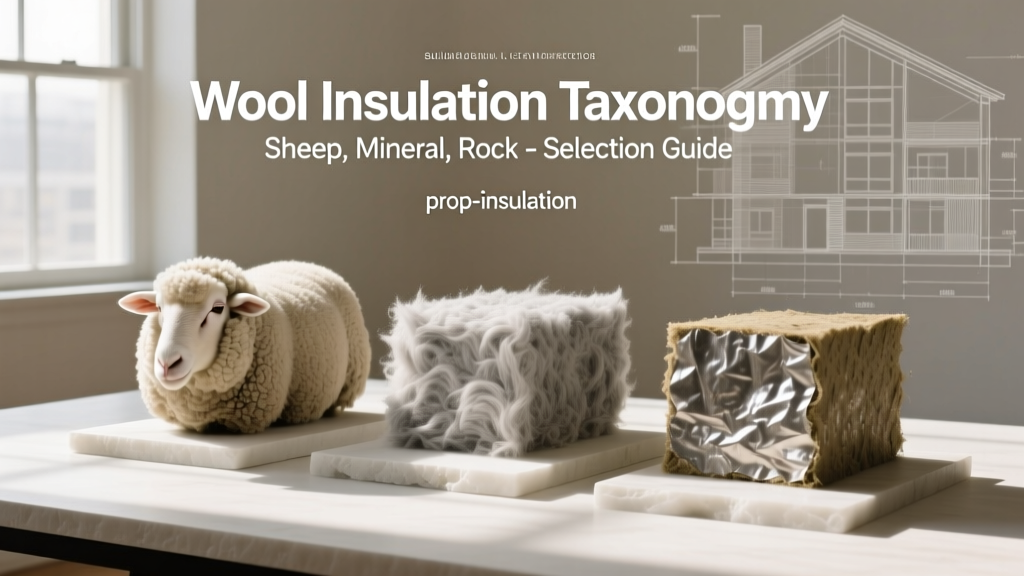
The Great 'Wool' Confusion in Building Science
When architects and builders specify 'wool insulation,' the procurement chain often faces immediate ambiguity. The term colloquially bridges two fundamentally distinct material categories: natural animal fibers (sheep's wool) and inorganic spun fibers (mineral wool, encompassing rock and slag wool). While both share a fibrous morphology that traps air to resist thermal transfer, their hygroscopic properties, fire ratings, and acoustic behaviors are diametrically opposed. Misclassifying these materials in building envelopes leads to catastrophic moisture entrapment or compromised fire assemblies. According to the U.S. Department of Energy, understanding the distinct thermal and moisture dynamics of insulation types is critical for meeting modern energy codes without inducing structural rot.
Material Taxonomy Matrix: Natural vs. Mineral Wool
To specify correctly, you must first separate the taxonomy. The table below contrasts the three primary 'wool' subtypes available in the 2026 commercial and residential market.
| Material Subtype | Base Source | R-Value per Inch | Max Service Temp | Acoustic NRC | Avg. Cost (per sq. ft.) |
|---|---|---|---|---|---|
| Sheep's Wool | Keratin (Animal Fiber) | 3.6 - 4.3 | 1,100°F (Charring) | 0.60 - 0.80 | $2.10 - $3.50 |
| Rock Wool | Basalt / Diabase Rock | 4.2 - 5.0 | 2,150°F (Non-combustible) | 0.85 - 1.05 | $0.85 - $1.40 |
| Slag Wool | Blast Furnace Slag | 3.7 - 4.2 | 1,800°F (Non-combustible) | 0.75 - 0.95 | $0.65 - $1.10 |
Sheep's Wool: Hygroscopic Thermal Management
Natural sheep's wool insulation is engineered for breathable building envelopes, particularly in mass timber, historic masonry retrofits, and off-grid structures. The core advantage of keratin fiber is its hygroscopic capacity. Sheep's wool can absorb up to 35% of its own weight in ambient moisture vapor without feeling wet or losing its thermal resistance. As the fiber absorbs moisture, it undergoes an exothermic reaction, releasing trace amounts of heat and buffering interior humidity swings.
Product Specs and Chemical Treatments
Raw wool is highly susceptible to moth infestation and flame spread. Premium manufacturers like Havelock Wool and Thermafleece treat their batts with borax or boric acid. This treatment achieves a Class A fire rating by promoting charring rather than active combustion, while simultaneously acting as an insect repellent. Standard batts are typically available in R-13 (3.5-inch) and R-19 (5.5-inch) thicknesses, friction-fit into 16-inch or 24-inch on-center framing.
Never install a Class I vapor retarder (like 6-mil polyethylene sheeting) over sheep's wool in a heating-dominated climate. As detailed in building science research on vapor barrier dynamics, trapping moisture inside a hygroscopic material prevents the wool from drying to the interior, leading to chronic condensation and adjacent timber rot. Always use a Class III vapor retarder (like latex paint on drywall) or a smart vapor membrane (e.g., Intello Plus) that modulates permeability based on humidity levels.
Mineral Wool: Fire and Acoustic Dominance
Mineral wool is manufactured by spinning molten rock or industrial slag into a dense matrix of fibers, bound together with thermosetting resins. Modern 2026 production lines have largely transitioned to bio-based, formaldehyde-free binders, eliminating the off-gassing concerns associated with older phenol-formaldehyde formulations.
Rock Wool vs. Slag Wool
Rock Wool (Stone Wool): Produced primarily from basalt. Brands like ROCKWOOL Comfortbatt and Comfortboard 80 dominate the market. Rock wool is exceptionally rigid and hydrophobic. It will not absorb liquid water, making it ideal for exterior continuous insulation (ci) and below-grade applications where bulk moisture is present. Its melting point exceeds 2,150°F, making it the default specification for commercial fire-stopping and passive fire protection assemblies.
Slag Wool: Manufactured from iron ore blast furnace slag. It is generally softer and less dense than rock wool, making it highly cost-effective for standard interior cavity insulation where extreme fire resistance or exterior moisture exposure is not a factor.
For soundproofing interior partition walls, do not default to standard thermal rock wool batts. Specify dedicated acoustic products like ROCKWOOL Safe'n'Sound. The thermal batts have a density of roughly 2.5 lbs/cu ft, whereas acoustic batts are engineered at 4.0 to 6.0 lbs/cu ft. This higher mass and tortuous fiber path are required to achieve a Sound Transmission Class (STC) of 50+ in standard wood-framed walls.
Project-Specific Selection Framework
Use this decision matrix to select the correct wool insulation for your specific assembly:
- Historic Masonry Retrofit (Interior): Specify Sheep's Wool. The interior side of mass masonry must remain breathable to allow the wall to dry inward. Mineral wool's hydrophobic nature can trap bulk water against the masonry, accelerating freeze-thaw spalling in cold climates.
- Exterior Continuous Insulation (Rainscreen): Specify Rigid Rock Wool Board (e.g., Comfortboard 80). It provides structural rigidity, maintains R-value when wet, and is entirely non-combustible, satisfying modern NFPA 285 fire propagation requirements for commercial exteriors.
- Multi-Family Demising Walls: Specify High-Density Rock/Slag Wool Batts. The friction-fit stiffness ensures the cavity is completely filled without gaps, blocking flanking noise paths between residential units.
- High-Humidity Indoor Pools / Natatoriums: Specify Hydrophobic Rock Wool paired with a specialized foil-faced membrane. Sheep's wool will permanently saturate and degrade in constantly high-humidity, chlorinated environments.
Installation Edge Cases and Failure Modes
Even with correct material selection, improper installation negates the performance of wool insulation. Be aware of these common field failures:
1. The Compression Penalty
Both sheep's wool and mineral wool rely on trapped, static air for their R-value. Forcing a 5.5-inch (R-19) mineral wool batt into a 2x4 (3.5-inch) wall cavity does not yield R-19 in a smaller space. The compression increases conductive heat transfer through the solid fibers, dropping the effective R-value to approximately R-13 while wasting material. Always match the batt thickness to the cavity depth.
2. Mineral Wool Wicking in Sill Plates
While rock wool is hydrophobic (it repels liquid water), the binder matrix can sometimes allow capillary wicking if the bottom edge of the insulation rests directly on a damp concrete slab or uninsulated sill plate. Always maintain a 1/2-inch gap at the bottom of the cavity or apply a fluid-applied flashing membrane to the sill plate before dropping the batts into place.
3. PPE and Fiber Shedding
Unlike natural sheep's wool, which is safe to handle with bare hands, mineral wool fibers are mechanical irritants. While not classified as a carcinogen, the microscopic glass and rock shards cause severe contact dermatitis and respiratory irritation. Installers must wear N95 respirators, long sleeves, and nitrile gloves. Furthermore, mineral wool must be cut with a serrated insulation knife rather than compressed with a straight edge, which frays the edges and prevents a tight friction-fit against the studs.