Best Heat Insulation Materials for Homes: 2026 Guide
Compare the best heat insulation materials for 2026. Explore R-values, costs, and applications for fiberglass, spray foam, and mineral wool.

The Physics of Thermal Resistance: R-Value and U-Factor
Heat transfer in building envelopes occurs via conduction, convection, and radiation. Selecting the right heat insulation materials requires moving beyond basic R-value comparisons to understand how materials interact with moisture, air leakage, and thermal bridging. While R-value measures resistance to conductive heat flow, the U-factor measures the overall rate of heat transfer through an entire assembly. In modern construction, mitigating convective heat loss (air leakage) is just as critical as stopping conduction. According to the EPA's ENERGY STAR program, sealing air leaks before installing insulation can improve a home's overall thermal efficiency by up to 20%.
Comparative Matrix: Top Heat Insulation Materials
The following matrix breaks down the primary thermal insulation materials used in residential and light-commercial construction, reflecting 2026 material costs and performance metrics.
| Material Type | R-Value per Inch | Installed Cost (per sq ft) | Vapor Permeability | Best Application |
|---|---|---|---|---|
| Fiberglass Batt (Standard) | 3.1 - 3.4 | $1.00 - $1.50 | High (Class III) | Standard interior wall cavities, attic floors |
| Closed-Cell Spray Foam (ccSPF) | 6.5 - 7.0 | $1.50 - $3.00 | Low (Class II) | High moisture areas, structural racking, rim joists |
| Mineral Wool Batt | 4.2 - 5.0 | $1.80 - $2.50 | High (Class III) | Fire-rated assemblies, acoustic separation, exterior ci |
| Polyiso Rigid Board | 6.0 - 6.5 | $2.00 - $3.50 | Low (Class I/II) | Continuous exterior insulation (ci), flat roofs |
| Vacuum Insulation Panels (VIP) | 25.0 - 30.0 | $15.00 - $25.00 | None | Space-constrained retrofits, high-end appliance panels |
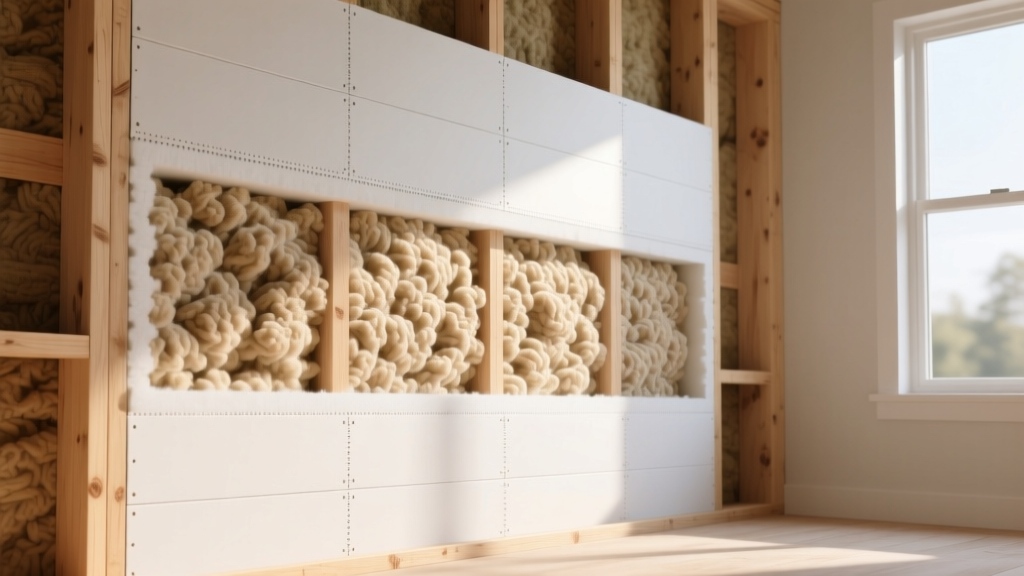
Deep Dive: Closed-Cell Spray Polyurethane Foam (ccSPF)
Closed-cell spray foam (typically 2.0 lb/ft³ density) remains the premier choice for environments requiring simultaneous thermal, air, and vapor control. Unlike open-cell foam, ccSPF utilizes a blowing agent that remains trapped in the cellular structure, yielding an R-value of up to 7.0 per inch.
HFO Blowing Agents and 2026 Environmental Standards
Historically, ccSPF relied on HFC blowing agents with high Global Warming Potentials (GWP). As of 2026, the industry has almost entirely transitioned to Hydrofluoroolefin (HFO) blowing agents (such as Honeywell's Solstice LBA), which boast a GWP of 1 or less. This shift maintains the high R-value of the foam while eliminating the environmental penalties associated with older formulations.
Mineral Wool: Fire Resistance and Hydrophobic Performance
Mineral wool (often referred to by the prominent brand name Rockwool) is manufactured from basalt rock and recycled slag. Its primary advantage over fiberglass is its hydrophobic nature and extreme fire resistance. Mineral wool batts do not absorb water; if a wall cavity gets wet, the mineral wool will retain its R-value and allow the moisture to pass through to dry, whereas fiberglass loses its insulating properties when saturated and can harbor mold.
For exterior continuous insulation (ci), high-density mineral wool boards (like Rockwool Comfortboard 80) are increasingly replacing expanded polystyrene (EPS) and extruded polystyrene (XPS). Mineral wool provides a fire-resistant, vapor-open layer that breaks thermal bridging through the wall studs while allowing the assembly to dry to the exterior. The North American Insulation Manufacturers Association (NAIMA) highlights that mineral wool's melting point exceeds 1,000°C (1,800°F), making it a critical component in passive fire protection assemblies.
The Flash-and-Batt Technique: Optimizing Cost and Performance
For builders seeking the air-sealing benefits of spray foam without the exorbitant cost of filling an entire 2x6 cavity, the 'flash-and-batt' method is the industry standard. This involves spraying 1.5 to 2 inches of closed-cell foam against the exterior sheathing to seal all penetrations and provide a vapor retarder, then filling the remainder of the cavity with a high-density fiberglass or mineral wool batt.
- Flash Coat (ccSPF): 1.5 inches @ R-6.5/inch = R-9.75
- Batt Fill (Mineral Wool): 4 inches @ R-4.2/inch = R-16.8
- Total Cavity R-Value: ~R-26.5 (excluding framing factor)
This hybrid approach reduces material costs by roughly 30% compared to a full foam fill while achieving superior airtightness and thermal performance.
Vacuum Insulation Panels (VIPs): The High-End Frontier
When space is at an absolute premium, Vacuum Insulation Panels (VIPs) offer unparalleled thermal resistance. A VIP consists of a gas-tight envelope surrounding a rigid core (usually fumed silica), from which the air has been evacuated. This near-vacuum eliminates convective and gaseous conduction, yielding R-values between 25 and 30 per inch.
However, VIPs come with severe edge cases. They cannot be cut or pierced on-site; doing so breaks the vacuum and immediately drops the R-value to roughly 4.0. They must be custom-manufactured to exact dimensions and are primarily used in high-end architectural retrofits where preserving interior square footage is paramount, or in structural insulated panels (SIPs) for specialized commercial applications.
Decision Framework: Matching Material to IECC Climate Zones
The International Energy Conservation Code (IECC) dictates minimum insulation levels based on climate zones. Selecting the correct heat insulation materials requires aligning the material's vapor profile with the zone's dominant moisture drive.
- Zones 1-3 (Hot-Humid / Hot-Dry): Prioritize air sealing and exterior continuous insulation. Avoid interior vapor retarders (like polyethylene or thick ccSPF) that prevent inward drying. Use vapor-open materials like mineral wool or unfaced fiberglass batts in cavities.
- Zones 4-5 (Mixed-Humid): The most complex zones due to dual heating and cooling seasons. Utilize 'smart' vapor retarders (like CertainTeed MemBrain) that change permeability based on humidity levels, paired with standard fiberglass or cellulose cavity insulation.
- Zones 6-8 (Cold / Very Cold): The dominant moisture drive is from the warm, humid interior to the cold exterior. Interior vapor retarders (Class I or II) are mandatory. Closed-cell spray foam or kraft-faced fiberglass batts are ideal here to prevent interior moisture from condensing on the cold exterior sheathing.
For comprehensive code requirements and regional specifications, refer to the U.S. Department of Energy's insulation guidelines, which provide detailed maps and R-value recommendations for every county in the United States.
Frequently Asked Questions
Does adding more insulation always yield proportional energy savings?
No. Insulation follows the law of diminishing returns. Upgrading from R-10 to R-20 cuts heat loss through that assembly by 50%. Upgrading from R-40 to R-50 only reduces heat loss by an additional 5%. Beyond code minimums, investments are often better spent on high-performance windows, advanced air sealing, and HVAC efficiency rather than excessively thick insulation.
Can I mix different types of insulation in the same wall cavity?
Yes, but you must manage the vapor profile. Mixing closed-cell spray foam (vapor impermeable) on the exterior sheathing with a vapor-permeable batt on the interior is standard practice (flash-and-batt). However, never sandwich a vapor-permeable material between two vapor-impermeable layers (e.g., closed-cell foam on both the interior and exterior), as this will trap any incidental moisture inside the cavity with no avenue for drying.
Written by
Marcus ChenMarcus Chen is a licensed structural engineer (PE) and building materials analyst with over 12 years of experience across residential, commercial, and industrial construction. He holds a Master of Science in Civil Engineering from UC Berkeley and spent six years at Thornton Tomasetti before transitioning to independent consulting and technical writing. Marcus specializes in material selection for seismic-prone regions, concrete reinforcement strategies, and lifecycle cost analysis. His work has been cited by the American Concrete Institute (ACI) and the Structural Engineers Association of California (SEAOC). When he is not on a job site or at his desk, you will find him hiking the Sierra Nevada or restoring a 1920s craftsman bungalow in Oakland, CA.
More from Marcus Chen
View all
Construction Cost
How Much Did the Eiffel Tower Cost to Build?
How much did the Eiffel Tower cost to build in 1889? We adjust for inflation and compare its budget to modern skyscraper construction.
Aug 4, 2026

Fire Resistance
What Is a Fire Resistant Material? Testing & Certification Guide
Discover what is a fire resistant material through ASTM and UL testing. Learn how fire ratings, certifications, and assemblies work in construction.
Aug 4, 2026

Construction Cost
How Much Did the Burj Khalifa Cost to Build?
How much did the Burj Khalifa cost to build? We break down the $1.5B project and extract 5 money-saving strategies for your next build.
Jul 30, 2026