Reflective Insulation Scenarios: Where Foil Works Best
Discover exactly when to use reflective insulation. We match foil and radiant barriers to specific climates, assemblies, and building scenarios.
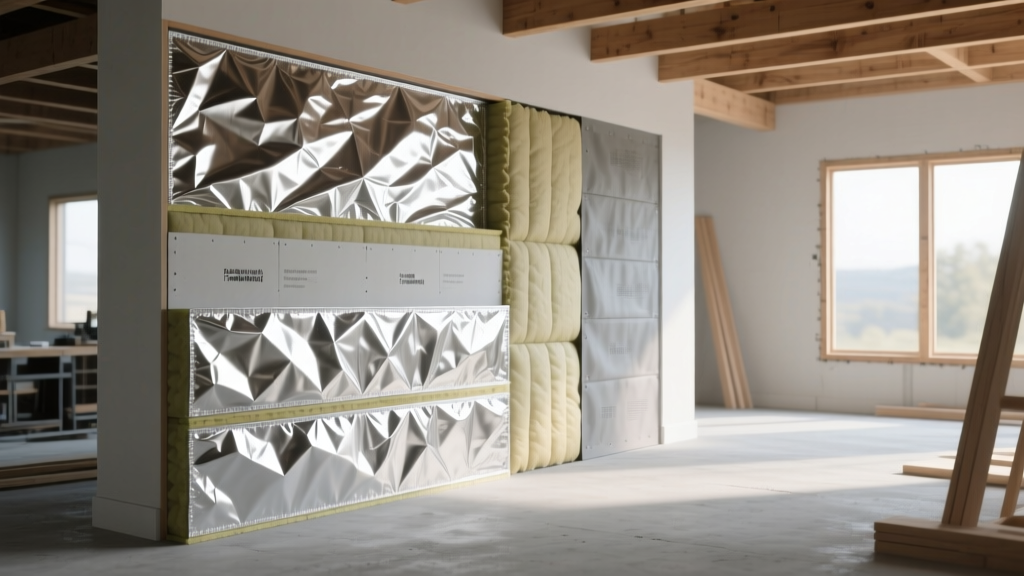
The Physics of Radiant Heat: Why R-Value is the Wrong Metric
When evaluating thermal control for a building envelope, most contractors and homeowners default to R-value. However, R-value exclusively measures resistance to conductive heat transfer—the movement of heat through solid materials like fiberglass batts or rigid foam. Reflective insulation and radiant barriers operate on an entirely different thermodynamic principle: they block radiant heat transfer.
Radiant heat travels in a straight line through empty space (or air) until it strikes a surface. In a hot climate, the sun heats the roof decking to 140°F or more, which then radiates heat downward into the attic. Reflective insulation features a highly polished aluminum surface with an emissivity (e) of less than 0.10 and a reflectivity of 90% to 97%. Instead of slowing the heat down like mass insulation, it bounces the thermal radiation back to its source. Therefore, assigning a traditional R-value to a standalone radiant barrier is physically meaningless; its performance is dictated by its emissivity and the assembly it is placed within.
Scenario Matching Matrix: Where Reflective Insulation Wins
Reflective insulation is not a universal replacement for cavity insulation. It is a highly specialized tool that excels in specific scenarios while failing entirely in others. Use this matrix to determine if your project requires a radiant barrier.
| Application Scenario | Assembly Type | Effectiveness | Primary Benefit |
|---|---|---|---|
| Vented Attics (Hot Climates) | Stapled to underside of rafters | Exceptional | Reduces attic air temp by up to 10°F, lowering cooling loads. |
| Metal Buildings / Pole Barns | Spanning purlins/girts | High | Blocks solar radiation through thin metal skins; prevents condensation. |
| HVAC Ductwork | Wrapped around flex or rigid ducts | High | Prevents duct gain/loss in unconditioned spaces like crawlspaces. |
| Enclosed Wood-Framed Walls | Stuffed into stud cavities | Zero / Negative | None. Blocks convective loops but provides negligible conductive R-value. |
| Cold Climate Roofs (Zones 6-8) | Under roof decking | Low | Minimal impact on winter heating loads; budget better spent on air sealing. |
The Two Unbreakable Rules: Air Gaps and Dust
The failure rate of reflective insulation in the field is remarkably high, almost entirely due to the violation of two physical requirements. If you ignore these, you are installing expensive aluminum foil with zero thermal benefit.
Warning: The Mandatory Air Gap
According to U.S. Department of Energy guidelines and ASTM C1224 specifications, a reflective surface must face an adjacent air space of at least 0.75 inches to function. If the foil is sandwiched tightly between two solid materials (e.g., glued directly to the roof sheathing or compressed inside a wall cavity), the heat simply conducts right through the aluminum. Aluminum is an excellent thermal conductor; without the air gap to allow the radiant reflection to occur, it actually accelerates heat transfer.
The Dust Degradation Factor
In horizontal or slightly pitched installations, dust accumulation is the Achilles' heel of radiant barriers. A study by the Florida Solar Energy Center (FSEC) demonstrated that when a radiant barrier installed on the attic floor accumulates just a thin layer of dust, its emissivity jumps from 0.05 to over 0.30. This cuts its thermal performance by more than half. Never install reflective insulation on the attic floor (over the ceiling joists) unless it is a specially designed multi-layer product with a dust-shedding top layer. Always staple it to the underside of the roof rafters where gravity prevents dust from settling on the reflective face.
Product Tiers and 2026 Pricing Breakdown
The market has evolved beyond simple single-layer foil. Here is a breakdown of the primary product categories, specific models, and current 2026 material costs (excluding labor).
- Single-Bubble Foil (e.g., Reflectix BP11050): Features one layer of polyethylene bubbles sandwiched between two foil layers. Thickness: 5/16 inch. Cost: $0.45 - $0.55 per sq. ft. Best for HVAC duct wraps and basic metal building liner panels where an air gap is naturally created by furring strips.
- Double-Bubble Foil (e.g., Reflectix BP21050): Two layers of bubbles separated by a center foil layer. Thickness: 5/16 to 3/8 inch. Cost: $0.65 - $0.85 per sq. ft. The industry standard for residential vented attics and crawlspaces. Provides a nominal R-1.1 to R-1.7 conductive value, but the real value is the 97% radiant reflectivity.
- Multi-Foil Systems (e.g., SuperFOIL SF19+): Contains up to 19 layers, including perforated reflective foils, aluminum-coated wadding, and breathable membranes. Thickness: 3/4 inch compressed, expanding to 3 inches in the cavity. Cost: $2.15 - $2.60 per sq. ft. Designed for complex roof retrofits, timber frame walls, and scenarios where maximizing R-value in a shallow rafter depth is critical. Achieves up to R-43 when installed with proper air gaps in a hybrid assembly.
Climate Zone Decision Tree: Do You Actually Need It?
Matching reflective insulation to your specific International Energy Conservation Code (IECC) climate zone is the most critical step in the design phase.
Cooling-Dominated Zones (1, 2, and 3)
Verdict: Highly Recommended. In the South and Southwest, cooling loads account for the majority of energy use. Radiant heat from the roof is the primary driver of attic temperatures. Installing a double-bubble radiant barrier on the rafters can reduce attic peak temperatures by 10°F to 15°F, directly reducing the load on your HVAC system by 5% to 10%.
Mixed Climates (Zones 4 and 5)
Verdict: Conditional / Hybrid Approach. Radiant barriers will still reduce summer cooling loads, but their impact on winter heating is negligible. If you are doing a full roof deck replacement, the low cost of adding a radiant barrier under the sheathing makes sense. For retrofits, prioritize air sealing and blowing in cellulose to R-49 first. Only add reflective insulation if budget permits after mass insulation is maxed out.
Heating-Dominated Zones (6, 7, and 8)
Verdict: Skip It. In northern climates, the primary thermal challenge is retaining interior heat during winter. Radiant barriers do not stop conductive heat loss through the ceiling. Your budget is vastly better spent on dense-pack cellulose, blown fiberglass, or closed-cell spray foam to achieve R-50 to R-60 cavity insulation, combined with meticulous air sealing at the top plate.
Common Failure Modes and How to Avoid Them
1. Compressing the Bubble Core
When stapling double-bubble foil to rafters, installers often pull the material too tight or staple through the center of the panel, compressing the polyethylene bubbles. This destroys the conductive thermal break the bubbles provide. The Fix: Always staple only the flanges (the flat edges) of the material, or use a cap stapler on the seams. Allow the bubble core to remain fully expanded.
2. Creating a Vapor Trap in Cold Climates
Aluminum foil is a Class I vapor retarder (perm rating < 0.1). If you install reflective insulation on the exterior side of a wall assembly in a cold climate, or on the interior side in a hot-humid climate, you will trap moisture inside the cavity, leading to mold and structural rot. The Fix: Always verify the vapor profile of your assembly. If using foil in a humid climate wall, ensure you are using a perforated radiant barrier (like Fi-Foil's perforated variants) that allows moisture to pass through while still reflecting radiant heat.
3. Ignoring the Fire Rating
Not all reflective insulation is created equal regarding fire safety. Cheap, imported foil products often lack proper fire testing. The Fix: Only purchase products that explicitly list an ASTM E84 Surface Burning Characteristics rating (Class A / Class 1) and comply with ASTM C1224. Products like Reflectix and rFOAM carry these certifications, ensuring they will not accelerate flame spread in an attic fire.
Frequently Asked Questions
Can I layer reflective insulation over existing fiberglass batts?
You can, but only if you maintain a minimum 0.75-inch air gap between the top of the fiberglass and the foil. However, laying it directly on top of the batts will trap the foil against the insulation, negating its radiant properties and potentially creating a moisture trap. A better approach for attic retrofits is to staple the foil to the roof rafters above.
Does reflective insulation work at night or in the winter?
Reflective insulation only works when there is a radiant heat source to reflect. At night, or during overcast winter days, the temperature differential is primarily conductive and convective. In these scenarios, the foil provides almost zero benefit compared to mass insulation like mineral wool or spray foam.
Is radiant barrier paint as effective as foil sheeting?
No. While 'radiant control coatings' (interior attic paints) exist, they typically achieve an emissivity of 0.15 to 0.25, compared to the 0.03 to 0.05 emissivity of polished aluminum foil. Paint is easier to apply via airless sprayer, but sheeting provides vastly superior thermal reflection and is the preferred choice for maximum energy reduction.