Mica Insulating Material for High-Heat Sound Control Assemblies
Learn how to specify mica insulating material for high-heat sound control in generator rooms, elevator shafts, and industrial acoustic enclosures.
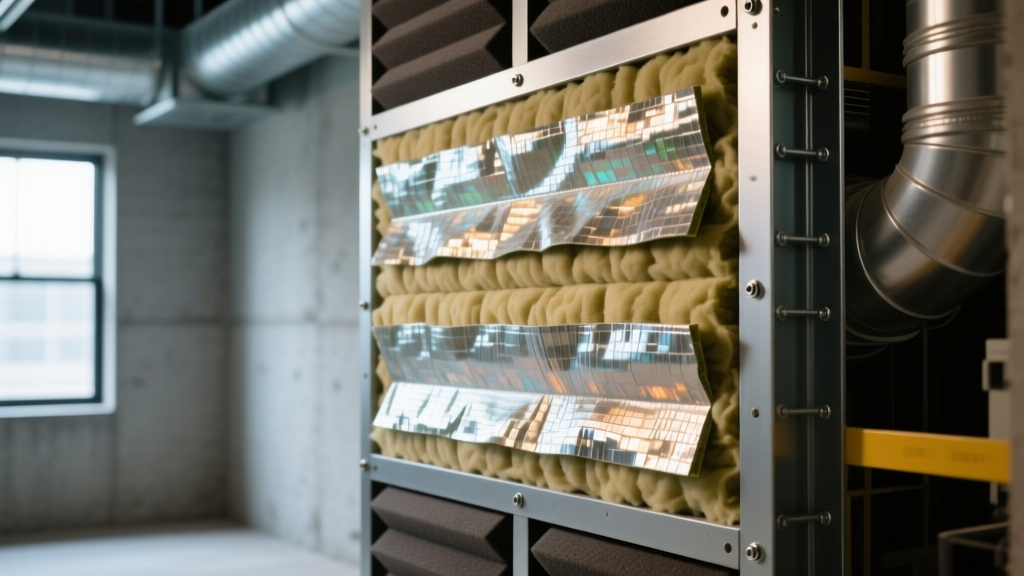
The Niche Role of Mica in Acoustic Engineering
When architects and acoustic engineers design soundproofing for standard residential or commercial spaces, they rely on porous absorbers like mineral wool and viscoelastic barriers like mass-loaded vinyl (MLV). However, these materials catastrophically fail in environments that demand simultaneous extreme thermal resistance and acoustic attenuation. This is where mica insulating material becomes an indispensable, albeit highly specialized, component in the acoustic engineer's toolkit.
Mica—specifically silicone-bonded phlogopite and muscovite boards—is globally recognized for its dielectric strength and thermal stability up to 1,000°C. Yet, its acoustic properties are frequently misunderstood. Mica is not a sound absorber; it is a high-mass, high-rigidity acoustic barrier and constrained-layer damper. According to the USGS National Minerals Information Center, the unique crystalline structure of mica allows it to maintain structural integrity under thermal shock, making it the only viable rigid barrier for high-heat acoustic enclosures where standard gypsum or cement boards would calcify, crack, and transmit flanking noise.
Acoustic Mechanics: How Mica Blocks and Dampens Sound
To specify mica insulating material correctly, you must understand its behavior under acoustic excitation. Sound transmission through a partition is governed by the Mass Law, but rigid, lightweight panels suffer from the 'coincidence effect'—a frequency at which the speed of bending waves in the panel matches the speed of sound in air, causing a sharp drop in Sound Transmission Class (STC).
Because mica boards possess an exceptionally high stiffness-to-weight ratio compared to standard silicate boards, their critical coincidence frequency is pushed well above the standard 125 Hz – 4000 Hz speech and mechanical noise range. When bonded to a steel substrate using a high-temperature elastomeric adhesive, mica acts as a constrained layer damper, dissipating low-frequency vibrational energy as heat.
Furthermore, the internal friction of the silicone resin binder used in industrial-grade mica boards provides inherent damping. When low-frequency mechanical noise (such as the 60 Hz hum of a diesel generator) strikes the mica surface, the micro-shearing within the resin matrix converts acoustic energy into negligible thermal energy, preventing structural resonance.
Where to Specify Mica for Sound Control (And Where Not To)
Mica insulating material is prohibitively expensive and acoustically inefficient for general-purpose wall cavities. It should only be specified when a project intersects strict fire/thermal codes with rigorous OSHA occupational noise standards. Prime applications include:
- Diesel Generator Enclosures: Gensets produce 105+ dB of low-frequency noise and exhaust temperatures exceeding 400°C. Mica lines the interior steel shell to prevent thermal degradation of the outer acoustic cladding while adding mass to block structure-borne vibration.
- Elevator Hoistways: High-speed traction elevators generate significant mechanical noise and require 2-hour fire-rated shaft separations. Mica boards serve as the rigid, fire-proof decoupling layer behind the shaft lining.
- Industrial HVAC and Kiln Exhaust Ducts: Lining the exterior of high-heat ductwork with mica prevents breakout noise from entering adjacent occupied spaces without risking the melting or off-gassing associated with asphalt-based acoustic wraps.
Composite Assembly Design: Integrating Mica Boards
Mica must never be used as a standalone acoustic panel. Its thin profile (typically 3mm to 15mm) lacks the standalone mass required for high STC ratings. It must be integrated into a composite decoupled assembly. Below is the proven step-by-step specification for a high-heat generator room wall:
- Primary Substrate: 12-gauge steel plate or heavy-duty CMU block (provides the foundational mass).
- Damping Layer: Apply a 3mm layer of high-temperature silicone adhesive, followed by a 6mm phlogopite mica board. This creates the constrained layer damper.
- Decoupling Air Gap: Install high-temperature resilient steel channels spaced 24 inches on center. Do not use standard galvanized drywall channels, as they will warp under thermal cycling.
- Cavity Absorption: Fill the 3-inch cavity with high-density (8 pcf) ceramic fiber or high-temp mineral wool batts to absorb mid-to-high frequency cavity resonance.
- Outer Shell: Fasten a secondary layer of 10mm mica insulating material to the resilient channels, sealing all joints with intumescent, high-temperature acoustic sealant.
Material Comparison Matrix for High-Heat Acoustics
When designing for environments exceeding 150°C, standard acoustic materials are immediately disqualified. The following table compares mica insulating material against alternative high-temperature acoustic solutions based on 2026 market data.
| Material | Max Temp Tolerance | Density (kg/m³) | Primary Acoustic Role | 2026 Est. Cost / Sq Ft |
|---|---|---|---|---|
| Phlogopite Mica Board (Silicone bonded) | 1,000°C | 2,200 | Rigid Barrier / Damper | $22.00 - $34.00 |
| Ceramic Fiber Blanket (Needled) | 1,260°C | 128 - 160 | Cavity Absorber | $8.00 - $12.00 |
| Calcium Silicate Board | 650°C | 1,050 | Low-Frequency Barrier | $14.00 - $18.00 |
| Standard Mass Loaded Vinyl (MLV) | 80°C (Fails) | 1,700 | Flexible Barrier | $3.50 - $5.00 |
Procurement and Specification Standards
When sourcing mica insulating material for acoustic assemblies, do not purchase generic electrical-grade mica tape or paper. You must specify rigid, calcined phlogopite boards manufactured to IEC 60371-3-2 standards, but explicitly request the acoustic-grade silicone resin formulation. Some manufacturers use rigid epoxy binders for electrical applications; while thermally stable, epoxy lacks the internal damping coefficient required for acoustic vibration control.
As of 2026, global supply chains for high-grade phlogopite have stabilized, but lead times for custom-cut acoustic panels (typically 1200mm x 2400mm) remain around 6 to 8 weeks. Expect to pay a 15% premium for boards pre-drilled with countersunk holes, which prevents micro-fracturing during on-site installation.
Critical Failure Modes to Avoid
Even with perfect material selection, acoustic assemblies utilizing mica frequently fail field testing due to installation errors. The NIOSH guidelines on industrial noise control emphasize that structure-borne noise will bypass any barrier if mechanical bridging occurs.
Never use standard self-tapping metal screws to secure mica boards directly to a vibrating steel chassis or generator skid. The screw acts as an acoustic short-circuit, transmitting low-frequency vibration directly through the mica and into the outer architectural shell. Always use high-temperature elastomeric isolation washers and floating clip systems to maintain true mechanical decoupling.
Additionally, thermal expansion must be accounted for in the acoustic sealant. If standard acrylic acoustic caulk is used at the perimeter joints of the mica boards, the heat from the adjacent equipment will bake the caulk brittle within weeks. Once brittle, the sealant cracks under vibrational stress, creating high-frequency air leaks that completely destroy the STC rating of the enclosure. Always specify high-modulus, intumescent silicone sealants rated for continuous 300°C exposure at all perimeter and butt joints.
Written by
Sarah WhitfieldSarah Whitfield is a chartered quantity surveyor (MRICS) and construction cost analyst with 15 years of experience in material pricing, procurement strategy, and project budgeting. She earned her degree in Construction Management from the University of Reading (UK) and has worked on projects ranging from $2M custom homes to $180M mixed-use developments across North America and Europe. Sarah currently leads cost estimating for BuildMat Insight, maintaining a proprietary database of 4,000+ material price points updated quarterly. She is a frequent contributor to RSMeans cost data panels and has presented at the International Cost Engineering Council (ICEC) congress. Based in Denver, CO, Sarah is an avid trail runner and volunteer mentor for Women in Construction.
More from Sarah Whitfield
View all
Wood & Lumber
What Are the Different Types of Wood? A Builder's Guide
Compare structural softwoods, finish hardwoods, and engineered lumber. Analyze Janka ratings, MOE values, and 2026 pricing for construction.
Aug 4, 2026

Walls & Panels
Steel Framing vs Wood Framing: Corrosion and Moisture Defense
Compare steel framing vs wood framing for moisture resistance. Learn about galvanized coatings, condensation risks, and corrosion protection strategies.
Jul 21, 2026

Stone & Masonry
How to Cut Stone Veneer: Wet Saw vs Grinder Comparison
Compare the best tools for cutting stone veneer. We review wet saws, angle grinders, and chop saws to help you achieve clean, chip-free cuts.
Jul 21, 2026