What Materials Are Good Insulators? A Complete R-Value Guide
Discover what materials are good insulators for your home. Compare R-values, costs, and applications for fiberglass, spray foam, and mineral wool.

The Core Metric: R-Value and Thermal Bridging
When asking what materials are good insulators, the definitive metric is thermal resistance, universally measured as the R-value. The R-value quantifies a material's resistance to conductive heat flow; the higher the number, the greater the insulating power. However, evaluating insulation requires looking beyond the manufacturer's label on a single batt. A wall assembly's effective R-value is frequently compromised by thermal bridging—heat transfer through highly conductive structural elements like wooden studs or steel framing—and convective air leakage.
According to the U.S. Department of Energy, up to 25% of a wall's thermal performance is lost through the wooden studs themselves in standard 2x4 framing. Therefore, the best insulating strategy in modern construction pairs cavity insulation with continuous exterior insulation (ci) to break these thermal bridges and meet stringent 2024/2026 International Energy Conservation Code (IECC) requirements.
What Materials Are Good Insulators? (The Big Six Compared)
Not all insulation is created equal. The chemical composition, cell structure, and density of the material dictate its R-value per inch, moisture permeability, and acoustic properties. Below is a technical comparison of the primary insulation materials used in residential and light-commercial construction.
| Material Type | R-Value per Inch | Avg. Cost (per sq. ft.) | Vapor Permeability | Best Application |
|---|---|---|---|---|
| Closed-Cell Spray Foam | 6.0 - 7.0 | $1.80 - $3.20 | Impermeable (Class I) | Below-grade, unvented roofs, rim joists |
| Foil-Faced Polyiso | 5.8 - 6.5 | $1.10 - $1.60 | Impermeable (Class I) | Exterior continuous insulation, flat roofs |
| Extruded Polystyrene (XPS) | 5.0 | $0.90 - $1.30 | Semi-Impermeable | Below-slab, foundation exteriors |
| Mineral Wool (Rock/Slag) | 4.0 - 4.3 | $1.20 - $1.90 | Highly Permeable | Fire-stopping, acoustic walls, exterior ci |
| Dense-Pack Cellulose | 3.2 - 3.8 | $0.80 - $1.20 | Permeable | Retrofit wall cavities, attic floors |
| Fiberglass Batts | 2.9 - 3.8 | $0.50 - $0.95 | Highly Permeable | Standard stud cavities, vented attics |
Application-Specific Material Selection
Selecting the right material requires matching its physical properties to the specific hygrothermal demands of the building envelope zone.
Attics and Open Cavities: Blown-In vs. Batts
For horizontal attic floors, blown-in cellulose or high-density fiberglass (like Owens Corning ProPink L77) outperforms traditional faced batts. Blown materials conform to irregular joist spacing and completely encapsulate plumbing and wiring penetrations, eliminating the convective looping that severely degrades the performance of poorly fitted batts. When insulating to an R-49 or R-60 code requirement, settling is a critical factor; cellulose must be installed at a minimum density of 1.5 lbs per cubic foot to prevent a 10-15% loss in thickness over the first five years.
Exterior Continuous Insulation: Polyiso vs. Mineral Wool
When wrapping the exterior of a wood-framed building, foil-faced polyisocyanurate (polyiso) offers the highest R-value per inch (up to R-6.5). However, polyiso suffers from "thermal drift"—its R-value actually decreases in freezing temperatures due to the condensation of blowing agents within the foam cells. In cold climates (IECC Zones 6 and above), Building Science Corporation recommends using semi-permeable mineral wool boards (like Rockwool Comfortboard 80) for exterior ci. Mineral wool maintains a stable R-4.2 per inch regardless of temperature extremes, is entirely non-combustible, and allows the wall assembly to dry outward.
Below-Grade and Foundations: Moisture Management
Below-grade environments demand materials that resist liquid water absorption while maintaining structural compressive strength. Expanded Polystyrene (EPS) and Extruded Polystyrene (XPS) are the standard choices. While XPS (often recognized by its blue or pink coloring) has a higher initial R-value (R-5.0), it relies on HFC blowing agents that off-gas over time, dropping its long-term R-value to roughly R-4.2. High-density, Type IX EPS maintains a stable R-3.9 to R-4.2 indefinitely and is often more cost-effective for deep foundation applications.
Acoustic Insulation: When Thermal Isn't Enough
Expert Insight: Thermal insulation does not automatically equal soundproofing. Lightweight, low-density materials like standard fiberglass trap heat but allow low-frequency sound waves to pass through. For acoustic decoupling, mass and density are mandatory.
If the project requires sound transmission class (STC) improvements for interior partition walls or floor-ceiling assemblies, mineral wool is the undisputed leader. Products like Rockwool Safe'n'Sound are engineered with a specific fiber density and non-directional web that creates friction, converting acoustic energy into trace amounts of heat. When paired with resilient channels and 5/8-inch gypsum board, a standard 2x4 wall can achieve an STC rating of 50+, effectively blocking loud speech and television noise.
Real-World Cost & ROI Framework
Insulation Payback Calculation
Upgrading from a code-minimum R-13 wall to an advanced R-23 wall (using R-13 cavity + R-10 exterior polyiso) costs approximately $1.45 extra per square foot of wall area. For a 2,500 sq. ft. home with 1,800 sq. ft. of wall area, the premium is roughly $2,610. Based on current energy rates and a 15-20% reduction in heating/cooling loads, the simple payback period in mixed-humid climates (like Zone 4) is typically 4.5 to 6 years, yielding a net-positive ROI over the lifespan of the mortgage.
Common Installation Failures and Edge Cases
Even the highest-performing materials will fail if installed incorrectly. The Environmental Protection Agency notes that installation defects can reduce whole-wall thermal performance by up to 30%. Avoid these critical errors:
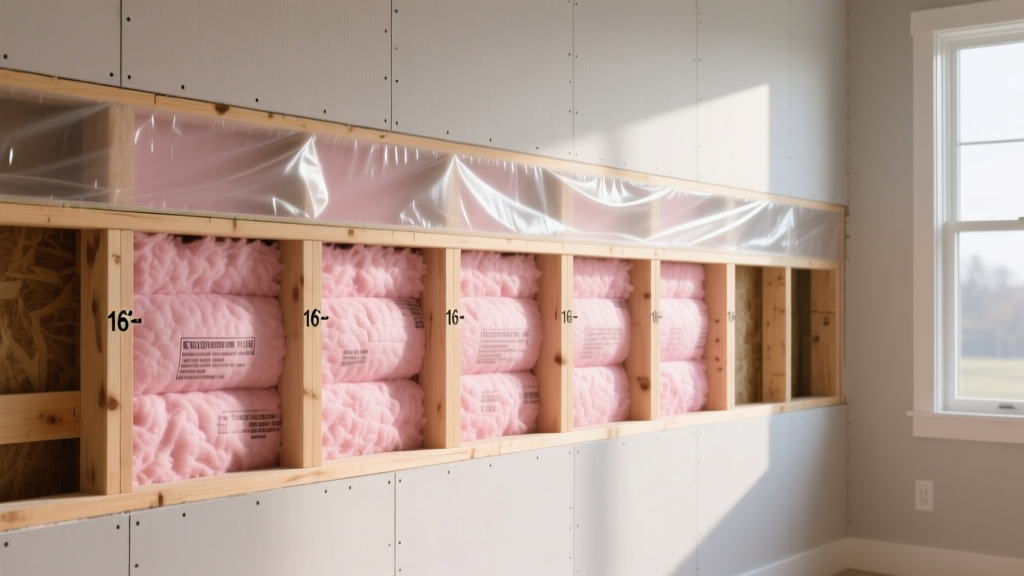
- Compressing Fiberglass: Forcing a 3.5-inch R-13 batt into a 2x4 cavity that has been narrowed by plumbing or electrical boxes compresses the glass fibers. This increases conductive heat transfer, dropping the localized R-value to R-9 or lower. Always cut and fit batts precisely around obstructions.
- Ignoring the Air Barrier: Insulation stops conduction, not convection. A 1-mph wind washing through a wall cavity can strip away up to 60% of the insulation's R-value. Spray foam or a meticulously taped exterior membrane (like Zip System or Tyvek) is mandatory to stop air infiltration.
- Polyiso in Below-Grade Applications: Never use polyisocyanurate below grade. Its facers absorb ground moisture, and the foam core will degrade, lose its R-value, and harbor mold. Stick to XPS, EPS, or closed-cell spray foam for subterranean use.
- Thermal Shock on Exterior Foam: When applying dark-colored siding (like navy blue fiber cement) over exterior foam insulation, the siding can reach temperatures exceeding 160°F in direct summer sun. Ensure the foam manufacturer's warranty covers high-heat exposure, or specify an exterior mineral wool board which is entirely heat-resistant.
Written by
Elena RodriguezElena Rodriguez is a civil engineer and technical writer specializing in concrete technology, masonry systems, and ASTM/ACI compliance. She earned her B.S. in Civil Engineering from Texas A&M University and spent a decade at a materials testing laboratory, performing over 2,000 concrete compressive strength tests and masonry prism evaluations. Elena is an ACI-certified Field Testing Technician (Grade I) and a member of ASTM Committee C12 on Natural Building Stone. She currently consults on forensic engineering cases involving concrete failures and moisture intrusion. Based in San Antonio, TX, Elena is a proud member of the Society of Women Engineers (SWE) and coaches her daughter's FIRST Robotics team.
More from Elena Rodriguez
View all
Walls & Panels
Cost Analysis: Light Gauge Steel Framing Advantages and Disadvantages
Evaluate light gauge steel framing advantages and disadvantages through a strict cost analysis lens, comparing material, labor, and lifecycle expenses.
Aug 4, 2026

Walls & Panels
Gypsum Board Types: Exact Specifications, Thickness & Dimensions
Compare standard, Type X, and moisture-resistant gypsum board types. Get exact specifications, thicknesses, dimensions, and ASTM standards for your project.
Aug 4, 2026

Fire Resistance
Best Fire-Resistant Outdoor Decking Materials: 2026 Buyer Guide
Discover the best fire-resistant outdoor decking materials for 2026. Compare Class A PVC, aluminum, and hardwood options for WUI compliance and safety.
Aug 4, 2026