What Material Is a Good Insulator? 2026 Cost vs. R-Value Analysis
Discover what material is a good insulator for your budget. We analyze 2026 installed costs, R-values, and hidden expenses for top insulation types.

The True Cost of Thermal Resistance: Beyond the Price Tag
When builders and homeowners ask what material is a good insulator, the conversation often stops at R-value per inch. However, evaluating insulation strictly by its thermal resistance metric is a financial trap. A material that is a good insulator in a laboratory setting can become a costly liability in the field if it requires expensive secondary vapor barriers, specialized framing, or meticulous labor to achieve its rated performance.
In 2026, the insulation market has shifted significantly. Supply chain stabilizations have lowered the baseline cost of mineral wool, while the EPA's phasedown of HFC blowing agents under the AIM Act has altered the pricing and environmental profile of extruded polystyrene (XPS) and closed-cell spray foams. To determine the most cost-effective material for your project, we must analyze the installed cost per R-value, factoring in labor, material waste, and necessary building science accessories.
Executive Summary: The 2026 Cost-to-Performance Verdict
Best Budget Baseline: Fiberglass batts remain the cheapest upfront, but require RESNET Grade I installation to avoid a 20% performance drop.
Best Overall Value: Mineral wool (stone wool) offers the best balance of cost, acoustic dampening, fire resistance, and vapor permeability without needing secondary retarders.
Best for Space-Constrained Retrofits: Closed-cell spray foam commands a 150% premium over batts but eliminates the need for separate air and vapor barriers.
Material Breakdown: Installed Cost Per R-Value
The following data reflects Q1 2026 national average installed costs for residential wall and attic applications, combining material and professional labor. Costs are normalized to show the price of achieving an R-21 equivalent (standard for 2x6 exterior walls in many climate zones).
| Insulation Material | R-Value / Inch | Cost per Sq. Ft. (R-21) | Hidden Cost Factors |
|---|---|---|---|
| Fiberglass Batts | R-3.1 to R-3.4 | $1.65 - $2.10 | Requires separate air barrier; high labor cost for Grade I fit. |
| Mineral Wool Batts | R-4.2 | $2.40 - $2.95 | Denser material increases cutting time; heavier to transport. |
| Open-Cell Spray Foam | R-3.5 to R-3.8 | $2.20 - $2.80 | Requires ignition barrier in exposed applications; vapor permeable. |
| Closed-Cell Spray Foam | R-6.5 to R-7.0 | $4.50 - $5.80 | High upfront capital; requires professional certification to install. |
| Polyiso Rigid Board | R-6.0 to R-6.5 | $3.10 - $3.80 | R-value drops in extreme cold; requires mechanical fastening. |
Source context: Pricing aggregates reflect 2026 contractor bids. For foundational R-value metrics, refer to the U.S. Department of Energy's insulation guidelines.
Deep Dive: Analyzing the Top Contenders
Fiberglass Batts: The Budget Baseline and Its Caveats
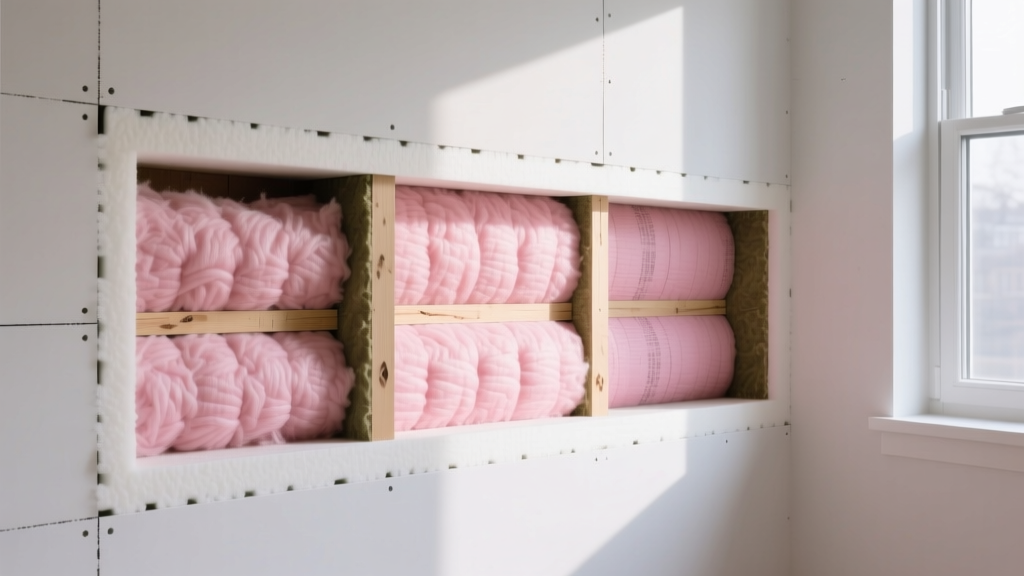
Fiberglass, such as Owens Corning EcoTouch or Knauf EcoBatt, is the default answer to what material is a good insulator for budget-conscious projects. At roughly $0.65 to $0.85 per square foot for materials alone, it is undeniably cheap. However, the financial advantage erodes during installation.
According to the North American Insulation Manufacturers Association (NAIMA), fiberglass relies on trapped air for its thermal resistance. If a batt is compressed to fit around wiring or plumbing, its R-value plummets. A standard R-19 batt compressed into a 3.5-inch 2x4 wall cavity performs at roughly R-13. Furthermore, achieving a RESNET Grade I installation (no gaps, no compressions, proper encapsulation) increases labor time by up to 30% compared to a sloppy Grade III install. If you choose fiberglass, budget for meticulous air-sealing tapes and membranes (like Intello or MemBrain) to prevent convective heat loss, which adds $0.40 to $0.70 per square foot to your total wall assembly cost.
Mineral Wool: The Acoustic and Fire Upgrade
Mineral wool (stone wool) has seen a surge in market share due to its superior building science profile. Products like ROCKWOOL Comfortbatt offer an R-value of R-4.2 per inch. More importantly, mineral wool is hydrophobic (repels water) and vapor-permeable. This means in many climate zones, you can omit the interior polyethylene vapor barrier, saving roughly $0.15 per square foot in materials and reducing the risk of trapped moisture causing wall rot.
Additionally, mineral wool carries an ASTM E84 Class A fire rating and provides exceptional acoustic dampening (STC ratings of 45+ in standard partitions). While the material cost is about 40% higher than fiberglass, the labor savings from its friction-fit rigidity (it requires no stapling and holds itself in place) and the elimination of secondary vapor retarders often narrow the final installed cost gap to just 15%.
Closed-Cell Spray Foam: The Premium Air and Vapor Barrier
When space is at a premium, closed-cell spray foam (ccSPF) like Demilec Heatlok H2 or Icynene ProSeal is the undisputed champion. Delivering R-6.5 to R-7.0 per inch, it allows builders to achieve high R-values in shallow framing. Crucially, at a thickness of just 1.5 inches, ccSPF qualifies as a Class II vapor retarder, and at 2 inches, it acts as a complete air barrier.
The hidden cost savings here are structural and mechanical. ccSPF adds up to 300% racking strength to wall assemblies, which can sometimes allow engineers to reduce the amount of structural sheathing or metal bracing. Furthermore, because it eliminates air infiltration almost entirely, HVAC contractors can often downsize the heating and cooling equipment by 15% to 25%. A $4,000 premium on insulation might yield a $2,500 savings on HVAC capital costs, altering the true ROI calculation.
The Hidden Costs Decision Matrix
Selecting the right material requires matching the insulation to the specific structural and environmental challenges of your build. Use this framework to avoid costly retrofits and change orders.
- If you are insulating an unvented cathedral ceiling: Avoid fiberglass and open-cell foam. The lack of a vent channel means you must use closed-cell spray foam or rigid polyiso to prevent condensation on the roof sheathing. The cost of replacing rotted roof decking ($15,000+) far outweighs the upfront premium of ccSPF.
- If you are retrofitting a 1970s home with 2x4 walls: Do not attempt to stuff R-15 batts into 3.5-inch cavities. Use dense-pack cellulose or low-expansion injection foam. The dense-pack cellulose costs roughly $1.80 per board foot installed and navigates existing wiring without the compression penalties of fiberglass.
- If you are building in Climate Zone 6 or higher (Cold/Very Cold): Rigid exterior insulation is mandatory to prevent thermal bridging through wood studs. Use Owens Corning FOAMULAR NGX (XPS) or polyiso. Note that due to the 2025/2026 AIM Act regulations, XPS manufacturers have transitioned to next-generation blowing agents with lower Global Warming Potential (GWP), which has stabilized XPS pricing after previous market volatility.
Long-Term ROI: Energy Savings vs. Upfront Capital
The ultimate measure of what material is a good insulator is its payback period. The U.S. Department of Energy estimates that properly insulating and air-sealing a home can reduce heating and cooling costs by 15% to 20%.
A 2,400 sq. ft. home in Climate Zone 5 upgrading from code-minimum R-13 fiberglass to an R-21 mineral wool and continuous exterior foam assembly will cost approximately $3,200 more upfront. With 2026 average energy rates, this yields an annual savings of $410 to $480, resulting in a simple payback period of 6.6 to 7.8 years, well within the lifespan of the mortgage.
For comprehensive regional data on how thermal resistance impacts local utility loads, builders frequently consult resources like Penn State Extension's building science publications, which break down the thermodynamics of wall assemblies in varied climates.
Final Verdict: Matching Material to Your Budget
There is no single universal answer to what material is a good insulator; there is only the right material for your specific assembly and budget.
For production builders operating on tight margins, high-density fiberglass batts paired with a smart vapor retarder and meticulous exterior tape-sealing remain the most economically viable path. For custom homes and high-performance builds, mineral wool in the cavities combined with exterior rigid foam provides the best defense against thermal bridging and moisture accumulation. Finally, for complex geometries, rim joists, and unvented roofs, the premium paid for closed-cell spray foam is justified by the elimination of secondary air and vapor control layers.
Evaluate your framing depth, local climate zone, and HVAC sizing before signing an insulation contract. The cheapest material on the shelf is rarely the cheapest material in the wall.
Written by
Sarah WhitfieldSarah Whitfield is a chartered quantity surveyor (MRICS) and construction cost analyst with 15 years of experience in material pricing, procurement strategy, and project budgeting. She earned her degree in Construction Management from the University of Reading (UK) and has worked on projects ranging from $2M custom homes to $180M mixed-use developments across North America and Europe. Sarah currently leads cost estimating for BuildMat Insight, maintaining a proprietary database of 4,000+ material price points updated quarterly. She is a frequent contributor to RSMeans cost data panels and has presented at the International Cost Engineering Council (ICEC) congress. Based in Denver, CO, Sarah is an avid trail runner and volunteer mentor for Women in Construction.
More from Sarah Whitfield
View all
Wood & Lumber
What Are the Different Types of Wood? A Builder's Guide
Compare structural softwoods, finish hardwoods, and engineered lumber. Analyze Janka ratings, MOE values, and 2026 pricing for construction.
Aug 4, 2026

Walls & Panels
Steel Framing vs Wood Framing: Corrosion and Moisture Defense
Compare steel framing vs wood framing for moisture resistance. Learn about galvanized coatings, condensation risks, and corrosion protection strategies.
Jul 21, 2026

Stone & Masonry
How to Cut Stone Veneer: Wet Saw vs Grinder Comparison
Compare the best tools for cutting stone veneer. We review wet saws, angle grinders, and chop saws to help you achieve clean, chip-free cuts.
Jul 21, 2026