Best AC Copper Pipe Insulation Material for Sound Control
Discover the best AC copper pipe insulation material for sound control. Compare elastomeric foam, MLV wraps, and mineral wool for HVAC noise reduction.

The Physics of AC Copper Pipe Noise
Copper refrigerant lines in HVAC systems are highly efficient thermal conductors, but they are equally efficient at transmitting acoustic energy. When selecting an AC copper pipe insulation material, contractors and homeowners must address two distinct noise profiles generated by the system:
- Structure-Borne Vibration (40–120 Hz): Low-frequency hums generated by the compressor and transmitted through the copper piping into wall studs and floor joists via rigid pipe hangers.
- Airborne and Fluid-Borne Noise (1,000–4,000 Hz): High-frequency hissing, gurgling, and pinging caused by high-pressure refrigerant expanding through the metering device, thermal expansion of the copper, and water hammer effects in adjacent hydronic lines.
Standard thermal insulation prevents condensation and energy loss, but it lacks the mass and decoupling properties required for true sound control. According to the U.S. Department of Energy, while thermal resistance (R-value) is the primary metric for energy code compliance, acoustic performance requires evaluating material density, stiffness, and Sound Transmission Class (STC) ratings.
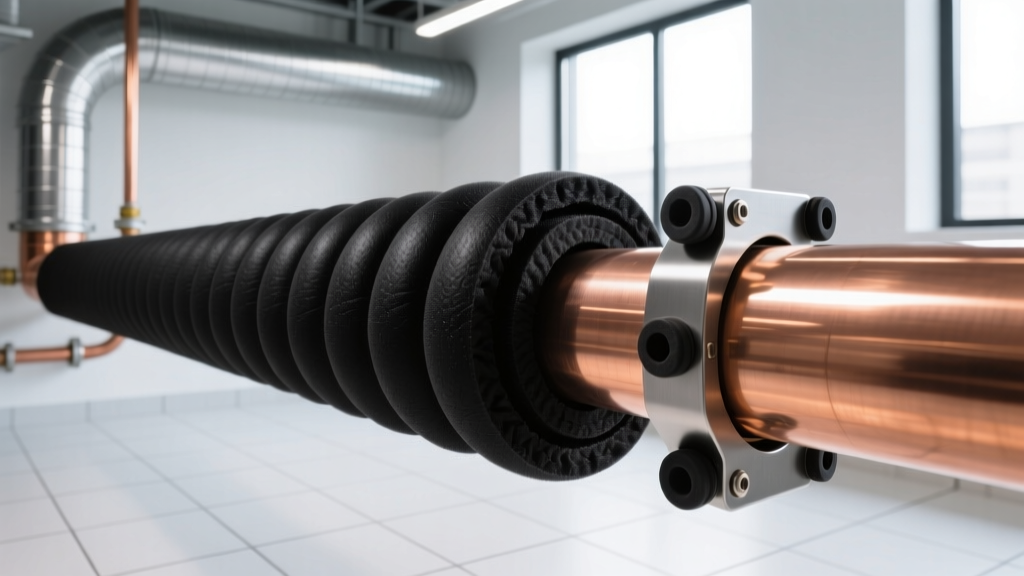
Top AC Copper Pipe Insulation Materials for Acoustics
Not all pipe wraps are created equal. Below is an expert breakdown of the most effective materials for dampening HVAC noise, ranked by acoustic efficacy.
1. Closed-Cell Elastomeric Foam (e.g., AP ArmaFlex)
Elastomeric foam is the industry standard for thermal insulation on AC suction and liquid lines. Manufactured to Armacell's ASTM C534 specifications, it features a density of roughly 4.5 lb/ft³. The closed-cell structure provides an excellent built-in vapor retarder, preventing condensation that can degrade acoustic seals over time. While it excels at dampening high-frequency refrigerant hiss, its low mass makes it largely ineffective against low-frequency compressor vibration.
2. Mass Loaded Vinyl (MLV) Pipe Wraps
For severe low-frequency vibration issues, MLV is the ultimate solution. MLV is a viscoelastic polymer loaded with barium sulfate or calcium silicate, yielding a surface density of 1.0 to 2.0 lbs per square foot. When wrapped over a primary layer of elastomeric foam, the MLV adds the necessary mass to block structure-borne noise, while the foam acts as a decoupling spring. This composite approach can reduce transmitted pipe noise by up to 25 decibels.
3. Polyethylene Foam (e.g., Insul-Tube)
Polyethylene is a budget-friendly, semi-rigid foam with a lower density (approx. 2.0 lb/ft³). While it provides adequate thermal protection for short runs, its high stiffness and low mass make it a poor choice for sound control. It tends to transmit low-frequency vibrations rather than absorbing them, and the longitudinal slit seams are prone to acoustic leaking if not sealed perfectly.
4. Mineral Wool with PVC Jacketing
Mineral wool offers superior sound absorption (NRC ratings up to 1.05) and high-temperature resistance. However, it is highly hygroscopic. If used on cold AC suction lines, it must be encased in a rigid, sealed PVC or aluminum jacket to prevent moisture ingress. If the vapor barrier is breached, the mineral wool absorbs water, loses its thermal resistance, and becomes a heavy conduit for structural vibration.
Material Comparison Matrix
| Material Type | Density (lb/ft³) | Best Noise Target | Vapor Retardant? | Avg. Cost (3/4" ID) |
|---|---|---|---|---|
| Closed-Cell Elastomeric | 4.0 - 5.0 | High-Freq Hiss / Thermal | Yes (Closed-Cell) | $2.15 / lin. ft. |
| MLV Composite Wrap | 90.0+ (Barium loaded) | Low-Freq Vibration | Yes (Impermeable) | $5.50 / lin. ft. |
| Polyethylene Foam | 1.5 - 2.5 | Minimal (Impact only) | Yes (Closed-Cell) | $0.85 / lin. ft. |
| Mineral Wool + PVC Jacket | 8.0 - 12.0 | Broadband Airborne | No (Requires Jacket) | $4.20 / lin. ft. |
Step-by-Step Installation Protocol for Maximum Sound Dampening
Even the most expensive AC copper pipe insulation material will fail acoustically if installed incorrectly. Follow this decoupling and sealing protocol to ensure optimal noise reduction.
- Isolate the Pipe Hangers: Never allow bare copper or rigid insulation to rest directly against wood framing or metal strut. Install neoprene-lined isolation hangers (e.g., Mason Industries Type WHD) at 4-foot intervals. This breaks the mechanical bridge that transmits compressor vibration into the building structure.
- Apply the Primary Decoupling Layer: Slide 3/4" ID closed-cell elastomeric foam over the suction line and 3/8" ID over the liquid line. Ensure the insulation fits snugly without compressing the foam. Compressing the material by more than 10% reduces its R-value and eliminates the air pockets necessary for acoustic dampening.
- Seal Longitudinal and Butt Seams: Use a specialized elastomeric adhesive (like ArmaFlex 520) on all butt joints and longitudinal slits. Do not rely solely on PVC tape; tape degrades and peels, creating micro-gaps where high-frequency airborne noise escapes.
- Apply the Mass Layer (For Critical Zones): In areas directly above bedrooms or home offices, wrap the insulated copper lines with a 1 lb/sq ft MLV pipe wrap. Overlap the MLV seams by 1 inch and seal with acoustic aluminum foil tape.
- Seal Wall Penetrations: Where the line set penetrates the exterior wall or interior fireblocks, fill the annular space with an intumescent acoustic fire-stop putty (e.g., 3M Fire Barrier Sealant). Standard spray foam is too rigid and will transmit vibration to the drywall.
Warning: The Flanking Noise Trap
Insulating 100% of the visible pipe run is useless if the copper lines are hard-piped or rigidly strapped to the compressor pad outside. Vibration will travel through the copper, bypass the interior insulation, and radiate noise at the first un-insulated joint or wall penetration. Always install a flexible vibration elimination hose (braided stainless steel with neoprene lining) at the condenser connection point.
Troubleshooting Common Acoustic Failures
If you have already insulated your AC lines but are still experiencing noise, diagnose the issue using this framework:
Symptom: Rhythmic Ticking or Pinging
Cause: Thermal expansion. The copper pipe is expanding as hot refrigerant gas enters the line, rubbing against a tight wall hole or rigid hanger.
Fix: Enlarge the wall penetration holes by at least 1/2 inch and line the interior of the hole with a 1/4" thick closed-cell foam sleeve. This provides an expansion buffer without compromising the acoustic seal.
Symptom: Low-Frequency Humming in the Walls
Cause: Structure-borne vibration bypassing the insulation via rigid hangers or direct contact with drywall.
Fix: Check all pipe hangers. Replace any rigid metal or plastic straps with elastomeric isolation hangers. Ensure the MLV wrap is not touching the drywall; maintain a minimum 1/2" air gap between the insulated pipe and the framing.
Symptom: Hissing Sound Near the Air Handler
Cause: Refrigerant metering device noise (TXV or EEV) radiating through a thin polyethylene foam layer.
Fix: Polyethylene lacks the density to block high-frequency fluid noise. Strip the polyethylene within 3 feet of the air handler and replace it with 1-inch thick closed-cell elastomeric foam, followed by a localized MLV wrap.
Cost Breakdown for a Standard 3-Ton AC System
The following table estimates the material costs for upgrading a standard 60-foot residential line set (3/4" suction, 3/8" liquid) from basic thermal insulation to a high-performance acoustic system.
| Component | Quantity | Unit Cost | Total Cost |
|---|---|---|---|
| AP ArmaFlex Elastomeric Foam (3/4" & 3/8") | 120 lin. ft. | $1.85 / ft. | $222.00 |
| MLV Pipe Wrap (1 lb/sq ft, 4" width) | 60 lin. ft. | $4.50 / ft. | $270.00 |
| Neoprene Isolation Hangers | 15 units | $8.50 / ea. | $127.50 |
| Elastomeric Adhesive & Acoustic Tape | 2 tubes / 3 rolls | $45.00 (Lot) | $45.00 |
| Total Material Cost | $664.50 |
Expert Summary
For standard installations in basements or garages, closed-cell elastomeric foam (like ArmaFlex) is sufficient for both thermal and basic acoustic control. However, when routing AC copper lines through interior walls, above dropped ceilings, or directly beneath second-floor bedrooms, the incremental cost of adding Mass Loaded Vinyl (MLV) and neoprene isolation hangers is mandatory. The combination of mass (MLV) and decoupling (elastomeric foam and hangers) is the only proven method to eliminate both high-frequency refrigerant hiss and low-frequency compressor vibration in residential HVAC systems.
Written by
James ThorntonJames Thornton is a construction industry veteran with 25 years of hands-on experience in wood framing, lumber grading, and residential building codes. He started as a framing carpenter in rural Oregon, earned his ICC Residential Building Inspector certification, and eventually became a senior plan reviewer for the City of Portland Bureau of Development Services. James holds a B.S. in Wood Science & Technology from Oregon State University and is a certified lumber grader through the West Coast Lumber Inspection Bureau (WCLIB). He has inspected over 3,000 residential construction sites and authored the city's internal guide on advanced framing techniques (2x6 at 24" O.C.). James lives in Bend, OR, where he builds custom timber-frame cabins and competes in lumberjack sports.
More from James Thornton
View all
Insulation
Best Home Insulation Materials: Complete 2026 Guide
Compare top home insulation materials for 2026. Find R-values, installed costs per square foot, and best uses for fiberglass, spray foam, and mineral wool.
Aug 4, 2026

Sustainable Building
Certify Your Green Building Material for LEED and WELL
Step-by-step guide to certifying a green building material for LEED v5 and WELL v2. Master EPDs, HPDs, and VOC limits for 2026 project specifications.
Aug 4, 2026

Stone & Masonry
Veneer Stacked Stone Panels: Interior Design & Style Showcase
Discover how veneer stacked stone panels transform interiors. Explore modern design profiles, material pairings, and technical installation specs.
Aug 4, 2026