Is the Best Heat Insulation Material Also Good for Sound Control?
Discover if the best heat insulation material also blocks noise. We compare R-values, STC ratings, and costs of mineral wool, spray foam, and fiberglass.

The Thermal vs. Acoustic Disconnect
When architects and builders search for the best heat insulation material, the focus almost exclusively lands on R-value—the measure of thermal resistance. However, a material that excels at trapping heat does not inherently excel at blocking sound. Thermal insulation combats conductive and convective heat transfer by trapping pockets of still air. Acoustic insulation, conversely, must address airborne sound waves and structure-borne impact noise through mass, decoupling, and damping.
This disconnect creates a critical blind spot in modern construction. A wall assembly packed with the highest R-value closed-cell spray foam might yield exceptional energy efficiency, but it can actually amplify low-frequency impact noise due to its rigid coupling to the framing. To design high-performance buildings in 2026, specifiers must evaluate thermal champions through an acoustic lens, understanding exactly where their dual-purpose capabilities succeed and where they fail.
Evaluating the Contenders: Thermal Champions in an Acoustic Arena
According to the U.S. Department of Energy, the primary insulation categories include mineral wool, fiberglass, spray foam, and rigid boards. Here is how the industry's top thermal performers behave when tasked with sound control.
Mineral Wool (Rock Wool & Slag Wool)
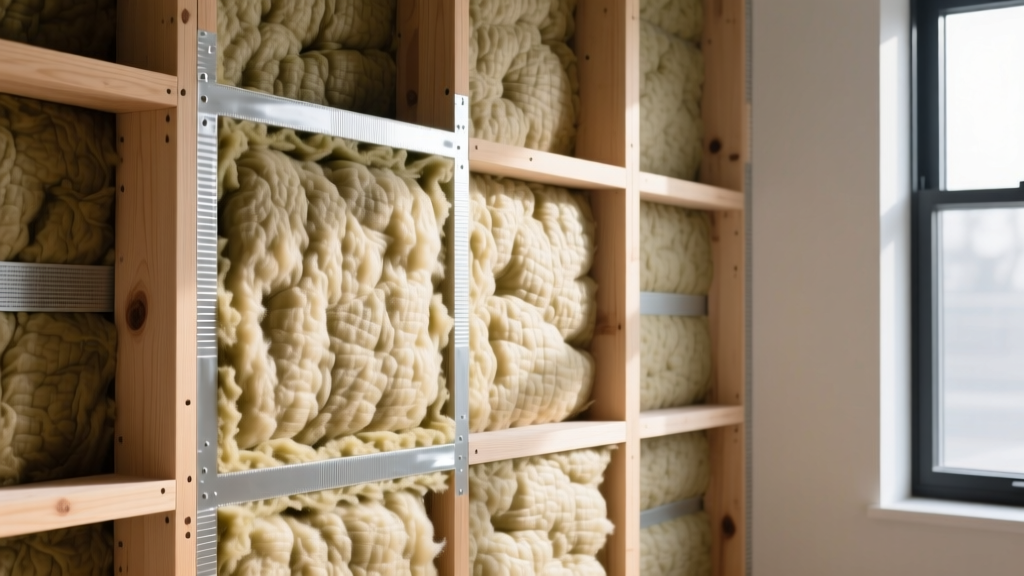
Mineral wool is the undisputed heavyweight in the dual-purpose category. Products like Rockwool Comfortbatt offer an R-value of R-4.2 per inch, making them highly competitive thermally. Acoustically, their high density (typically 2.5 to 3.0 lbs/ft³) and complex, interlocking fiber matrix create immense friction for sound waves, converting acoustic energy into trace amounts of heat.
- Thermal Performance: R-4.2 per inch (excellent for exterior walls).
- Acoustic Performance: Noise Reduction Coefficient (NRC) of 1.05 at 3 inches. In a standard 2x4 wood-framed wall with 5/8-inch drywall, mineral wool pushes the Sound Transmission Class (STC) to 52, compared to an uninsulated wall's STC of 35.
- The Catch: Dedicated acoustic mineral wool (like Rockwool Safe'n'Sound) is denser and superior for sound, but it is not stamped with an R-value, meaning it cannot be used alone to meet exterior energy codes.
Closed-Cell Spray Polyurethane Foam (ccSPF)
Closed-cell foam (e.g., Icynene CC+, Demilec Heatlok) is often crowned the best heat insulation material for space-constrained assemblies, boasting R-6.5 to R-7.0 per inch. It acts as its own vapor and air barrier. Acoustically, however, it is highly problematic for impact noise.
- Thermal Performance: R-6.5 to R-7.0 per inch (industry-leading).
- Acoustic Performance: Because ccSPF cures into a rigid, structural plastic, it creates a direct mechanical bridge between the exterior sheathing and interior drywall. While it seals air leaks (stopping airborne flanking noise), it readily transmits structure-borne vibrations like traffic rumble, bass frequencies, and mechanical hums.
- The Alternative: Open-cell spray foam (ocSPF) has a lower R-value (R-3.6 per inch) but remains spongy, offering vastly superior sound absorption (NRC ~0.70) without rigid coupling.
Fiberglass Batts
Standard fiberglass (like Owens Corning Pink) remains the most common thermal insulator due to its low cost and R-3.1 to R-3.8 per inch rating. Standard batts are relatively low density (0.5 to 0.7 lbs/ft³), meaning high-frequency airborne sounds (like speech) can penetrate the fiber matrix more easily than they can mineral wool.
To bridge the gap, manufacturers produce high-density acoustic fiberglass (e.g., Owens Corning QuietZone, Johns Manville Spider). These products increase the fiber density to improve mid-to-high frequency sound absorption, though they still lack the sheer mass of mineral wool for low-frequency blocking.
2026 Material Performance & Cost Matrix
The following table synthesizes current 2026 market data, comparing thermal resistance, acoustic contribution, and installed material costs for standard 16-inch on-center framing.
| Material Type | R-Value / Inch | STC Contribution (Standard 2x4 Wall) | Density (lbs/ft³) | Material Cost / Sq Ft (2026) |
|---|---|---|---|---|
| Mineral Wool (Thermal Batts) | R-4.2 | STC 50 - 52 | 2.5 - 3.0 | $1.25 - $1.60 |
| Closed-Cell Spray Foam | R-6.5 - R-7.0 | STC 38 - 40 (High Impact Transfer) | 2.0 | $1.60 - $2.30 |
| Open-Cell Spray Foam | R-3.5 - R-3.7 | STC 42 - 45 | 0.5 | $0.90 - $1.30 |
| Standard Fiberglass Batts | R-3.1 - R-3.8 | STC 39 - 41 | 0.5 - 0.7 | $0.60 - $0.85 |
| High-Density Acoustic Fiberglass | R-3.5 (approx) | STC 45 - 48 | 1.0 - 1.5 | $0.95 - $1.20 |
| Rigid Polyiso Board | R-6.0 - R-6.5 | STC 36 (Severe Flanking) | 1.5 - 2.0 | $1.10 - $1.50 |
Extruded Polystyrene (XPS) and Polyisocyanurate (Polyiso) boards offer exceptional thermal resistance (up to R-6.5 per inch). However, when installed continuously over studs or inside stud cavities, their rigid, lightweight cellular structure acts as an acoustic sounding board. They provide virtually zero sound damping and can create resonant cavities that amplify airborne noise. Never rely on rigid foam for interior partition sound control.
The Hybrid Assembly Strategy
If your project demands the absolute best heat insulation material for exterior thermal envelopes while simultaneously requiring high STC ratings for acoustic privacy (such as multi-family residential, home theaters, or homes near flight paths), a single material will not suffice. You must engineer a hybrid assembly utilizing the principles of the North American Insulation Manufacturers Association (NAIMA) guidelines combined with acoustic decoupling.
Step 1: The Absorption Core
Fill the stud cavity with mineral wool or high-density fiberglass. This addresses the thermal R-value requirement while absorbing airborne sound waves within the cavity, preventing them from reverberating and building up pressure against the drywall.
Step 2: Decoupling the Mass
Sound travels through rigid connections. To stop structure-borne noise, install resilient channels or use a staggered-stud/double-stud wall configuration. This physically breaks the mechanical path between the noisy side and the quiet side.
Step 3: Damping and Sealing
Apply a viscoelastic damping compound (like Green Glue) between two layers of 5/8-inch Type X gypsum board on the quiet side. Crucially, seal all perimeter gaps, electrical boxes, and penetrations with acoustic sealant. A 1% gap in a wall assembly can reduce its effective STC rating by up to 50%, rendering your expensive insulation investment useless.
"Acoustic performance is entirely dictated by the weakest link. You can specify the most expensive mineral wool on the market, but if the HVAC ducting acts as a flanking path or an electrical outlet is back-to-back with a noisy room, the wall's STC rating will collapse. Airtightness is just as critical for sound as it is for thermal efficiency."
Troubleshooting Common Acoustic Failures in Insulated Walls
Even when specifying the correct materials, installation errors frequently compromise both thermal and acoustic performance. Use this decision matrix to diagnose field issues:
- Symptom: High-frequency noise (speech, TV) bleeds through the wall.
Cause: Unsealed flanking paths or compressed insulation.
Fix: Verify that batts are not compressed to fit behind electrical boxes (compression destroys R-value and reduces acoustic thickness). Apply acoustic putty pads over all outlet boxes and seal top/bottom plates with flexible acoustic caulk. - Symptom: Low-frequency rumble (traffic, HVAC, bass) is felt and heard.
Cause: Rigid coupling via closed-cell spray foam or continuous rigid foam boards.
Fix: Decoupling is mandatory. Retrofit with resilient sound isolation clips and hat channels, or add a secondary decoupled mass layer (Mass Loaded Vinyl + drywall) to the interior face. - Symptom: Impact noise (footsteps from above) transmits through the ceiling.
Cause: Insulation in the floor joist cavity only treats airborne noise, not structural impact.
Fix: Cavity insulation (mineral wool) must be paired with a decoupled ceiling (isolation hangers) or a floating floor assembly on the level above to break the impact transmission path.
Final Verdict: Specifying for Dual Performance
There is no single "magic bullet" that serves as the best heat insulation material and the ultimate soundproofer simultaneously. The physics of heat transfer and sound transmission require different material properties.
For standard exterior walls where moderate noise control is acceptable, high-density fiberglass or standard mineral wool batts provide the best balance of R-value, cost, and baseline STC improvement. For space-constrained exterior walls requiring maximum thermal resistance, use closed-cell spray foam, but pair it with decoupled interior drywall to mitigate impact noise transfer. For interior partition walls where thermal resistance is irrelevant but acoustic privacy is paramount, abandon R-value requirements entirely and specify dedicated, unrated high-density acoustic mineral wool alongside decoupling hardware.
By treating thermal resistance and acoustic attenuation as separate but parallel engineering challenges, builders can deliver structures that are both highly energy-efficient and acoustically serene.
Written by
Elena RodriguezElena Rodriguez is a civil engineer and technical writer specializing in concrete technology, masonry systems, and ASTM/ACI compliance. She earned her B.S. in Civil Engineering from Texas A&M University and spent a decade at a materials testing laboratory, performing over 2,000 concrete compressive strength tests and masonry prism evaluations. Elena is an ACI-certified Field Testing Technician (Grade I) and a member of ASTM Committee C12 on Natural Building Stone. She currently consults on forensic engineering cases involving concrete failures and moisture intrusion. Based in San Antonio, TX, Elena is a proud member of the Society of Women Engineers (SWE) and coaches her daughter's FIRST Robotics team.
More from Elena Rodriguez
View all
Walls & Panels
Cost Analysis: Light Gauge Steel Framing Advantages and Disadvantages
Evaluate light gauge steel framing advantages and disadvantages through a strict cost analysis lens, comparing material, labor, and lifecycle expenses.
Aug 4, 2026

Walls & Panels
Gypsum Board Types: Exact Specifications, Thickness & Dimensions
Compare standard, Type X, and moisture-resistant gypsum board types. Get exact specifications, thicknesses, dimensions, and ASTM standards for your project.
Aug 4, 2026

Fire Resistance
Best Fire-Resistant Outdoor Decking Materials: 2026 Buyer Guide
Discover the best fire-resistant outdoor decking materials for 2026. Compare Class A PVC, aluminum, and hardwood options for WUI compliance and safety.
Aug 4, 2026