Rigid Foam Insulation Scenarios: Matching XPS, EPS, and Polyiso
Match the right rigid foam insulation to your project. Compare XPS, EPS, and polyiso for below-grade, exterior CI, and roofing scenarios.
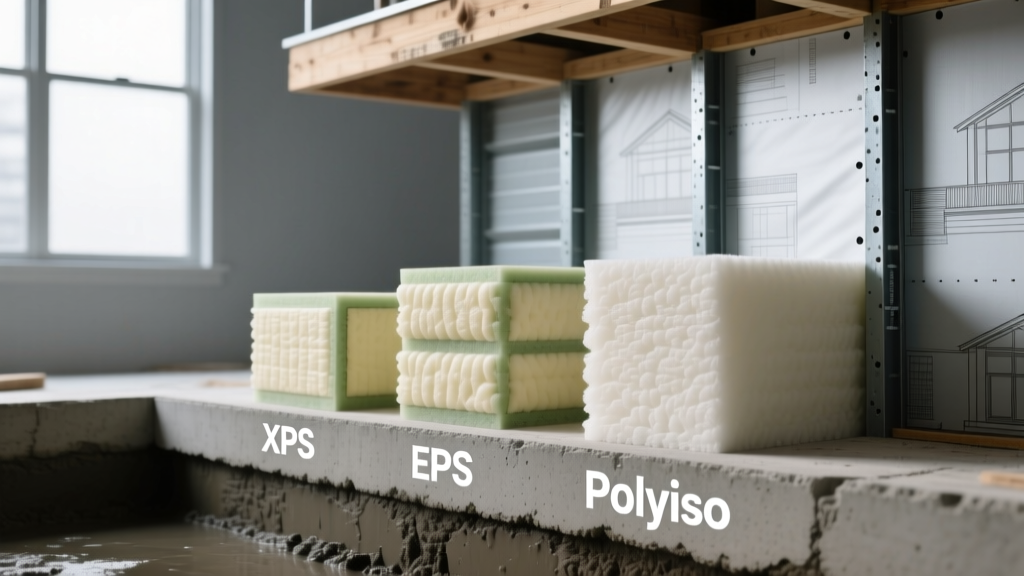
The Rigid Foam Insulation Triad: XPS, EPS, and Polyiso
Specifying the wrong rigid foam insulation leads to concealed moisture damage, thermal bridging, and code violations. While all three primary types of rigid foam—extruded polystyrene (XPS), expanded polystyrene (EPS), and polyisocyanurate (polyiso)—provide continuous thermal resistance, their chemical structures dictate vastly different behaviors under hydrostatic pressure, freezing temperatures, and vapor drive. According to the U.S. Department of Energy, selecting insulation based solely on initial R-value per inch is a critical error; application-fit and long-term environmental exposure must drive the decision.
| Material | Core Chemistry & Facers | R-Value (at 75°F) | Compressive Strength | Primary Scenario Fit |
|---|---|---|---|---|
| XPS | Extruded closed-cell; unfaced or plastic | R-5.0 per inch | 25 to 100 psi | Below-grade, slab edges, plaza decks |
| EPS | Expanded fused beads; unfaced or foil | R-3.8 to R-4.4 per inch | 10 to 60 psi (density dependent) | Below-grade (high-density), flat roofing, ICFs |
| Polyiso | Thermoset closed-cell; foil or glass facers | R-6.0 to R-6.5 per inch | 16 to 25 psi | Above-grade exterior CI, wall sheathing, roofing |
Scenario 1: Below-Grade Foundations and Slab Edges
Below-grade applications subject insulation to soil acidity, hydrostatic pressure, and constant moisture. The traditional default has been XPS, such as Owens Corning FOAMULAR NGX, which utilizes next-generation HFO blowing agents to comply with modern environmental regulations while maintaining an R-5 rating and 25 psi compressive strength (Type IV).
The Moisture Paradox: Why EPS is Beating XPS Below Grade
While XPS resists initial water absorption better than EPS, long-term in-situ studies reveal a moisture paradox. XPS has a highly closed-cell structure that slows water entry but also prevents drying. Over a 10- to 15-year period in damp soil, XPS can absorb moisture and retain it, causing its R-value to degrade by up to 10-15%. Conversely, high-density EPS (like Insulfoam R-Tech Type II at 1.35 pcf density) is bead-fused. It may absorb water more readily under direct hydrostatic head pressure, but it drains and dries almost instantly when conditions allow, maintaining its R-3.8 to R-4.2 rating over the lifespan of the foundation.
Never use standard 10 psi or 15 psi EPS under a concrete slab-on-grade. The hydrostatic pressure of wet concrete during the pour, combined with long-term structural creep, will crush the foam. Always specify a minimum of 25 psi compressive strength (ASTM D1621) for sub-slab applications, regardless of whether you choose XPS or EPS.
Scenario 2: Above-Grade Exterior Continuous Insulation (CI)
For above-grade walls requiring continuous insulation (CI) to eliminate thermal bridging through wood or steel studs, polyiso is the undisputed leader. Products like DuPont Thermax or Johns Manville ENRGY 3 offer an impressive R-6.5 per inch at 75°F, and their foil facers act as highly effective exterior weather-resistive barriers (WRBs) when seams are properly taped.
Navigating the Polyiso Thermal Drift
The critical vulnerability of polyiso is "thermal drift." The blowing agents used to create the closed-cell structure condense at low temperatures. In Climate Zones 5 and above, when exterior temperatures drop to 25°F, the R-value of polyiso can plummet from R-6.5 to approximately R-5.6 per inch. The Environmental Protection Agency notes that understanding temperature-dependent R-values is essential for accurate energy modeling in colder climates.
Expert Framework for Cold Climates: If you are designing a wall assembly in a cold climate (Zone 5+), do not rely on polyiso's summer R-value for your dew point calculations. Either increase your polyiso thickness by 15% to compensate for winter thermal drift, or utilize a hybrid wall assembly: place a thinner layer of polyiso outside the sheathing for bulk R-value, and use mineral wool batts inside the stud cavity, which suffer zero thermal drift.
Scenario 3: Interior Basement Finishing
When insulating the interior side of a below-grade concrete wall, vapor permeability dictates your material choice. Concrete is a vapor semi-permeable membrane; it constantly wicks moisture from the exterior soil and attempts to dry inward.
- The Fatal Mistake: Installing foil-faced polyiso directly against interior concrete. The foil acts as a Class I vapor retarder, trapping moisture against the concrete. This causes efflorescence, spalling, and creates a hidden mold incubator behind your drywall.
- The Correct Protocol: Use unfaced XPS or unfaced EPS. These materials are Class II or III vapor retarders, allowing the concrete to dry inward at a controlled rate.
- Air Sealing: Rigid foam must be sealed to the concrete and at all joints. Use a low-expansion polyurethane foam sealant (like Great Stuff Pro) at the perimeter, and high-quality acrylic or butyl tape (like Tyvek or Zip System tape) on the board seams to prevent interior humid air from reaching the cold concrete surface and condensing.
2026 Pricing and Sizing Framework
Material costs fluctuate based on regional supply chains and petrochemical indices. Below is the current baseline pricing for standard 4x8-foot sheets at a 2-inch thickness, representing typical contractor-tier pricing for 2026.
| Material Type | Product Example | Thickness | Cost per 4x8 Sheet | Cost per Board Foot |
|---|---|---|---|---|
| EPS (Type II, 1.35 pcf) | Insulfoam R-Tech | 2.0" | $19.00 - $23.00 | $0.60 - $0.72 |
| XPS (25 psi, Unfaced) | OWENS CORNING FOAMULAR NGX | 2.0" | $36.00 - $42.00 | $1.12 - $1.31 |
| Polyiso (Foil-Faced) | Johns Manville ENRGY 3 | 2.0" | $45.00 - $55.00 | $1.40 - $1.71 |
| XPS (High Density, 40 psi) | OWENS CORNING FOAMULAR 600 | 2.0" | $58.00 - $65.00 | $1.81 - $2.03 |
Critical Failure Modes and Edge Cases
Beyond material selection, installation errors frequently compromise rigid foam assemblies. Avoid these common field failures:
- Fastener Pull-Through on Exterior CI: When attaching furring strips or siding through thick polyiso or XPS, standard screws lack the bearing surface to hold the foam against wind uplift. You must use specialized insulation fasteners with 2.5-inch to 3-inch diameter plastic cap washers, or rely on structural screws that penetrate a minimum of 1.5 inches into the underlying wood studs or masonry.
- Solvent Degradation: XPS and EPS are highly susceptible to melting when exposed to the volatile organic compounds (VOCs) in standard solvent-based adhesives, roofing tars, and spray foams. Always use manufacturer-approved, low-VOC polyurethane adhesives (like Olybond or Dow Weathermate) when gluing boards to substrates.
- UV Degradation: None of these rigid foams are UV-stable. If left exposed to sunlight on a job site for more than 30 to 60 days, the surface will oxidize, chalk, and lose structural integrity. If delays occur, cover the stacks with opaque, light-colored tarps (dark tarps create a greenhouse effect that can warp the boards).
For irregular spaces, rim joists, and complex penetrations where rigid boards cannot fit tightly, do not force-cut XPS. Instead, use closed-cell spray foam (ccSPF) in 2-lb density cans to seal the perimeter of the rigid foam. The spray foam acts as both an adhesive and a flexible, airtight gasket that accommodates seasonal wood framing movement without breaking the thermal seal.