2026 Insulation Material Cost & ROI Selection Framework
Evaluate true insulation material cost in 2026. Compare upfront pricing, labor, R-value, and lifecycle ROI to choose the best building insulation.
The Flaw in Upfront Insulation Material Cost Analysis
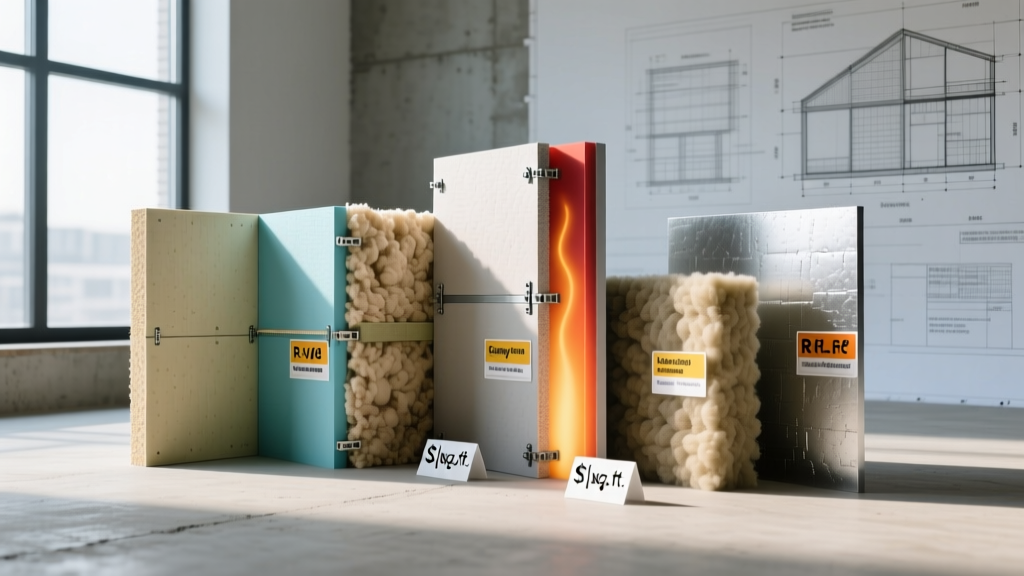
Procurement teams and builders frequently evaluate insulation material cost through a single, flawed metric: dollars per square foot. In 2026, with building codes adopting stricter IECC continuous insulation mandates and energy prices fluctuating, this surface-level metric leads to severe budget miscalculations. A $0.50 per square foot fiberglass batt may appear economical until you factor in the required air-sealing labor, thermal bridging losses, and the resulting HVAC oversizing.
To make an accurate procurement decision, you must shift from a Cost per Square Foot model to a Cost per Effective R-Value framework. This requires analyzing the material's thermal resistance, its susceptibility to thermal drift, assembly integration requirements, and long-term energy payback.
The 2026 Insulation Material Cost & Performance Matrix
The table below breaks down current 2026 market pricing for the five dominant insulation categories. Note that "Hidden Cost Factors" represent secondary assembly expenses triggered by the material choice.
| Material Type | Product Example | Material Cost (per sq ft) | R-Value / Inch | Cost per R-Unit | Hidden Cost Factor |
|---|---|---|---|---|---|
| Fiberglass Batt | Owens Corning EcoTouch | $0.45 - $0.75 | R-3.2 - R-3.4 | $0.15 - $0.22 | Requires separate fluid-applied air barrier & housewrap labor. |
| Mineral Wool | Rockwool Comfortbatt | $0.95 - $1.35 | R-4.2 - R-4.3 | $0.23 - $0.31 | Heavier weight increases handling time; requires specialized cutting tools. |
| Closed-Cell Spray Foam (ccSPF) | Icynene ProSeal | $1.60 - $2.30 | R-6.0 - R-6.5 | $0.26 - $0.36 | Requires certified installers; trim-back labor if over-sprayed past studs. |
| Rigid Polyiso (Foil-Faced) | Carlisle Polyiso | $0.85 - $1.15 | R-5.8 - R-6.0 | $0.15 - $0.19 | Thermal drift in cold climates reduces effective winter R-value. |
| Dense-Pack Cellulose | NuCore Cellulose | $0.65 - $0.95 | R-3.5 - R-3.7 | $0.18 - $0.26 | Requires netting and specialized blowing equipment; moisture risk during install. |
Pillar 1: Thermal Drift and Effective R-Value
According to research published by Building Science Corporation, laboratory-tested R-values rarely reflect field performance. The most critical variable in insulation material cost analysis is thermal drift—the phenomenon where a material's R-value changes based on outdoor temperatures.
The Polyisocyanurate Cold-Weather Penalty
Polyisocyanurate (Polyiso) rigid foam boasts an impressive laboratory R-value of R-6.0 per inch at 75°F. However, the blowing agents trapped within the closed cells condense when temperatures drop below 40°F. In cold climates (IECC Zones 5 through 8), the effective winter R-value of Polyiso can plummet by 20% to 25%.
Mineral Wool and Fiberglass Stability
Conversely, air-permeable insulations like mineral wool and fiberglass do not suffer from thermal drift. In fact, fiberglass performs slightly better in extreme cold because the thermal conductivity of the trapped air decreases as temperatures drop. When comparing the cost per effective R-value in freezing climates, mineral wool frequently beats Polyiso despite a higher upfront material cost.
Pillar 2: Assembly Integration and Labor Multipliers
Insulation does not exist in a vacuum; it dictates the labor and materials required for the rest of the wall or roof assembly. When evaluating insulation material cost, you must apply a labor multiplier based on air-sealing and structural requirements.
- The Air-Sealing Premium: The U.S. Department of Energy notes that convective heat loss (air leakage) can reduce the effective performance of batt insulation by up to 40%. If you select fiberglass batts, you must budget for a separate fluid-applied air barrier or meticulous A/V housewrap taping. Closed-cell spray foam (ccSPF) acts as its own Class II vapor retarder and air barrier, eliminating the need for separate air-sealing materials and labor.
- Fastener and Furring Costs: When utilizing thick exterior rigid mineral wool or Polyiso to meet continuous insulation (ci) code requirements, standard siding nails are insufficient. You must budget for heavy-duty structural screws (e.g., FastenMaster ThruLok) and potentially vertical wood furring strips to create a rain screen gap and provide a nailing base for cladding. This can add $1.50 to $2.50 per square foot to the total exterior assembly cost.
Pillar 3: Lifecycle Degradation and Settling
Material cost must be amortized over the 50-year lifecycle of the building envelope. Materials that settle, sag, or absorb moisture lose their R-value, effectively driving up the lifecycle cost per thermal unit.
"Dense-pack cellulose is an excellent, cost-effective choice for retrofitting existing walls, but in new construction open stud bays, it requires strict density verification (minimum 3.5 lbs/cu ft). If installed too loosely, gravity will cause settling over the first five years, leaving uninsulated voids at the top of the wall cavity that thermal imaging will easily detect."
— Building Envelope Commissioning Guidelines, 2025 Edition
For high-humidity zones or below-grade applications, materials like EPS (Expanded Polystyrene) and XPS (Extruded Polystyrene) must be evaluated for moisture retention. XPS absorbs less water initially but can trap moisture over decades, whereas EPS allows moisture to dry out, maintaining its long-term R-value stability. For below-grade foundation walls, the EPA's Seal and Insulate program recommends rigid foam rated specifically for ground contact, factoring in the cost of dimple-drainage mats to protect the insulation investment.
Pillar 4: Calculating the Energy Payback Period (ROI)
To finalize your selection framework, calculate the Energy Payback Period. This metric reveals how many years it will take for the energy savings of a premium insulation material to offset its higher upfront cost compared to a baseline material.
Payback Period (Years) = (Premium Material Installed Cost - Baseline Material Installed Cost) / Annual Energy Savings ($)
Scenario: Upgrading from R-13 Batts to R-21 ccSPF in a 2,500 sq ft Home (Zone 5)
- Baseline (R-13 Fiberglass + Air Sealing): $3,200 installed
- Premium (R-21 Closed-Cell Spray Foam): $6,800 installed
- Cost Delta: $3,600
- Annual HVAC Energy Savings: $410/year (based on 2026 regional utility rates)
- HVAC Downsizing Savings: $1,200 (smaller tonnage heat pump required due to tighter envelope)
- Adjusted Cost Delta: $2,400
- Payback Period: 5.8 Years
Once the 5.8-year threshold is crossed, the spray foam generates pure ROI through reduced utility bills. Furthermore, the Energy Efficient Home Improvement Credit (extended through 2032) can immediately offset up to 30% of the insulation material cost (capped at $1,200 annually), instantly slashing the payback period to under 4 years.
Decision Matrix: Matching Material to Building Zone
Do not use a single insulation material for the entire structure. Optimize your budget by deploying specific materials where their physical properties provide the highest ROI.
| Building Zone | Recommended Material | Cost Justification |
|---|---|---|
| Exterior Continuous (ci) | Mineral Wool Board (e.g., Rockwool Comfortboard 80) | Fire-resistant, vapor-permeable, no thermal drift in cold. Eliminates need for intumescent fire-stopping at rim joists. |
| Stud Cavities (Above Grade) | Dense-Pack Cellulose or Mineral Wool Batt | Superior acoustic dampening and fire-stopping compared to fiberglass. High density prevents convective looping inside the cavity. |
| Unvented Cathedral Ceilings | Closed-Cell Spray Foam (ccSPF) | Highest R-value per inch maximizes headroom. Acts as its own vapor retarder, preventing interstitial condensation on the roof sheathing. |
| Below-Grade Foundation | EPS Rigid Foam (Type II or IX) | Lowest cost per R-value for below-grade. Does not retain moisture long-term like XPS, preserving R-value over 50 years. |
Procurement Checklist for 2026
Before issuing a purchase order, run your selected materials through this final validation checklist:
- Verify Code Compliance: Does the assembly meet the prescriptive R-value requirements of the locally adopted IECC code, or are you utilizing the U-factor alternative path?
- Check Vapor Retarder Class: Ensure the material's permeability rating (Class I, II, or III) aligns with your climate zone's drying potential to avoid mold liability.
- Confirm Lead Times: Specialty products like high-density mineral wool boards and specific ccSPF chemical blends frequently carry 6-to-10-week lead times. Factor storage and weather-protection costs if materials arrive before the building is dried in.
- Demand Third-Party Testing: Require the supplier to provide an ASTM C518 (thermal resistance) and ASTM E96 (water vapor transmission) test report for the specific manufacturing batch.
Written by
Marcus ChenMarcus Chen is a licensed structural engineer (PE) and building materials analyst with over 12 years of experience across residential, commercial, and industrial construction. He holds a Master of Science in Civil Engineering from UC Berkeley and spent six years at Thornton Tomasetti before transitioning to independent consulting and technical writing. Marcus specializes in material selection for seismic-prone regions, concrete reinforcement strategies, and lifecycle cost analysis. His work has been cited by the American Concrete Institute (ACI) and the Structural Engineers Association of California (SEAOC). When he is not on a job site or at his desk, you will find him hiking the Sierra Nevada or restoring a 1920s craftsman bungalow in Oakland, CA.
More from Marcus Chen
View all
Construction Cost
How Much Did the Eiffel Tower Cost to Build?
How much did the Eiffel Tower cost to build in 1889? We adjust for inflation and compare its budget to modern skyscraper construction.
Aug 4, 2026

Fire Resistance
What Is a Fire Resistant Material? Testing & Certification Guide
Discover what is a fire resistant material through ASTM and UL testing. Learn how fire ratings, certifications, and assemblies work in construction.
Aug 4, 2026

Construction Cost
How Much Did the Burj Khalifa Cost to Build?
How much did the Burj Khalifa cost to build? We break down the $1.5B project and extract 5 money-saving strategies for your next build.
Jul 30, 2026