Best Insulation Material for Maximum R-Value Performance
Compare the best insulation material options by R-value per inch, cost, and moisture performance to optimize your building envelope in any climate zone.

Selecting the best insulation material requires looking past the labeled R-value per inch printed on the packaging. Real-world thermal resistance is dictated by framing factors, moisture dynamics, air leakage, and temperature-dependent performance shifts. A material that performs exceptionally in a laboratory setting at 75°F may underperform drastically in a freezing, humid, or wind-washed environment. To optimize your building envelope, you must evaluate materials based on whole-wall R-value, vapor permeability, and long-term thermal resistance (LTTR).
• Closed-Cell Spray Foam (ccSPF): R-6.5 to R-7.0
• Polyisocyanurate (Polyiso): R-6.0 to R-6.5 (Temperature dependent)
• Extruded Polystyrene (XPS - HFO): R-4.6 to R-4.8
• Mineral Wool (Stone Wool): R-4.2 to R-4.3
• High-Density Fiberglass Batts: R-3.8 to R-4.3
The R-Value Hierarchy: Material Breakdown & Real-World Costs
The following matrix compares the most common insulation categories based on 2026 market pricing, nominal R-value, and whole-wall performance when installed in a standard 2x6 framed wall at 16 inches on center (OC). According to the U.S. Department of Energy, whole-wall R-value accounts for the thermal bridging of the wood studs, which typically reduces the effective R-value of cavity insulation by 20% to 25%.
| Material Type | Nominal R/Inch | Whole-Wall R (2x6) | Installed Cost / Sq Ft | Permeability (Perms) |
|---|---|---|---|---|
| Closed-Cell Spray Foam (ccSPF) | 6.5 - 7.0 | ~R-19.5 (3") | $2.80 - $3.50 | < 1.0 (at 1.5") |
| Foil-Faced Polyiso (Rigid) | 6.0 - 6.5 | N/A (Continuous) | $1.30 - $1.80 | < 0.05 (Class I) |
| HFO XPS (Rigid) | 4.6 - 4.8 | N/A (Continuous) | $1.10 - $1.50 | 1.1 - 1.5 |
| Mineral Wool Batts | 4.2 - 4.3 | ~R-15.5 (5.5") | $1.60 - $2.20 | 30 - 50 (Vapor Open) |
| High-Density Fiberglass | 3.8 - 4.3 | ~R-15.2 (5.5") | $0.90 - $1.30 | 25 - 40 (Vapor Open) |
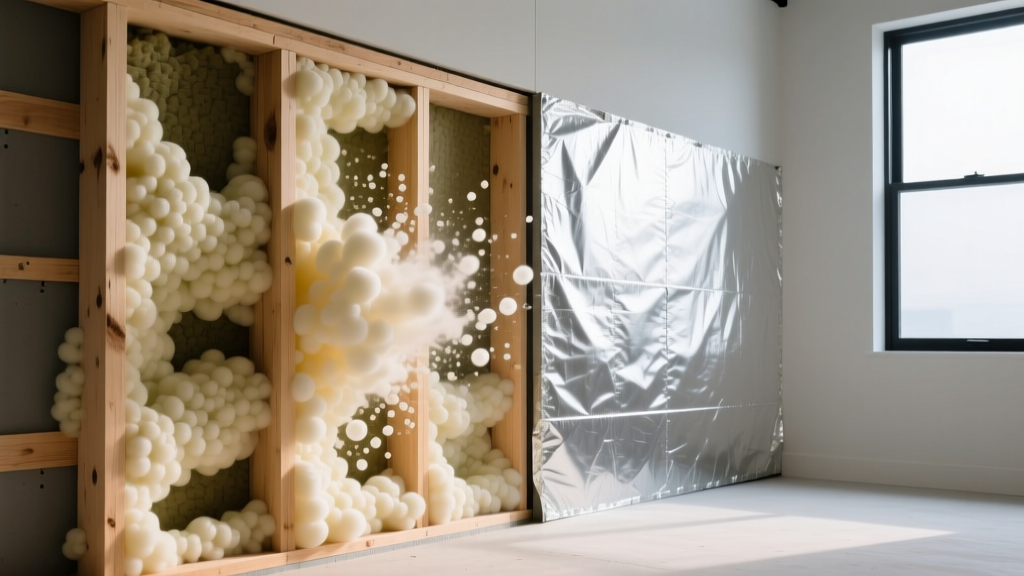
Why Lab R-Value Fails in the Field (The Performance Gap)
The Building Science Corporation frequently highlights the discrepancy between ASTM C518 lab testing and field performance. Three primary mechanisms degrade real-world R-value:
1. Temperature-Dependent R-Value Shifts
Polyisocyanurate (Polyiso) is highly rated for its R-6.5 per inch, but this is measured at a mean temperature of 75°F. When exterior temperatures drop below 40°F, the blowing agents trapped inside the polyiso cells begin to condense, causing the R-value to drop by 15% to 20%. Conversely, XPS and mineral wool maintain stable R-values across extreme temperature differentials. If you are building in Climate Zones 5 through 8, relying solely on exterior Polyiso without accounting for cold-weather degradation will result in an underperforming envelope.
2. Convective Looping and Wind Washing
Fiberglass and mineral wool batts are air-permeable. If the exterior sheathing is not sealed with a continuous air barrier, or if the interior drywall lacks proper air sealing, wind will penetrate the cavity. This creates convective loops—where warm air rises and cool air sinks within the wall cavity—stripping heat from the insulation and reducing effective thermal resistance by up to 40%. Closed-cell spray foam (ccSPF) eliminates this failure mode entirely by acting as both an insulator and an air barrier.
3. Thermal Bridging
Wood framing has an R-value of roughly 1.25 per inch. In a 2x6 wall, the studs, plates, and headers make up about 25% of the wall area. This thermal bridging acts as a heat sink, bypassing the cavity insulation. The only way to achieve maximum R-value performance is to incorporate continuous insulation (ci) on the exterior of the sheathing, breaking the thermal bridge.
Climate-Specific Decision Matrix
The 'best' material changes depending on your hygrothermal region. Use this framework to specify your envelope:
Hot-Humid Climates (Zones 1-3)
Primary Threat: Exterior moisture driving inward, condensing on cool interior surfaces (air-conditioned drywall).
Best Material Strategy: Use vapor-permeable cavity insulation (Mineral Wool or unfaced Fiberglass) combined with exterior continuous Polyiso or XPS. The exterior foam must be thick enough to keep the interior side of the sheathing above the dew point. Avoid interior polyethylene vapor barriers, which trap moisture inside the wall cavity.
Cold Climates (Zones 5-8)
Primary Threat: Interior moisture driving outward, condensing on freezing exterior sheathing.
Best Material Strategy: Closed-cell spray foam (ccSPF) in the cavity provides an interior air/vapor barrier that stops moist indoor air from reaching the cold sheathing. Alternatively, use exterior mineral wool (which is vapor-open, allowing the wall to dry outward) paired with an interior Class II vapor retarder like MemBrain or kraft-faced batts.
Mixed Climates (Zone 4)
Primary Threat: Bidirectional moisture flow (cooling in summer, heating in winter).
Best Material Strategy: 'Flash and Batt' method. Apply 1.5 inches of ccSPF against the interior sheathing to seal air leaks and control condensation, then fill the remainder of the cavity with cost-effective mineral wool or high-density fiberglass. This hybrid approach maximizes R-value per dollar while managing moisture in both seasons.
Top Product Specifications for 2026 Envelopes
When specifying materials, look for these industry-leading products that address historical insulation flaws:
- Owens Corning FOAMULAR NGX (XPS): The transition to HFO blowing agents is now the industry standard. NGX uses a blowing agent with a Global Warming Potential (GWP) of 1. Unlike legacy HFC XPS, which lost R-value over 15 years as gases diffused out, NGX maintains a stable LTTR of R-4.7 per inch indefinitely.
- ROCKWOOL Comfortbatt (Mineral Wool): Offers R-4.2 per inch but excels in dimensional stability. It does not sag, compress, or support mold growth. Its high density provides superior acoustic dampening and fire resistance (non-combustible up to 2,150°F), making it the best choice for fire-rated assemblies and soundproofing interior partitions.
- Demilec Heatlok XT (ccSPF): A high-performance closed-cell foam yielding R-7.0 per inch. It utilizes an HFO blowing agent and provides structural rigidity to wall assemblies, increasing racking strength while serving as a code-compliant water-resistive barrier (WRB) when applied at specific thicknesses.
Installation Failure Modes to Avoid
Even the best insulation material will fail if installed incorrectly. Avoid these common field errors:
- Compression: Stuffing an R-19 fiberglass batt (designed for a 6.25" cavity) into a 2x4 wall (3.5" cavity) does not yield R-19. The compression increases the density but reduces the total thermal resistance to roughly R-13. Always match the batt thickness to the cavity depth.
- Missed Air Sealing: Insulation is not an air barrier (except ccSPF). Failing to caulk, foam, or tape the top and bottom plates, window rough openings, and electrical penetrations before insulating will render the R-value irrelevant due to convective heat loss.
- Improper Vapor Retarder Placement: Placing a Class I vapor retarder (like poly sheeting) on the wrong side of the wall assembly for your climate zone will trap moisture, leading to sheathing rot and mold. Always consult the IECC climate zone map for vapor retarder requirements.
Ultimately, the best insulation material is the one that correctly manages heat, air, and moisture for your specific climate zone. Prioritize continuous exterior insulation to eliminate thermal bridging, and ensure rigorous air sealing to protect the cavity insulation's rated performance.
Written by
James ThorntonJames Thornton is a construction industry veteran with 25 years of hands-on experience in wood framing, lumber grading, and residential building codes. He started as a framing carpenter in rural Oregon, earned his ICC Residential Building Inspector certification, and eventually became a senior plan reviewer for the City of Portland Bureau of Development Services. James holds a B.S. in Wood Science & Technology from Oregon State University and is a certified lumber grader through the West Coast Lumber Inspection Bureau (WCLIB). He has inspected over 3,000 residential construction sites and authored the city's internal guide on advanced framing techniques (2x6 at 24" O.C.). James lives in Bend, OR, where he builds custom timber-frame cabins and competes in lumberjack sports.
More from James Thornton
View all
Insulation
Best Home Insulation Materials: Complete 2026 Guide
Compare top home insulation materials for 2026. Find R-values, installed costs per square foot, and best uses for fiberglass, spray foam, and mineral wool.
Aug 4, 2026

Sustainable Building
Certify Your Green Building Material for LEED and WELL
Step-by-step guide to certifying a green building material for LEED v5 and WELL v2. Master EPDs, HPDs, and VOC limits for 2026 project specifications.
Aug 4, 2026

Stone & Masonry
Veneer Stacked Stone Panels: Interior Design & Style Showcase
Discover how veneer stacked stone panels transform interiors. Explore modern design profiles, material pairings, and technical installation specs.
Aug 4, 2026