Rigid Insulation Board Insulation: Performance Ratings & Specs
Compare rigid insulation board insulation performance ratings, R-values, compressive strength, and LTTR specs for XPS, EPS, and polyiso applications.
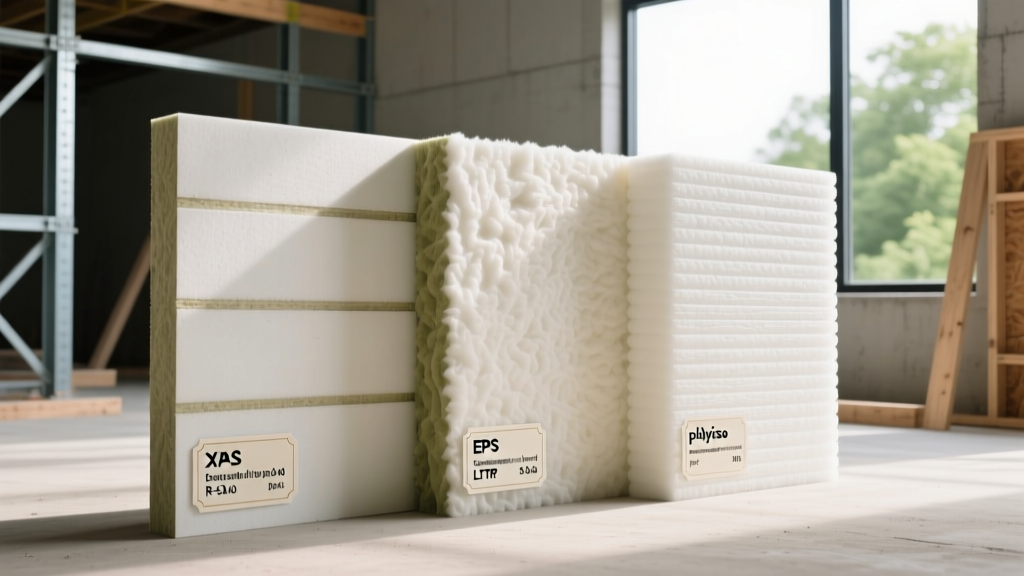
Decoding Rigid Insulation Board Insulation Performance Metrics
Specifying rigid insulation board insulation for commercial and high-performance residential envelopes requires looking far beyond the initial R-value printed on the packaging. While thermal resistance is the primary function, the long-term viability of an insulation system depends on a matrix of secondary performance ratings: compressive strength, moisture absorption, vapor permeance, and long-term thermal resistance (LTTR). In 2026, with building codes demanding stricter continuous insulation (CI) and lower global warming potential (GWP) for blowing agents, understanding the exact ASTM specifications of rigid foam boards is critical for avoiding catastrophic envelope failures.
- ASTM C578: Standard Specification for Rigid, Cellular Polystyrene Thermal Insulation (Covers EPS and XPS).
- ASTM C1289: Standard Specification for Faced Rigid Cellular Polyisocyanurate Thermal Insulation Board.
- ASTM C518: Standard Test Method for Steady-State Thermal Transmission Properties (Thermal Resistance).
- ASTM D1621: Standard Test Method for Compressive Properties of Rigid Cellular Plastics.
Material Breakdown: EPS vs. XPS vs. Polyiso Specifications
The three dominant rigid foam boards used in construction—Expanded Polystyrene (EPS), Extruded Polystyrene (XPS), and Polyisocyanurate (Polyiso)—each possess distinct cellular structures that dictate their performance boundaries. According to the U.S. Department of Energy, selecting the correct board type depends heavily on the specific environmental and structural loads the material will face.
Expanded Polystyrene (EPS)
EPS is manufactured by expanding polystyrene beads in a mold, creating a closed-cell structure that is technically semi-permeable to vapor. Under ASTM C578, EPS is categorized by Type (e.g., Type I, Type II, up to Type XV), which directly correlates to its density and compressive strength. Standard Type I EPS offers a compressive strength of 10 psi at 10% deflection, while high-density Type XV can reach 60 psi. The thermal resistance of EPS is highly stable over time, typically ranging from R-3.6 to R-4.2 per inch, because it uses air as its primary insulating gas within the cells.
Extruded Polystyrene (XPS)
XPS is extruded through a die, creating a continuous, tightly closed-cell matrix that excels in moisture resistance. The Extruded Polystyrene Foam Association (XPSA) notes that XPS typically offers an initial R-value of R-5.0 per inch. However, XPS relies on high-GWP blowing agents (historically HFCs, now transitioning to HFOs) that slowly diffuse out of the cellular structure over decades. Therefore, specifiers must use the LTTR (Long-Term Thermal Resistance) value, which usually stabilizes around R-4.5 to R-4.7 per inch over a 50-year lifespan. XPS compressive strengths range from 15 psi (Type IV) to 100 psi (Type X), making it the premier choice for below-grade and heavy-load applications.
Polyisocyanurate (Polyiso)
Polyiso is a thermoset plastic produced with a continuous lamination process, almost always faced with aluminum foil or glass-fiber mats. The Polyisocyanurate Insulation Manufacturers Association (PIMA) highlights that polyiso boasts the highest initial R-value of standard rigid boards, ranging from R-5.6 to R-6.5 per inch. However, polyiso is highly susceptible to "thermal drift" at extreme temperatures. At sub-freezing temperatures (below 40°F), the R-value of polyiso can drop by 15% to 20% due to the condensation of the blowing agents within the cells. It is strictly an above-grade material, as its facers and cellular structure degrade rapidly when exposed to bulk water.
Comprehensive Performance Specification Matrix
| Performance Metric | EPS (Type II) | XPS (Type IV) | Polyiso (Foil-Faced) |
|---|---|---|---|
| LTTR (per inch) | R-3.8 (Stable) | R-4.5 to R-4.7 | R-5.6 to R-6.0 |
| Compressive Strength (ASTM D1621) | 13 - 15 psi | 25 psi | 16 - 20 psi |
| Water Absorption (ASTM C272) | 2.0% - 4.0% by vol. | < 0.3% by vol. | < 1.5% by vol. (core) |
| Vapor Permeance (ASTM E96) | 3.5 - 5.0 perms | 1.0 - 1.5 perms | < 0.1 perms (foil-faced) |
| Max Service Temperature | 167°F (75°C) | 165°F (74°C) | 250°F (121°C) |
Critical Performance Ratings Beyond R-Value
When evaluating insulation board insulation for specific structural applications, secondary ratings often dictate whether a system passes municipal inspections or survives a 30-year weather cycle.
Compressive Strength and Creep Deflection
Compressive strength is measured at 10% deflection, but in real-world applications like plaza decks or below-slab foundations, the material must resist continuous static loads without "creeping" (slow, permanent deformation). For heavy-load commercial foundations, specify XPS Type V (40 psi) or Type X (60 psi). If using EPS to save costs, you must step up to high-density Type IX (25 psi) or Type XV (60 psi) to match the load-bearing capacity and prevent long-term slab settling.
Moisture Absorption and Freeze-Thaw Cycles
Water is a highly efficient thermal conductor. If rigid insulation absorbs moisture, its R-value plummets. XPS absorbs less than 0.3% water by volume after 24 hours of submersion (ASTM C272), making it the mandatory choice for inverted roof membrane assemblies (IRMA) and below-grade exterior foundations. EPS can absorb up to 4%, requiring careful drainage detailing. Polyiso facers can delaminate if exposed to hydrostatic pressure or standing water, permanently destroying the board's structural integrity and thermal profile.
Fire and Smoke Ratings (ASTM E84)
Rigid foam boards are organic plastics and are inherently combustible. To meet International Building Code (IBC) requirements for interior exposure or specific exterior wall assemblies, boards must be tested via the Steiner Tunnel test (ASTM E84). Look for boards rated Class A (or Class 1), which dictates a Flame Spread Index (FSI) of 25 or less and a Smoke Developed Index (SDI) of 450 or less. Polyiso, being a thermoset plastic, naturally chars rather than melts, giving it superior fire performance compared to the thermoplastic EPS and XPS, which can melt and drip when exposed to direct flame.
"The transition to HFO blowing agents in XPS and Polyiso manufacturing has radically altered the environmental specifications of rigid boards. Modern boards now boast a Global Warming Potential (GWP) of less than 10, down from the 1,400+ GWP of legacy HFC-blown boards, fundamentally changing how these materials score in LEED v4.1 and Living Building Challenge certifications."
Thermal Drift: The Polyiso Sub-Freezing Penalty
A common specification error in cold-climate zones (Zones 5 through 8) is relying solely on the labeled R-value of polyiso for exterior continuous insulation. Due to the physics of the pentane and HFO blowing agents trapped in the polyiso cells, the gas conductivity changes at low temperatures. At 40°F, polyiso performs as labeled. At 0°F, the R-value can degrade by up to 20%. To mitigate this thermal drift, building scientists recommend a "hybrid" exterior insulation approach: using a 1-inch outer layer of XPS (which actually performs better at sub-freezing temperatures) over an inner layer of polyiso, or switching entirely to mineral wool boards for exterior CI in extreme cold climates.
Application-Specific Selection Framework
Use this decision matrix to specify the correct insulation board insulation based on the structural zone:
- Below-Grade Foundations & Under-Slab: Specify XPS Type IV or V. The closed-cell extrusion prevents ground moisture ingress, and the high compressive strength resists soil hydrostatic pressure and concrete pour loads. Never use foil-faced polyiso below grade.
- Commercial Flat Roofing (Above Deck): Specify Polyiso (ASTM C1289 Type II). Its high R-value per inch minimizes roof edge detailing thickness, and its thermoset properties withstand the high heat of hot-asphalt or torch-applied roofing membranes without melting.
- Exterior Continuous Insulation (Wood/Metal Stud Walls): Specify unfaced EPS or mineral wool if vapor permeability is required for a "flash-and-batt" or drying-to-the-exterior wall assembly. Specify foil-faced polyiso if an exterior vapor barrier and continuous water-resistive barrier (WRB) integration is the design intent.
- Plaza Decks & Green Roofs: Specify high-density XPS (Type V or X, 40-60 psi). These assemblies endure massive dead loads from soil, pavers, and water retention, alongside constant moisture exposure.
By aligning the exact ASTM specifications of rigid insulation boards with the mechanical, thermal, and hygric demands of the specific building envelope zone, specifiers can eliminate thermal bridging, prevent moisture entrapment, and ensure the structural longevity of the assembly.