Top Building Insulation Materials for Sound Control and Acoustics
Compare the best building insulation materials for sound control. Learn STC ratings, densities, and assembly strategies for superior acoustic isolation.

The Physics of Acoustic Insulation: STC vs. NRC
When selecting building insulation materials for sound control, it is critical to distinguish between sound absorption and sound isolation. Many contractors mistakenly assume that thermal insulation automatically provides acoustic benefits. In reality, acoustic performance relies on specific material properties: mass, density, and decoupling.
STC (Sound Transmission Class): Measures a material's ability to block airborne sound from passing through a partition. A standard interior wall has an STC of 33; a high-performance acoustic wall targets STC 50+.
NRC (Noise Reduction Coefficient): Measures how much sound a material absorbs within a room to reduce reverberation. An NRC of 1.0 means 100% absorption of mid-to-high frequencies.
According to the Whole Building Design Guide (WBDG), achieving optimal acoustic comfort requires addressing both metrics. Cavity insulation primarily improves STC by dampening resonance within the wall cavity, while surface treatments and mass address NRC and structural transmission.
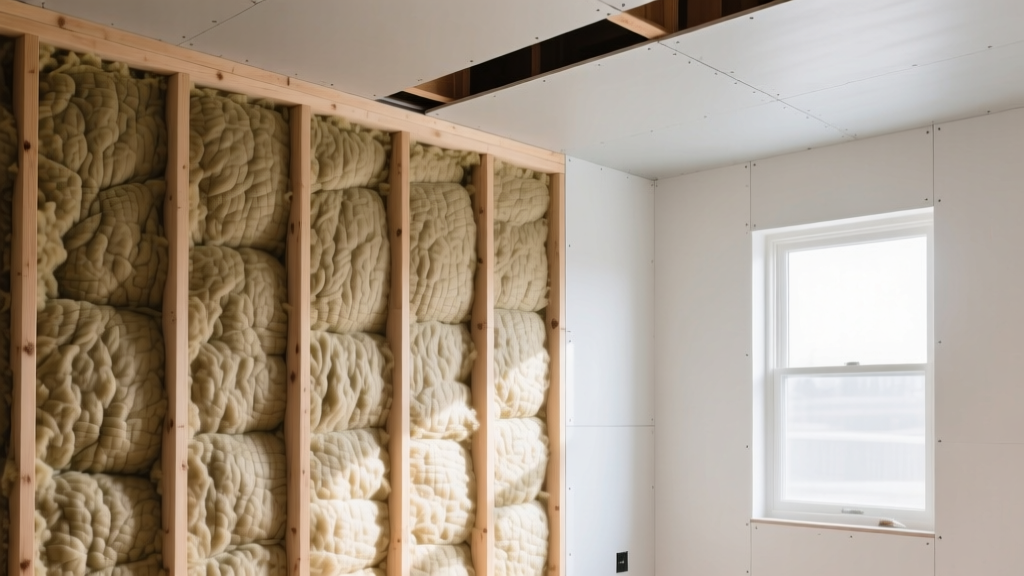
Evaluating Building Insulation Materials for Sound Control
Not all insulation is created equal. Standard thermal batts (typically 0.7 lbs/ft³) do little to stop low-frequency noise like bass or footfalls. For acoustic applications, you need high-density materials that create friction to convert sound waves into trace amounts of heat energy. Below is a comparison matrix of the top building insulation materials used in acoustic assemblies.
| Material Type | Density (lbs/ft³) | NRC Rating | STC Contribution | Avg Cost (per sq ft) | Best Application |
|---|---|---|---|---|---|
| Mineral Wool Batts | 2.5 - 3.0 | 1.05 | +8 to +10 STC | $1.20 - $1.50 | Interior partition walls, home theaters |
| High-Density Fiberglass | 2.5 - 3.0 | 0.95 - 1.0 | +7 to +9 STC | $1.10 - $1.40 | Staggered stud walls, ceiling plenums |
| Dense-Pack Cellulose | 3.0 - 3.5 | 0.85 | +6 to +8 STC | $1.50 - $2.00 | Retrofit existing walls, floor joist bays |
| Open-Cell Spray Foam | 0.4 - 0.5 | 0.70 | +3 to +5 STC | $1.80 - $2.50 | Irregular cavities, sealing flanking paths |
| Closed-Cell Spray Foam | 1.8 - 2.0 | 0.20 | 0 to -2 STC | $2.50 - $3.50 | Avoid for acoustics (causes structural coupling) |
Mineral Wool (Rockwool Safe'n'Sound)
Mineral wool is the undisputed industry standard for cavity soundproofing. Products like ROCKWOOL Safe'n'Sound are engineered specifically for acoustic damping. With a density of roughly 2.5 lbs/ft³, the intertwined stone fibers create immense internal friction, effectively trapping mid and high-frequency airborne noise. Furthermore, mineral wool is inherently fire-resistant and hydrophobic, preventing the mold issues that can plague cellulose in humid environments. For a standard 2x4 wall, installing 3.5-inch Safe'n'Sound batts yields an immediate, measurable drop in cavity resonance.
High-Density Fiberglass (Acoustic Batts)
Standard pink fiberglass is virtually useless for sound control. However, specialized acoustic fiberglass boards, such as Owens Corning Thermafiber SAFB (Sound Attenuation Fire Blankets), perform nearly identically to mineral wool. These boards are compressed to 2.5 or 3.0 lbs/ft³. They are highly effective in commercial drop ceilings and staggered-stud residential assemblies. The primary advantage over mineral wool is a slightly lower material cost and easier handling, though installers must wear heavy PPE due to the fine glass particulates.
Dense-Pack Cellulose
When retrofitting soundproofing into existing finished walls, dense-pack cellulose is the optimal choice. Blown in at 3.0 to 3.5 lbs/ft³, cellulose adds significant mass to the wall cavity. Mass is a primary defender against low-frequency sound transmission. According to the U.S. Department of Energy, cellulose also provides superior air-sealing compared to batts, which inadvertently blocks airborne flanking noise through microscopic wall gaps.
The Closed-Cell Spray Foam Trap
A common and costly mistake in acoustic design is specifying closed-cell spray foam for interior partition walls. While closed-cell foam (2.0 lbs/ft³) is an exceptional thermal barrier and structural adhesive, its rigidity is detrimental to acoustics. By gluing the drywall directly to the wooden studs, closed-cell foam creates a rigid mechanical bridge that transmits impact and low-frequency vibrations directly through the wall assembly. Always specify open-cell foam (0.5 lbs/ft³) if spray insulation is required for sound control, as its spongy matrix absorbs vibration rather than transmitting it.
Assembly Strategies: Maximizing STC with Cavity Insulation
Building insulation materials only reach their maximum acoustic potential when paired with the correct framing assembly. Stuffing mineral wool into a standard single-stud wall will only raise the STC from roughly 35 to 42. To achieve STC 50+ (the threshold where loud speech is completely inaudible), you must combine cavity insulation with decoupling techniques.
Sound behaves like water; it will find the path of least resistance. If your wall cavity is perfectly insulated but you have unsealed electrical boxes, shared HVAC ducts, or gaps at the top plate, your STC rating will plummet. Always apply acoustic sealant (e.g., Tremco Acoustical Sealant) to all top/bottom plates and install putty pads behind all electrical outlet boxes.
Decision Matrix: Choosing the Right Wall Assembly
- Standard 2x4 Wood Studs + Mineral Wool: Yields STC 40-42. Suitable for basic bedroom privacy. Cost-effective and easy to frame.
- Staggered Studs (2x6 Plate) + Mineral Wool: Yields STC 48-52. The drywall on each side attaches to different studs, breaking the structural bridge. Ideal for home theaters and basement apartments.
- Double Stud Wall (Two 2x4 walls with 1" air gap) + Mineral Wool: Yields STC 55-60+. The gold standard for recording studios and multi-family party walls. Requires sacrificing 4-6 inches of floor space.
- Standard Studs + Resilient Channel + Mineral Wool: Yields STC 45-48. Metal channels decouple the drywall from the studs. High risk of installation error (a single misplaced screw through the channel into the stud ruins the decoupling).
Real-World Costs: Acoustic Upgrade for a 12x12 Room
To provide actionable budgeting data, here is a material cost breakdown for upgrading the interior partition walls (approx. 350 sq ft of wall space) of a 12x12 media room from a standard thermal assembly to a high-performance acoustic assembly in 2026.
| Material / Component | Quantity | Unit Cost | Total Cost |
|---|---|---|---|
| ROCKWOOL Safe'n'Sound (3.5" Batts) | 350 sq ft | $1.35 / sq ft | $472.50 |
| 5/8" Type X Drywall (Mass Layer) | 350 sq ft | $0.65 / sq ft | $227.50 |
| Green Glue Damping Compound (2 tubes per 4x8 sheet) | 22 tubes | $18.00 / tube | $396.00 |
| Acoustical Sealant (Caulk) | 6 tubes | $9.50 / tube | $57.00 |
| Electrical Box Putty Pads | 8 pads | $4.00 / pad | $32.00 |
| Total Material Cost | $1,185.00 |
Note: Labor costs for acoustic detailing (sealing, double-drywall installation) typically add 30-40% to standard drywall labor rates due to the precision required.
Troubleshooting Common Acoustic Insulation Failures
Symptom: Low-Frequency Bass Still Bleeds Through
Cause: Cavity insulation (like mineral wool) absorbs mid and high frequencies but lacks the mass to stop low-frequency sound waves (20Hz - 100Hz). Bass wavelengths are physically larger than the wall thickness.
Fix: You must add mass and damping. Install a second layer of 5/8" drywall with a viscoelastic damping compound (like Green Glue) sandwiched between the layers. The compound converts the low-frequency shear energy into heat.
Symptom: Sound Leaks Around the Perimeter
Cause: Flanking paths. The insulation was installed perfectly, but the drywall was hard-mounted to the floor or ceiling joists without a flexible gap.
Fix: Maintain a 1/4-inch gap between the bottom edge of the drywall and the subfloor. Fill this gap with non-hardening acoustical sealant before installing baseboards. Never use rigid spackling or standard silicone.
Frequently Asked Questions
Can I use standard R-13 fiberglass batts for soundproofing?
Standard R-13 fiberglass (density ~0.7 lbs/ft³) will improve an empty wall's STC by only 2 to 3 points. It is too light to dampen cavity resonance effectively. Always upgrade to high-density mineral wool or acoustic fiberglass (2.5+ lbs/ft³) for meaningful sound control.
Does insulation stop impact noise (footsteps from above)?
No. Cavity insulation only addresses airborne noise (voices, TVs). Impact noise travels through the physical structure of the building. To stop impact noise, you must decouple the ceiling using resilient isolation clips and hat channels, or install a high-mass acoustic underlayment on the floor above.
Is mineral wool safe to handle during installation?
Modern mineral wool is bio-soluble and classified as non-carcinogenic. However, the fibers are highly abrasive and can cause severe skin and respiratory irritation. Installers must wear long sleeves, nitrile gloves, N95 respirators, and safety goggles. Unlike spray foam, it requires no chemical off-gassing period once the drywall is sealed.
Written by
James ThorntonJames Thornton is a construction industry veteran with 25 years of hands-on experience in wood framing, lumber grading, and residential building codes. He started as a framing carpenter in rural Oregon, earned his ICC Residential Building Inspector certification, and eventually became a senior plan reviewer for the City of Portland Bureau of Development Services. James holds a B.S. in Wood Science & Technology from Oregon State University and is a certified lumber grader through the West Coast Lumber Inspection Bureau (WCLIB). He has inspected over 3,000 residential construction sites and authored the city's internal guide on advanced framing techniques (2x6 at 24" O.C.). James lives in Bend, OR, where he builds custom timber-frame cabins and competes in lumberjack sports.
More from James Thornton
View all
Insulation
Best Home Insulation Materials: Complete 2026 Guide
Compare top home insulation materials for 2026. Find R-values, installed costs per square foot, and best uses for fiberglass, spray foam, and mineral wool.
Aug 4, 2026

Sustainable Building
Certify Your Green Building Material for LEED and WELL
Step-by-step guide to certifying a green building material for LEED v5 and WELL v2. Master EPDs, HPDs, and VOC limits for 2026 project specifications.
Aug 4, 2026

Stone & Masonry
Veneer Stacked Stone Panels: Interior Design & Style Showcase
Discover how veneer stacked stone panels transform interiors. Explore modern design profiles, material pairings, and technical installation specs.
Aug 4, 2026